

by Daniel Hathaway
 This article was originally published on Cleveland.com
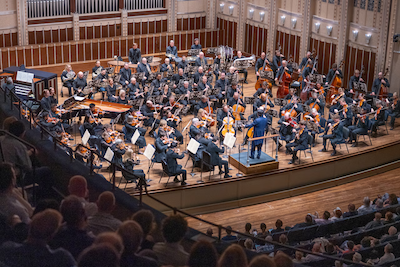
CLEVELAND, OHIO — The July 30th Summers at Severance concert by The Cleveland Orchestra celebrated a beautiful evening, with many people decked out in their summer best enjoying pre-concert drinks and nibbles on the terraces and in the grand foyer of Severance Music Center. It was terrific to see a capacity crowd that included so many younger people enjoying the amenities of Severance — and the energy their reactions brought to the program of music by Joseph Haydn, Nino Rota, and Camille Saint-Saëns was memorable.
The main order of business was the concerto debut of the Orchestra’s principal trombone, Brian Wendel, in Nino Rota’s Trombone Concerto. The 15-minute piece was written in 1966 by the composer best known for his film scores for The Godfather, Romeo and Juliet, and La Strada, but the sources of his musical inspiration can be elusive.
If you were playing “Name the Composer,” Paul Hindemith would be a good guess. Although Rota avoids writing what sounds like music for the cinema in the solo part, every now and then it briefly creeps into the orchestration only to be pulled back.
The opening Allegro giusto gave Wendel a majestic solo line to sing over tightly accented rhythmic figures in the orchestra, and he played it with flawless intonation and a clear tone that rang beautifully into Mandel Concert Hall.
The Lento, ben ritmato was a gorgeous aria over orchestral pizzicati, and the Allegro moderato gave the soloist the opportunity to bring his burnished tone to the movement’s persistent arpeggios.
Guest conductor Kazuki Yamada and the Orchestra beautifully supported Wendel, and the response from the capacity audience and his orchestra colleagues, both onstage and listening at the back of the hall, was immediate and lengthy. He was called back four times.
Yamada returned after the Rota to close out the evening with Camille Saint-Saëns’ Symphony No. 3, dubbed “Organ” for its extensive use of that instrument as well as four-hand piano. Its movements are cast into two parts, with the opening Allegro and the slow movement constituting the first part, and the scherzo and finale the second.
Yamada led a well-paced performance that began intimately and slowly gathered momentum for 35 minutes all the way to the triumphal concluding Maesoto.
The deliberate introduction flowed, unrushed, into a glamorous French romantic statement with long, arching lines. Using a hymnlike motif, the Norton Memorial E.M. Skinner organ gradually added colors enroute to the final cadence.
A fiery allegro and an expressive trio in the second part set up the entrance of the organ’s grand C Major chord — the moment everybody is waiting for and never fails to seize the listeners’ attention.
Mindful of the dangers lurking in Saint-Saëns’ multiple climaxes, Kazuki Yamada stuck to his gameplan and the orchestra obliged every step of the way. Once again the ovation was quick, thunderous and long-lasting.
While the evening ended riotously, it opened intimately with a stately performance of Joseph Haydn’s “London Symphony” No. 104, its fluid introduction leading to a relaxed allegro marked by beautiful string playing and attractive wind passages. The minuet was danceable, its trio was striking, and the folkish theme of the finale was spirited.
Photo by Julian Dube
Published on ClevelandClassical.com, August 6, 2026
Click here for a printable copy of this article
