

by Daniel Hathaway
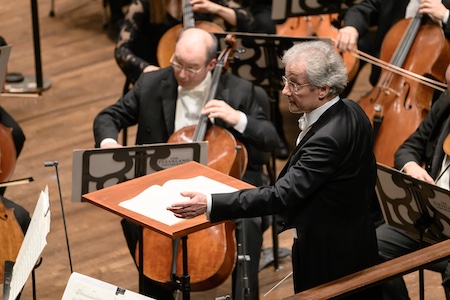
Franz Welser-Most conducts the Cleveland Orchestra on Thursday evening. Human Artist Photography + Cinema / Yevhen Gulenko
This article was originally published on Cleveland.com
CLEVELAND, Ohio – What makes a piece a symphony? That label invokes the ancient Greek notion of musicians playing together harmoniously, but in actual usage, “symphonies” are just containers into which composers pour their orchestral inspirations, with few common features from one work to another.
This was obvious on Thursday evening, January 8 at Severance Music Center, when music director Franz Welser-Möst led The Cleveland Orchestra in wildly dissimilar Symphonies by Wolfgang Amadé Mozart and Dmitri Shostakovich.
As he noted in his program notes, “When crafting a program as a conductor, you typically face one of two choices: build a cohesive throughline to tell a story, or embrace bold contrasts. For this program, I chose contrasts.”
And so he did, adding as an aside that immersing himself in the deep waters of Mozart helped answer some questions about historical performance practice. Those who were surprised by the size of the orchestra that gathered for Mozart’s 41st symphony on Thursday should recall the composer’s letter to his father in which he expressed delight at the 40 violins and double winds he had at his disposal.
But that was for another work. Unfortunately, Mozart may never have performed his final trio of symphonies due to changing tastes in Vienna that favored concertos. Padding the string section in Cleveland gave Symphony 41 unusual heft without ruining their lean, clear and often intimate sound.
The winds achieved a splendid, buttery blend punctuated with shapely solo passages throughout the 30-minute work. The Minuet was distinguished by a delightful trio led by oboist Frank Rosenwein
The last movement of Symphony 41 is a standout among Mozart’s finales. Contrapuntally complex and harmonically daring, it requires virtuosic precision from the orchestra to match its compositional brilliance. Welser-Möst led a breathtaking performance that threatened to, but never actually ran off the rails.
By way of contrast, Shostakovich’s thrilling Symphony No. 11 commemorates the first Russian revolution, hence its subtitle, ‘The Year 1905.” Composed in 1956, the Symphony uses themes from workers’ songs as well as from the composer’s own Ten Songs of Nineteenth-Century Revolutionary Poets to create what commentators have described as “an opera without words.”
The hour-long performance was riveting.
In “The Palace Square: Adagio,” Welser-Möst drew a cold, haunting and mesmerizing sound from the Orchestra. Brief solos by trumpet, timpani, harps, horn, and snare drum depicted the anguished suffering of the people.
Welser-Möst built up a huge sound from his players in “The 9th of January.” The percussion section was spectacular in their ability to keep the intensity of the march growing stronger and stronger, depicting the massacre of the people at the Winter Palace.
The violas shone in their affecting funeral chant section solo in “Eternal Memory: Adagio.”
Finally, in “Tocsin: Allegro non troppo – Allegro,” Wesler-Möst kept the sound building. Just when you thought it had reached its pinnacle, it grew even more but never became harsh. The movement and the Symphony were topped off by the sound of church bells — the people’s struggle is not over.
Shout-outs go to the percussion section, especially Thomas Sherwood for his relentless snare drumming, trumpeter Michael Sachs, bassoonist John Clouser, and Robert Walters for his affecting English horn solo.
At the conclusion, the large audience who had sat enthralled for a solid hour erupted into an immediate and powerful ovation.
Published on ClevelandClassical.com January 14, 2026
Click here for a printable copy of this article
