


by Kevin McLaughlin
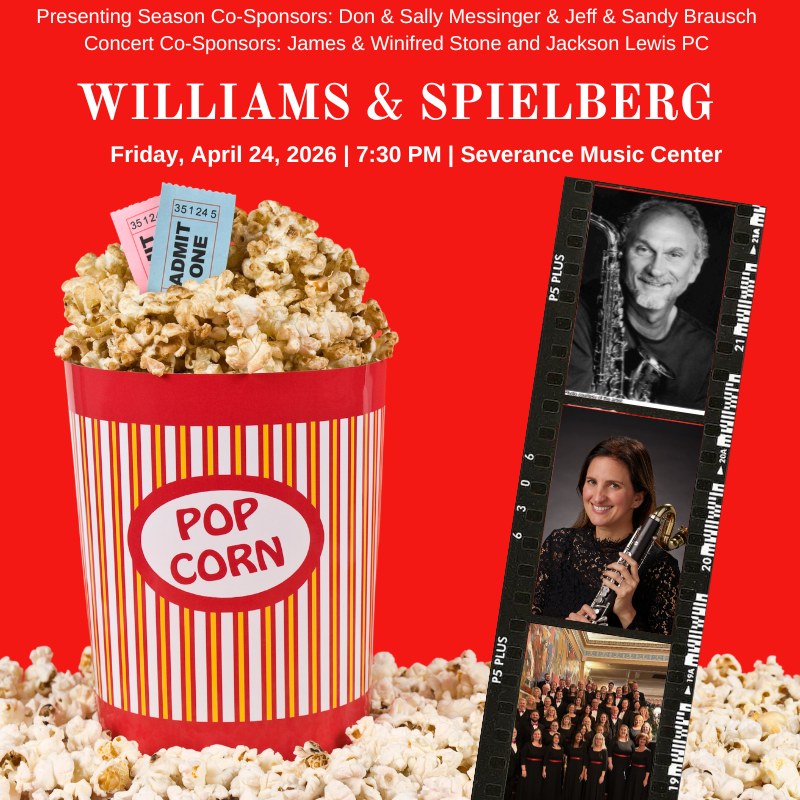 On Friday, April 24 at Severance Music Center, the Cleveland Pops Orchestra played to a packed house with a program devoted to John Williams and Steven Spielberg — a partnership that reliably fills seats. Williams writes themes you can recognize in seconds, sometimes in two notes.
Carl Topilow made that point before the first downbeat. “Ladies and gentlemen — the two notes that changed the course of music history,” he said, letting Jaws swim in with low strings, and a steady pulse, the interval repeating then tightening like a screw.
From there, the program moved among Williams’ familiar modes. The “March from 1941” had a buoyant snap. Close Encounters offered short, bright phrases, almost conversational. And in Jurassic Park, the orchestra leaned into the composer’s gift for breadth.
Not all of Williams’ music trades in spectacle. As the New York Times has noted, it often works by taking older materials and presenting them in technicolor. The themes of Schindler’s List are spare and direct, the emotion carried by contour and tone rather than overt passion.
Violinists Yahli Anter, Alisa Berenshtein, and Fiona Khuong-Huu, took the three movements in turn, each finding the calm, understated sadness in the melodies. Harpist Emily Laurance supported the soloists with quiet warmth.
“Scherzo for Motorcycle and Orchestra,” from Indiana Jones and the Last Crusade, shifted gears — charging along, built on short figures and rhythms to ride to. Fragments of the march theme pass through and disappear.
Perhaps after intermission a star was born. Nicholas Jacques, 15, winner of the Gordon and Jean L. Petitt Young Artists Competition, played the third movement of a Saint-Saëns’ Cello Concerto. His approach was direct and unextravagant: a quick tempo, the line always moving, no lingering over lyrical passages, and the technical demands met head-on. After he returned for two bows, a short presentation followed — a plaque, a check and a reminder from Topilow not to leave it behind.
The 46-member Cleveland Pops Chorus took the stage next. In “Exsultate Justi,” from Empire of the Sun, the Latin text was clear, with its sacred inflections lending the music a suspended quality. In “Hymn to the Fallen” from Saving Private Ryan, the voices carried the music without words, pure and steady. In “Dry Your Tears, Afrika,” from Amistad, the writing builds from restraint to a broader statement and the chorus opened the sound without losing focus.
Cleveland Orchestra clarinetist Amy Zoloto brought charm and agility to “Viktor’s Tale” from The Terminal. The piece is light but busy, its invented Eastern European accent touched with klezmer. Zoloto’s tone was warm and even from bottom to top, and her phrasing had a quicksilver grace. She was clearly enjoying herself.
“Escapades,” from Catch Me If You Can leans on mid-century jazz — cool, controlled, and a little sly. On alto saxophone Howie Smith kept a clean, unhurried line over brushed drums. Evan Mitchell’s vibraphone lent a polished ease, while Timothy Powell supplied a discreet walking bass.
“Adventures on Earth,” from E.T., closed the program. The main theme unfolds in long, rising arcs, and the brass carried the climaxes with precision. Jody Chaffee’s piccolo solo sparked joy. The music builds by accumulation, each return of the theme adding weight. It reached its peak without strain.
The encore returned to Indiana Jones — the main theme — and the response in the hall was immediate: one part giggle, two parts applause.
Published on ClevelandClassical.com April 22, 2026
Click here for a printable copy of this article
