


by Kevin McLaughlin
 Audiences often associate Beethoven’s Fifth Symphony with orchestral mass — huge string sections, blazing brass, and symphonic muscle.
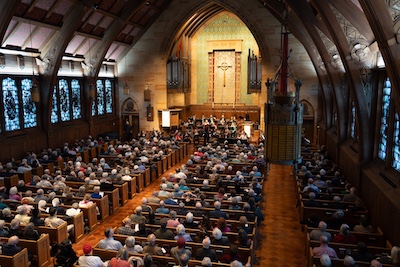
On May 14 at Fairmount Presbyterian Church, conductor Jeannette Sorrell and CityMusic Chamber Orchestra offered another approach, a leaner fate-knocker that surrendered none of its dramatic power.
From the podium, Director of Development Em Laudeman Ezell acknowledged Sorrell’s connection to CityMusic during the ensemble’s founding years. With Apollo’s Fire, Sorrell had already shown that a smaller professional ensemble in Cleveland could thrive outside the major-orchestra model. Her appearance for this series felt less like a guest engagement than a return.
The three opening chords of Mozart’s Overture to The Magic Flute weren’t exactly stone monuments — they opened directly onto an already bustling theatrical world. Sorrell kept the music buoyant and transparent throughout. The strings moved lightly and with remarkable unanimity while the winds handled their exchanges with conversational ease, and the brass entered firmly but without heaviness.
Felix Mendelssohn’s youthful Double Concerto in d, with violinist Diana Cohen and pianist Roman Rabinovich, carried the evening into early Romantic territory. Written when the composer was only fourteen, the work reveals Mendelssohn’s precocious understanding of dramatic pacing and instrumental color. Cohen brought a lyrical, tensile voice to the piece.
Rabinovich, a virtuoso in the grand style, played with sleek fluency and crisp articulation, bringing full concert-hall confidence to the smaller space. The soloists’ interplay was conversational but charged: phrases volleyed and intertwined with the ease of longtime partners. Sorrell shaped the accompaniment attentively, keeping a sense of nervous energy throughout.
The slow movement was the concerto’s beating heart: simple, exposed, and quietly sincere. Cohen and Rabinovich left the music largely alone, allowing emotion to emerge naturally. Cohen’s understated vibrato brought warmth without disturbing the music’s youthful candor. In the finale, soloists and strings navigated Mendelssohn’s quick exchanges with dazzling clarity.
After intermission Beethoven’s Fifth was stripped of excess. Heard on a chamber scale, the symphony sounded unusually urgent. Sorrell favored propulsion over monumentality. The famous four-note motif arrived less as ritual than command.
Textures remained clear, bringing inner voices and rhythmic figures into sharper focus. The first movement advanced with little wasted motion and the Andante flowed steadily forward without relaxing the underlying tension. Sorrell handled Beethoven’s transitions with particular care, allowing pressure to accumulate across larger spans.
The Scherzo carried an undercurrent of unease, cellos and basses laying a dark foundation beneath the fugal passages. Sorrell paced the transition into the finale patiently, letting anticipation build almost beyond comfort. When the finale arrived, the accumulated tension gave way to exhilaration — the brass and timpani brilliant, the ensemble fully aligned. Beethoven had won.
Published on ClevelandClassical.com May 21, 2026
Click here for a printable copy of this article
