


by Daniel Hathaway
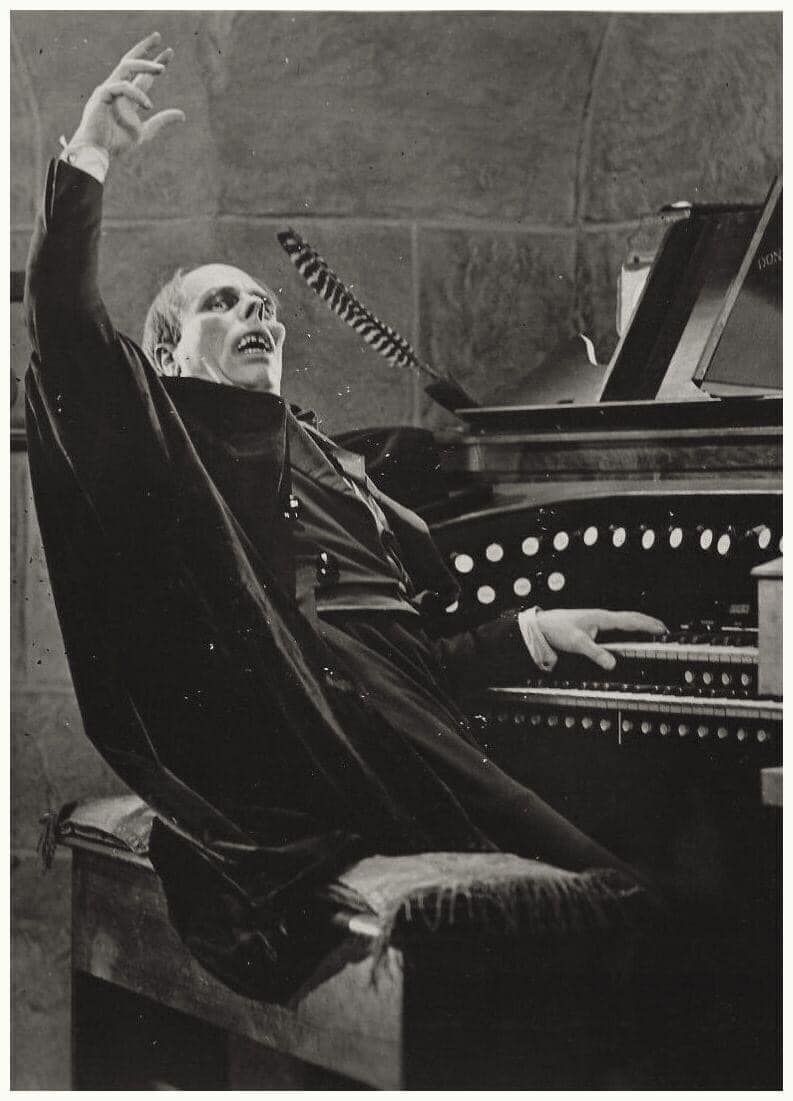 The 2025-2026 Cleveland Silent Film Festival and Colloquium got off to an impressive start with the screening of one of the icons of the pre-talkies era: Universal Pictures’ Phantom of the Opera in a restoration of its original version of 1925.
Presented before a large crowd in Gartner Auditorium at the Cleveland Museum of Art on Sunday afternoon, September 14, the screening was accompanied by an orchestra score itself restored from the original piano score — mostly existing photoplay selections, plus three original cues by one G. Hinrichs orchestrated by Larry Moore.
What made this occasion special was the presence of a live orchestra from Canton’s American Musical Productions, a 17-piece ensemble of strings, flute, oboe, clarinet, horns, trumpets, trombone, timpani, drums and piano conducted by Joseph Rubin, who may wield the longest baton in the industry. Jay Spencer presided over the Gartner organ, which doubled as an off-stage prop.
Phantom had shed 29 minutes between its 1925 debut at New York’s Astor Theatre and its 78-minute runtime on Sunday afternoon, but the results were probably better for the trimming. The film makers appeared to be less concerned with presenting a coherent version of Gaston Leroux’s 1910 horror story than with letting their imaginations run wild with set design, stage effects, and crowd scenes. A few times at the peak of a dramatic development, the screen went black and the story resumed without transition. Similarly, the night after the Phantom takes out dozens of opera patrons with the chandelier, it’s back in place for the masked ball as though nothing had happened.
The Orchestra underscored the acting with appropriate if occasionally repetitive music. Organist Jay Spencer added new colors each time the Phantom took to the keyboard for solace or inspiration.
lon Chaney’s arresting self-designed makeup and expressive gestures carries the movie along without explaining how the Phantom managed to transform the multiple subterranean levels of the Palais Garnier into his nefarious personal domain (and fit it out, Captain Nemo-style, with a pipe organ and various mod cons including a torture chamber). As Christine, the Phantom’s tragic infatuation, Mary Philbin is a master of melodrama and histrionic expressions.
Phantom is an intriguing relic of that brief chapter in the history of film when cinematography was nearing perfection and waiting for the incorporation of speech and music to catch up. Still, it’s easy to see why this silent film continues to enthrall audiences.
Published on ClevelandClassical.com September 25, 2025.
Click here for a printable copy of this article
