



by Daniel Hathaway
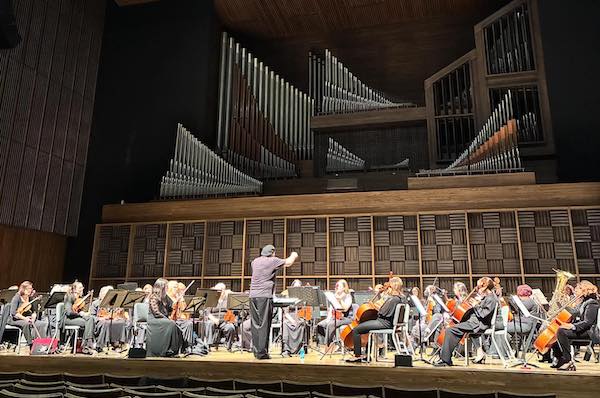 The Cleveland Women’s Orchestra, “the lone survivor of the numerous women’s orchestras that existed in the early 20th century,” as described in the program, celebrated its 90th birthday with a concert in Gartner Auditorium at the Cleveland Museum of Art on Sunday afternoon, October 26.
The original purpose of those ensembles was to provide performance opportunities for talented female musicians barred by gender from the ranks of symphony orchestras. As that world has all but disappeared, the Cleveland Women’s Orchestra has played on.
This well-attended anniversary program featured four works, three of them by women, all introduced and led by the CWO’s unassuming music director, Eric Benjamin, who immediately set an informal tone by knocking the music for Fanny Mendelssohn’s Overture in C off the first stand of violins. That spirited, fresh-sounding work in the style of the composer’s brother Felix, received a polished performance abounding in lovely wind solos.
Benjamin told the audience that he discovered Scottish composer Clara-Jane Maunder and her seascape The Coast (2022) while browsing on YouTube. It’s a real gem. The seven-minute-long piece — which vividly paints such scenes as a “Misty Sea Before Sunrise,” “Sea Birds,” and “Early Morning Light,” memorializes those who have been lost at sea, then conjures up a brewing storm and its aftermath — should become a favorite of school and avocational orchestras. The CWO gave it a strong performance for its U.S. premiere.
Keeping close to watery subjects, mezzo-soprano Kira McGirr joined the ensemble for a sensitive performance of Edward Elgar’s Sea Pictures, Op. 37, which sets the brooding Victorian verse of five poets, including Elgar’s wife.
Although McGirr chose not to imitate the famous British mezzo Clara Butts — who sang the cycle dressed as a mermaid — she got inside the lyrics and inhabited Elgar’s music in striking ways.
This would have been a great opportunity to take advantage of Gartner’s projection capabilities to float the texts of the poems overhead, because the composer’s settings for voice and instruments had to compete in the same range and the orchestra sometimes won.
Even so, McGirr’s beautiful phrasing came through in Caroline Alice Elgar’s “In Haven,” as did her heartfelt singing in Richard Garnett’s “Where Corals Lie.” Mezzo and orchestra delivered a haunting account of Elizabeth Barrett Browning’s “Sabbath Morning at Sea” and crafted a dramatic conclusion to the cycle from the lines Elgar chose to set from Adam Lindsay Gordon’s lengthy poem “The Swimmer.”
After telling the story of how much of Florence Price’s music came to light when a trunkful of scores was discovered in her abandoned summer home in St. Anne, Illinois, Benjamin and the Orchestra brought the concert to a festive conclusion with her Symphony No. 1.
In the opening Allegro, Benjamin set a nice, flowing tempo and drew a full-bodied sound from his players. Wind solos were numerous and impressive. The Largo featured a splendid brass choral and lovely solos by oboist Marsha Kincade and clarinetist Elizabeth Carney.
The Juba Dance, an African American style that involves stomping as well as slapping and patting various parts of the body, got off to a false start, but developed a nice swing and strut. In the Finale, the Orchestra made easy work of Price’s tricky rhythmic phrases.
The audience’s applause was long and enthusiastic. Congratulations, CWO, on 90 years!
Published on ClevelandClassical.com November 6, 2025.
Click here for a printable copy of this article
