



 After two days of impressive performances by the nineteen participants in the Cooper International Violin Competition, the Jury selected six to advance to Round Two. Yesterday at Oberlin Conservatory’s Warner Concert Hall, the six contestants — each vying for a spot among the final three — presented 45-minute programs with piano. Here are our impressions.
Afternoon Session by Daniel Hathaway
Lauren Yoon (16, Tenafly, N.J.) played the opening movement (Allegro con brio) of Beethoven’s Sonata No. 1 in D with stylish lyricism, clean articulations, and long expansive phrases.
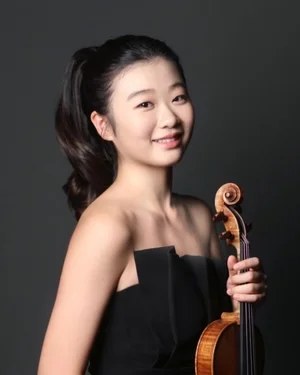 She achieved a lovely singing quality, nice color changes, and a shapely cadenza in the second movement (Andante cantabile) of Mozart’s Concerto No. 4.
Yoon made the technical passages in Jessie Montgomery’s unaccompanied Rhapsody No. 2 sound easy. She created an anguished mood in the slow section and made a fine transition into the ending.
She came out of the blocks with a big sound and passion in Wieniawski’s Polonaise in D and dug deep into the violin’s lower register for the Habanera in Waxman’s Carmen Fantasy — a fun performance that perfectly captured the moods of Bizet’s music.
Throughout Yoon’s set, pianist Hyunsoo Kim proved to be the perfect collaborator.
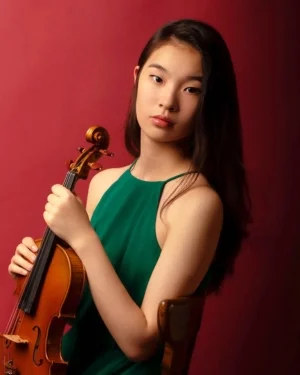 Xiaozhuo (Julia) Wang (17, Nanjing, China) set a spirited tempo for the first movement (Presto) of Beethoven’s Sonata No. 4 in a, shaping stately phrases and classy concluding notes.
She crafted a beautiful musical arc during her well-paced performance of Jessie Montgomery’s Rhapsody No. 2 — under her bow and fingers, it coalesced into a whole.
Wang followed that with an arresting performance of another unaccompanied work, Heinrich Wilhelm Ernst’s Grand Caprice on Schubert’s Der Erlkönig. Never letting its intensity wane, she captured the essence of the four characters in Goethe’s poem.
Each phrase grew organically from the lovely, opening gesture in her performance of the second movement (Adagio) of Mozart’s Concerto No. 5 in A. She maintained a beautiful tone and played an attractive cadenza.
Wang brought musical flair to Saint-Saëns’ Caprice d’après en forme de Valse, spinning off the work’s twists and turns with nonchalance.
Pianist Tatiana Lokhina was a congenial partner.
 Stylishly capturing the music’s many moods, Emrick Revermann (16, Toronto, Canada) established a brisk tempo in the first movement (Presto) of Beethoven’s Sonata No. 4 in A, and demonstrated wonderful coordination with pianist Hyunsoo Kim.
Intimate sound and beautiful phrasing characterized the middle movement (Adagio) of Mozart’s Concerto No. 5 in A, in which Revermann played a remarkably flexible cadenza.
In his thoughtful performance of Jessie Montgomery’s Rhapsody No. 2, every passage had meaning. Revermann stretched the slow section to its limits.
Revermann brought beautiful, mature control to the unaccompanied work — Ysaÿe’s Sonata No. 4 in e — crafting magical pizzicatos in the Sarabande Quasi lento and a stylish account of the concluding Presto ma non troppo.
The Canadian concluded his program with Wieniawski’s Fantasia Brillante on Themes from Gounod’s “Faust” in a performance that blossomed from start to finish.
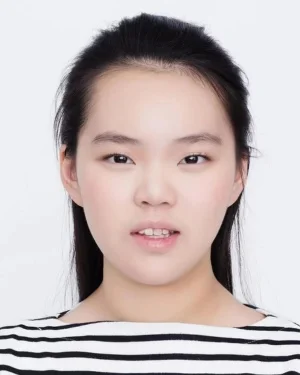 Tiantian Lu (15, Ningbo, China) brought a huge, intense sound to her program, the last in the afternoon session, opening her thoughtful and technically solid program with the first movement (Allegro) of Beethoven’s Sonata No. 5 in F that boasted lyrical phrasing and smooth fast passages.
In the seductive Habanero of Waxman’s Carmen Fantasy, she captured the complicated moods of the opera’s titular character. A relaxed tempo and long lines characterized her performance of the middle movement (Adagio) of Mozart’s Concerto No. 5 in A.
Lu’s playing of Jessie Montgomery’s Rhapsody No. 2 was defined by well-controlled technique, long, singing lines, and well-paced transitions.
She concluded her set with Paganini’s Nel cor più non mi sento for solo violin, a showpiece that asks the player to dig deep into their bag of tricks during its theme and seven variations — spiccatos and left handed pizzicatos abound. Her calculated approach worked well — she never lost track of the direction of its musical lines.
Evening Session by Stephanie Manning
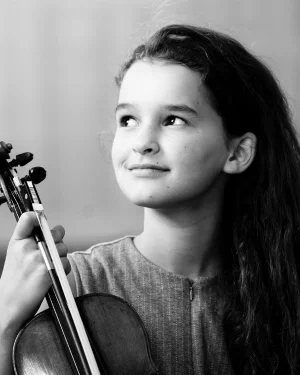 Edna Unseld (13, Zurich, Switzerland) immediately filled Warner Concert Hall with her full-bodied, dark sound. In Ravel’s Tzigane, she dug into each chord with a single-minded focus, burnished by sensitive playing from pianist Evan Hines.
Composed and confident, the violinist made the most of the dynamic changes and accents in the first-movement Allegro from Beethoven’s Sonata No. 5. She enjoyed every accelerando and kept the tempo brisk.
After an equally swift performance of Jessie Montgomery’s Rhapsody No. 2, the second-movement Andante Cantabile from Mozart’s Concerto No. 4 provided Unseld a chance to breathe and highlighted the amazing warmth of her low register.
The youngest violinist of the competition then closed her set with a technical fireworks spectacle: Henryk Wieniawski’s Variations on an Original Theme. Her even double-stops and crisp bow re-articulations ensured the piece’s energy reached its peak as she approached its dazzling conclusion.
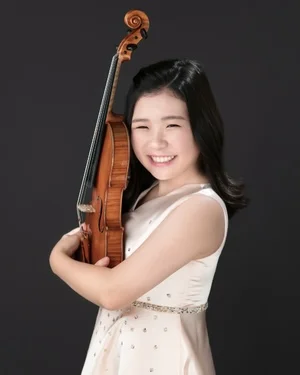 Jinan Laurentia Woo (17, Englewood Cliffs, N.J.) also opted to end her set with a showpiece: Franz Waxman’s Carmen Fantasie. With a generally bright and flexible sound, she produced some spectral harmonic effects, adding tasteful rubato in certain places to help things feel more personalized.
Woo sounded most at home in the Classical repertoire, opening things with a refined and elegant Allegro Vivace from Beethoven’s Sonata No. 2. Crafting a musical conversation between her and pianist Evan Hines, each phrase brought out something different — gaiety, curiosity, and assertiveness by turn. The Adagio from Mozart’s Concerto No. 3 felt similarly untroubled.
Ernest Chausson’s Poème gained surety as it continued, a good avenue to showcase her healthy vibrato and butterfly-like trills. The violinist’s even keel also served her well in the evening’s contemporary work — her measured interpretation of Montgomery’s Rhapsody No. 2 produced a clean, poised result.
Published on ClevelandClassical.com January 9, 2025
Click here for a printable copy of this article
