

by Stephanie Manning
Reposted with the permission of Oberlin Conservatory
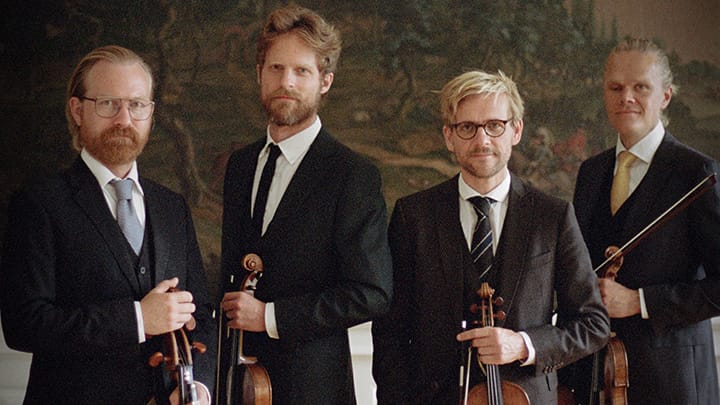 These days, the Danish String Quartet keep their touring schedule simple. Arrive in a new city in the morning, play a concert in the evening, and repeat. That’s not because the group doesn’t like exploring new places — it’s because they’ve got little ones waiting at home.
“ Back before we had kids, we did three-week tours, four-week tours in the States,” violinist Frederik Øland says. “Now we’re down to two weeks at a time, because anything more than that is just too much.”
A lot has changed since the early 2000s, when the newly-formed quartet were all teenagers at Copenhagen’s Royal Danish Academy of Music. But what’s stayed constant is the critical acclaim that follows wherever they go. On Friday, November 21, the celebrated ensemble — comprised of violinists Øland and Rune Tonsgaard Sørensen, violist Asbjørn Nørgaard, and cellist Fredrik Schøyen Sjölin — will make their Oberlin debut as part of the Artist Recital Series.
“I love traveling and touring in the States,” Øland says. “I love the nature — you can go from deserts to mountain areas to huge forests.” He makes a point to try and explore the outdoors at every tour stop. “One thing that I try to do every place is go for a run. Because then you get a feel of this city, just a little bit.”
As part of the Quartet’s visit to Oberlin, the group will hold public master classes for both solo strings and chamber music on November 22. Working with students “is something that we love to do,” the violinist says. He himself is an associate professor at the Royal Danish Academy of Music, and the Quartet also interacts with students through programs like the annual DSQ Academy.
This year’s edition of the five-day music camp, held in the Danish countryside, wrapped up in early October. Thirty students from all over the world spent time not only learning and making music together, but also relaxing and enjoying each other’s company. Øland says that kind of experience reminds the quartet of how they originally met, kicking a ball around at a summer camp for amateur musicians. “There’s a ton of music being played, but you also get the personal connection. And that’s what we always wanted to do with this.”
In concert, the Quartet’s distinctive style of programming spans music from the Classical to the contemporary, complete with original folk tune arrangements and compositions. Their Oberlin program is a classic example of this approach, with the addition of movie music via Jonny Greenwood’s Suite from There Will Be Blood. The soundtrack to Paul Thomas Anderson’s 2007 period drama includes Greenwood’s characteristically unnerving musical style.
Øland says the Quartet has enjoyed branching out into something new. “We like when we do something that’s a little bit off the beaten path — when you find something that you can really make your own.”
The Suite is paired with Igor Stravinsky’s Three Pieces for String Quartet, a quirky trio of short movements. Øland sees a particular connection to Greenwood’s style in the second piece, titled “Eccentric,” which Stravinsky based on an English clown named Little Tich. “He had a funny way of walking, and you can totally hear that in the music.”
After intermission comes a selection of folk music arrangements and compositions, as well as Ludwig van Beethoven’s String Quartet No. 16 in F Major, Op. 135. Although Beethoven wasn’t a huge focus for the group in the early years, they’ve since performed multiple quartet cycles and recorded the late quartets for their Prism album series.
The violinist says that the late quartets in particular bring out his “nerdy classical musician side.” Rather than seeing these works as masterpieces that fell from the sky, “I think they’re very human pieces, and that’s what I really appreciate,” he says. “Beethoven shows us the complexity and the imperfections of being a human being. When I listen to that music and when I play it, there’s always something in the music that I can relate to, and I feel comforted by that feeling.”
His appreciation for human connection is also reflected in his recent podcast, Fiddle Talks. He and his co-host, fellow violinist Peter Herresthal, bring in guest musicians to chat in a relaxed setting. “We can have a conversation about some deep topics, but we also have a good time and don’t pretend that we’re super fancy,” he says. “It’s kind of like Beethoven in a way.”
Photo by Caroline Bittencourt
Published on ClevelandClassical.com November 12, 2025.
