



by Mike Telin
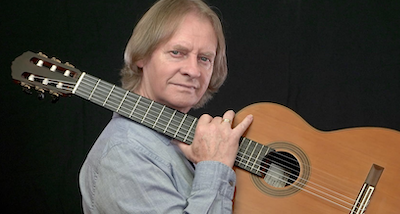 The Cleveland Classical Guitar Society International Series will host celebrated guitarist David Russell on Saturday, April 11at 7:30 pm at the Maltz Performing Arts Center.
Russell’s program will feature works by Mauro Giuliani, Isaac Albéniz, J.S. Bach, Stephen Goss, and Gabriel Estarellas. Tickets are available online.
On Sunday, April 12 at 2:00 pm, Russell will present a masterclass at the CCGS offices at 7100 Euclid Avenue in Cleveland.
I caught up with the guitarist in San Francisco where he was in the middle of his annual residency at the San Francisco Conservatory. I began our Zoom conversation by welcoming him back to Cleveland.
David Russell: I’m Looking forward to being there. I’ve played quite a few times in Cleveland, and the recording company that I used to record CDs for was based in Cleveland. So it’s always great to see our friends Bob Woods and Elaine Martone.
Mike Telin: You have an interesting program. The first half, with all due respect, is traditional. Then the second half features music by composers that you’ve known for quite some time.
DR: Gabriel Estrellas is a fabulous guitarist and has had a great career as a concert artist in Europe, especially in Spain. He also taught at the conservatory in Madrid. He’s from Mallorca and the first time I went there as a kid, I met him, and since then we’ve been good friends.
He’s been composing for a long time, and some years back he gave me a few of his compositions so I decided to choose a group of pieces from a larger collection that’s a homage to Charles Chaplin. The whole collection is more than an hour long so I chose a group of six. It’s a lot of fun to do his music, it’s super enjoyable and the audience always love it.
MT: I’m curious to know how he incorporates Charlie Chaplin into his music.
DR: Gabriel’s music is really quite Spanish, so he doesn’t try to imitate Charlie Chaplin. But in the ones that I’ve chosen, there are small bits of tunes that are directly from Charlie Chaplin. But the music is really more Gabriel’s expression of these kinds of snapshots, if you like.
The first one is called Sueños (Dreams) and the middle part is more like Charlie Chaplin. But Blanco y Negro (Black and White) is about the experience of seeing Chaplin’s films and not so much imitating them. The last one’s called Tramoyista, which means stagehand. And again it’s quite Spanish in style and is about the feelings he had when he saw those films.
MT: Please say a few words about the first half of the program.
DR: You mentioned earlier that the first half is traditional. It is, but I’ve chosen some pieces by J.S. Bach that I like to play that you might not normally hear on the guitar. It’s not really a suite that you would normally hear either.
I did the same thing with music by Albéniz. They are all pieces by him but ones that you might not normally hear — for example, the Malagueña, which is the last of the group. Albéniz wrote two Malagueñas, one is very famous and the other is not so famous. It’s also very beautiful so I chose the not so famous one. It’s really great, and when you transcribe it for the guitar, you almost don’t lose a single note.
MT: You begin the program with music by Maruo Giuliani — he was an interesting composer.
DR: The Grand Overture is very famous amongst guitarists so I’m really kicking things off with a well-known piece.
But I would say that although Gabriel Estarellas’ music is well known, the centerpiece of the program is really Stephen Goss’s Don Quixote.
This piece is more programmatic than most of his music. For example at one point, Don Quixote attacks a windmill — that’s the famous windmill story. You will hear the windmill, but you will also see the windmill in projected images. It’s really a way of enhancing the imagination.
There’s one movement where he writes a song for Don Quixote’s love interest Dulcinea, so we have some images of Dulcinea taken from 18th to 19th century prints or engravings. All together there are maybe 70 images. My wife Maria follows the score and changes the images as the music progresses.
I premiered the piece in January and for most of December I spent a lot of time choosing images. Although the stories are satirical, even comical at times, everything is treated with total respect. I didn’t want to put up silly cartoons of Don Quixote attacking windmills.
MT: Is there anything you would like to add?
DR: Just that we started this tour at the beginning of February and we don’t get home till the beginning of May. So it’s a long trip, but we’re having lots of fun. And I’m enjoying playing this program. I love it, and I hope that the audience will love it as much as I do.
Published on ClevelandClassical.com April 8, 2026
Click here for a printable copy of this article
