

by Daniel Hathaway
 HAPPENING TODAY:
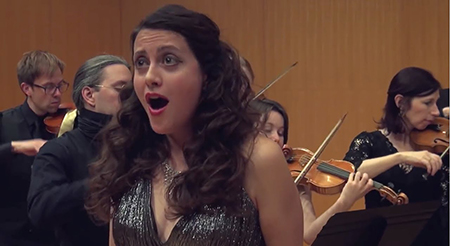
Two in-person concerts feature a CityMusic Cleveland chamber ensemble in works by Louise Adolpha Le Beau and Elfrida Andrée at the Shrine Church of St. Stanislaus, and Apollo’s Fire in “Virtuosity: Fireworks from J.S. Bach” featuring soprano Amanda Forsythe (pictured), violinist Alan Choo, and trumpeter Stephen Marquardt, at First Baptist Church in Shaker Heights. Check links in our Concert Listings to see if tickets are still available.
Online, New York’s Carnegie Hall offers “The premiere of a new music film in which violinist Jennifer Koh and opera singer Davóne Tines collaborate to distill the history of Asian American oppression, and highlight the untold story of solidarity between Asian Americans and the Black community.” And the Los Angeles Chamber Orchestra presents “Sonic Shift,” the first of two episodes curated by Jessie Montgomery, in which she collaborates with charcoal artist Will Kim “to create animations which will enhance the visual presence of LACO’s musicians.”
A VIDEO TOUR:
Trinity Cathedral music director Todd Wilson shows off the console — which reminds him of an airplane cockpit — of the new chancel organ, created with materials from earlier Skinner instruments. The pandemic has even affected the supply chain for organ parts like stop knobs. Watch the April 13 video here.
DO YOU KNOW WHO INVENTED THE PDF?
One of the greatest inventions of the 20th century, of particular usefulness to musicians, is the Portable Document Format or .pdf, which has made it possible to download scores from libraries like the Petrucci Project (IMSLP), and load music onto tablets for paperless performances — among dozens of other applications.
This morning’s New York Times obituary for Cleveland native Chuck Geshke details the St. Ignatius grad’s remarkable career in the desktop publishing industry as the founder of Adobe. Although he achieved great success in that business, he always thought of himself as an engineer. “Engineers dream of building something that millions of people will use; that’s their ultimate goal.”
TODAY’S ALMANAC:
 According to some sources, “The Bard of Avon,” William Shakespeare, was born on April 23, 1564, and it’s a fact that he died on the same date in 1616. Setting aside the contentious question of whether or not the son of a glove maker from Stratford-Upon-Avon actually authored the plays and poems attributed to him, we’ll honor both his arrival and departure dates with a setting of words from The Merchant of Venice, Act 5, Scene 1. By moonlight, Lorenzo and Jessica are discussing music both earthly and celestial, and Lorenzo comes to the conclusion that
The man that hath no music in himself,
Nor is not mov’d with concord of sweet sounds,
Is fit for treasons, stratagems and spoils;
The motions of his spirit are dull as night
And his affections dark as Erebus:
Let no such man be trusted.
Ralph Vaughan Williams wrote A Serenade to Music to mark the 50th anniversary of the first concert conducted by Sir Henry Wood, who led the popular “Proms” (Promenade Concerts) for 50 years. The original work featured sixteen soloists chosen by the conductor and the composer, who at times sing as a choir. Members of the London Symphony, the BBC Symphony, and the London Philharmonic joined together for the first performance at the Royal Albert Hall on October 5, 1938 (listen to the first recording here.)
Here, in one album, are three versions of the piece from Vaughan Williams’ pen: for soloists (with the London Philharmonic conducted by Sir Adrian Boult), for chorus and orchestra (with the Royal Philharmonic Choir and Orchestra, led by Vernon Handley), and for orchestra alone (with the Northern Sinfonia under Richard Hickox).
And on this date in 1891, Russian composer Sergei Prokofiev was born in Sontzovka, Ekaterinoslav, Ukraine. Many works come to mind to celebrate that occasion, but since we’ve just been talking about choral music — which is in a weird kind of limbo during the pandemic — it seems like a good time to revisit his music for Sergei Eisenstein’s 1938 film Alexander Nevsky, for which Prokofiev wrote the score and later turned the material into a cantata. The composer was impressed with the director’s approach. As he wrote in broken English at the time,
Eisenstein’s respect for music was so great that he was ready to “hitch” film with visual image forward or backward only not to break the value of musical fragment. Do I need to say that working with such a condition gave me a great satisfaction!
Watch the full movie here and pay particular attention to the “Battle on Ice” scene and the touching mezzo-soprano solo in “The Field of the Dead.” We can recommend two videos of the cantata.
The first features mezzo soprano Ketevan Kemoklidze, the Saint Petersburg Philharmonic Orchestra, and the Choir of the National Academy of Santa Cecilia, led by Yuri Temirkanov.
The second, celebrating the 70th anniversary of the BBC Symphony, was led by Leonard Slatkin at London’s Barbican Hall in 2000. Mezzo-soprano Michelle DeYoung is well known to Clevelanders from her appearances with The Cleveland Orchestra.
