



by Daniel Hathaway
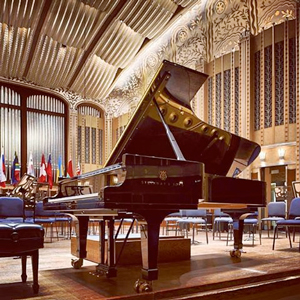 CIPC MOVES TO SEVERANCE:
The grand finale of the Cleveland International Piano Competition begins tonight at Severance Hall and continues on Saturday evening, as the four 2021 finalists play concertos with Jahja Ling and The Cleveland Orchestra. At 7 pm Friday, Byeol Kim plays Tchaikovsky’s Concerto No. 1 in b-flat, and Yedam Kim solos in Rachmaninoff’s Concerto No. 3 in d. And on Saturday at 7, Lovre Marušić plays Beethoven’s Concerto No. 4 in G, and Martín García García solos in the second final round performance of Rachmaninoff’s Third Concerto.
You can attend in person (face masks required) or watch the performances online. Tickets for both live and virtual attendance are available online.
ONLINE TODAY:
Last Monday’s Diary linked to a New York Times article that previewed the Bard Music Festival’s two week-long exploration of the world of French composer and pedagogue Nadia Boulanger. The opening concert, which pairs several of her own compositions with music by some of her female students goes online today at 5:00 pm.
Program: Nadia Boulanger’s Vers la vie nouvelle and Lux aeterna, Lili Boulanger’s Faust et Hélène and Pie Jesu, Priaulx Rainier’s Reminiscence, Louise Talma’s Alleluia in the Form of a Toccata, Grazyna Bacewicz’s Music for Strings, Trumpet, and Percussion, and Julia Perry’s Stabat mater. Performers include J’Nai Bridges mezzo-soprano, Fei-Fei piano, Joshua Guerrero tenor, Samantha Hankey mezzo-soprano, Joelle Harvey soprano, Joshua Hopkins baritone, Renée Anne Louprette organ, Nicholas Phan tenor, Bard Festival Chamber Players, and The Orchestra Now conducted by Rebecca Miller and Leon Botstein. Tickets are $10. View the live stream here.
TODAY’S ALMANAC:
 On this date in 1904, German music critic Eduard Hanslick died in Baden at the age of 78. One of the most divisive figures in the demi-monde of music criticism, Hanslick allied himself with the traditions represented by Mozart, Beethoven, and Schumann that culminated in the music of Brahms, eventually waging a personal war on the “Music of the Future” represented by Wagner and Liszt and leading to Bruckner. This 1890 cartoon from the Vienna satirical magazine Figaro lampoons his position.
Summing up Hanslick’s achievements in The Hungarian Review, Nicholas T. Parsons writes: The times were propitious and newspapers were expanding to meet the demand from an increasingly cultivated bourgeois public for accessible but authoritative cultural journalism. When his career began mid-century, the Viennese competition in Hanslick’s speciality of music criticism was lamentable, as he put it: “stuffed with epithets and shallow enthusiasms, limp wit and phrase-making, unmanly heroisations and idolatry – echt wienerisch!” His first and perhaps greatest achievement was to raise musical appreciation to a professional level, diffusing his knowledge effortlessly in urbane prose, but dedicating himself to his task by playing every score right through before a performance. He would also do extensive background reading, for example of a Shakespeare play and commentary on it, before reviewing a Verdi opera. One lasting impact of his approach was that he addressed the work primarily and the performance secondarily, from which it followed that the quality of a work might not necessarily be obscured by inadequacy of performance, or, of course, vice versa…
And in a world-changing event, on August 6, 1945, the United States, with the consent of the United Kingdom, detonated the first of two atomic bombs over the city of Hiroshima, Japan (a second bomb was dropped over Nagasaki three days later).
Click here to watch a performance of Polish composer Krzysztof Penderecki’s 1960 Threnody for the Victims of Hiroshima for 52 string instruments, as performed by Sinfonia Varsovia led by Krzysztof Urbański at Penderecki’s 80th Birthday Celebration in Warsaw in November, 2013.
