

by Daniel Hathaway
 TODAY’S EVENTS:
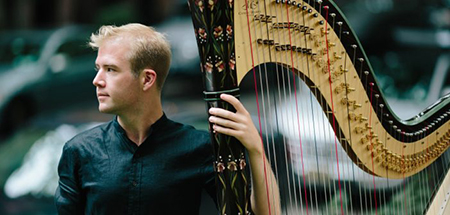
Tonight at 7:30 pm, harpist Parker Ramsay will play Johann Sebastian Bach’s Aria with Thirty Variations, popularly known as the Goldberg Variations, in a Bach’s Birthday Bash at Trinity Cathedral.
IN THE NEWS:
Applications are now open for singer-pianist team auditions for the 2022 edition of the Cleveland Art Song Festival, to be held at the Cleveland Institute of Music from May 23-28. In addition to masterclasses and a final concert, the event (which has been on hiatus thanks to the pandemic) features performances with the festival guest artists: soprano Tamara Wilson and tenor David Portillo, and pianists Warren Jones and Craig Terry. Read more here.
Akron’s Tuesday Musical Association has announced the 21 winners of its 66th annual Scholarship Competition, who will receive awards totaling $31,300. The competition drew more than 130 applicants, and awards saw a significant increase this year. Read the press release here.
TODAY’S ALMANAC:
We already raised a stein to Johann Sebastian Bach over the weekend, whose birthdate coincided with the arrival of spring, so we’ll be brief and just mention two important performances of ninth symphonies that debuted on this date.
On March 21, 1825, Beethoven’s Ninth received its first London performance, barely a year after it was first heard in Vienna. And in 1839, Schubert’s Ninth was played for the first time in Leipzig a decade after its completion, conducted by Felix Mendelssohn. Robert Schumann had a hand in that debut, having given Mendelssohn a score of the work which Schubert had finished some three years before his death in 1828.
What did the critics think of these two new works?
In “Mixed. A Judgment from London of Beethoven’s Last Symphony.” the correspondent for the Allgemeine musikalische Zeitung wrote:
The new symphony of Beethoven, composed for and purchased at a liberal price by this society, was now first publicly produced. In our last number we mentioned it, and we see no reason for altering the opinion we there offered. We must, however, correct our statement as to its duration. At a rehearsal, where so many interruptions occur, it is next to impossible to ascertain exactly the length of a piece: we now find this to be precisely one hour and five minutes; a fearful period indeed, which puts the muscles and lungs of the band, and the patience of the audience, to a severe trial.
In the present symphony we discover no diminution of Beethoven’s creative talent; it exhibits many perfectly new traits, and in its technical formation shews amazing ingenuity and unabated vigour of mind. But with all the merits that it unquestionably possesses, it is at least twice as long as it should be; it repeats itself, and the subjects in consequence become weak by reiteration.
In quitting the present subject, we must express our hope that this new work of the great Beethoven may be put into a produceable form; that the repetitions may be omitted, and the chorus removed altogether; the symphony will then be heard with unmixed pleasure, and the reputation of its author will, if possible, be further augmented.
It’s a good thing that the writer hadn’t yet encountered Schubert No. 9, whose “heavenly length” Schumann celebrated in an essay where he also wrote,
The brilliance and novelty of the instrumentation, the breadth and expanse of the form, the striking changes of mood, the whole new world into which we are transported—all this may be confusing to the listener, like any initial view of the unfamiliar. But there remains a lovely aftertaste, like that which we experience at the conclusion of a play about fairies or magic. There is always the feeling that the composer knew exactly what he wanted to say and how to say it, and the assurance that the gist will become clearer with time.
