


by Daniel Hathaway
HAPPENING TODAY:
 The Witcher in Concert: Tonight at 7:30 in Mandel Concert Hall at Severance Music Center, a live orchestra will celebrate the 10th anniversary of the open-world RPG (Role-Playing Game) with a performance of The Witcher 3: Wild Hunt. The evening will feature a special performance by the Polish folk metal band Percival (pictured), the original co-composers of the game’s soundtrack.
TODAY’S ALMANAC:
There are only a handful of obscure candidates for tributes today, so let’s focus on another aspect of September 29: Michaelmas, or the Feast of St. Michael and All Angels, falls on this date each year, and marks the beginning of autumn in many Christian cultures.
It lends its name to the fall term in British universities, and gives rise to a number of folk customs, including making Michaelmas Bannock on the eve of the Feast of Saint Michael from equal parts of barley, oats, and rye without employing any metal implements. And Michaelmas draws the line after which you should stop picking blackberries. That last piece of advice derives from the legend that when the Archangel Michael expelled the rebellious Lucifer from heaven, he landed in a blackberry bush (ouch!), which he cursed and defiled in a special way. Don’t eat the berries.
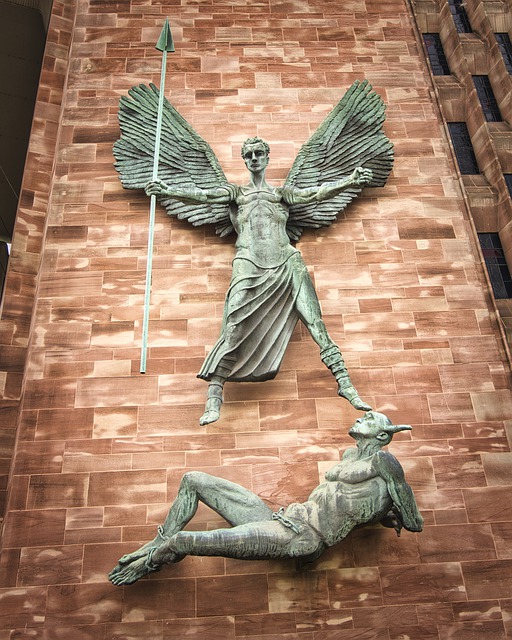
Sir Jacob Epstein, St. Michael and Satan on the facade of Coventry Cathedral
Angels — divine messengers charged with delivering news good and bad to humans — are part of the rich mythology of Christianity, Judaism, and Islam alike. The archangels Raphael, Uriel and Gabriel join a trio in “The Heavens are telling” in Haydn’s The Creation (sung here by the Cleveland Orchestra Chorus under Robert Shaw). Later, Gabriel returns to the story to bring surprising news to Mary of Nazareth (listen to Franz Biebl’s Ave Maria sung by Chanticleer).
He’s also likely to have been part of the heavenly host that sends the shepherds to the stable in Bethlehem (as re-enacted by Kiera Duffy and St. Paul Chamber Orchestra and Chorale). And Gabriel may even have taken up a viol to entertain the bystanders as in Matthias Grünewald’s altarpiece that Hindemith turned into “The Angel Concert” in Mathis der Maler (here played by the Gustav Mahler Youth Orchestra under Herbert Blomstedt).
Celebrate Michaelmas with an Anglican service of Choral Evensong for the Eve of the Feast of St. Michael and All Angels from England’s York Minster that was live streamed yesterday.
As the British pianist and polymath Stephen Hough has written, “Evensong hangs on the wall of life like an old, familiar cloak passed through the generations. Rich with prayer and scripture, it is nevertheless totally nonthreatening. It is a service into which all can stumble without censure – a rambling old house where everyone can find some corner to sit and think, to listen with half-attention, trailing a few absentminded fingers of faith or doubt in its passing stream.”
Burrow deeper with Herbert Howells’ Sequence for St. Michael, written for Sir George Guest and the choir of St. John’s College, Cambridge, and dedicated to the memory of Howells’ son Michael, who died as a child. Click here for the text by Alcuin.
