

by Daniel Hathaway
NEWS BRIEFS:
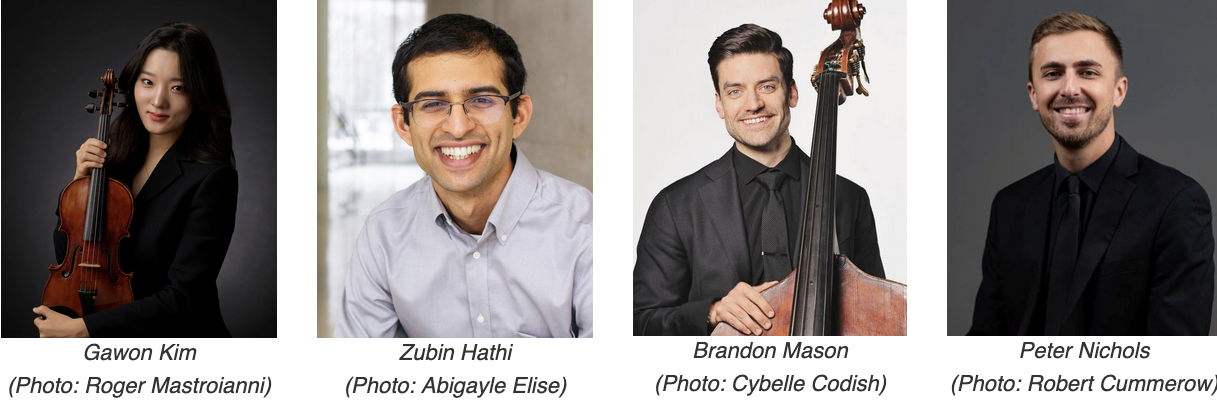 On Wednesday, The Cleveland Orchestra announced four new appointments to its roster of musicians (pictured). “The Orchestra welcomed Second Violinist Gawon Kim last fall, and this summer will welcome three more members: Zubin Hathi as Principal Timpani and Brandon Mason as Section Bass in July, followed by Peter Nichols as Assistant Principal Timpani and Section Percussion in August. Now entering his 24th year as Music Director, Franz Welser-Möst has appointed more than half of the musicians currently performing with The Cleveland Orchestra.” Read more here.
HAPPENING TODAY:
At 2 pm, Ohio Light Opera raises the curtain on the second of its six summer shows, Lerner and Loewe’s Brigadoon, in Freedlander Theatre at The College of Wooster.
TODAY’S ALMANAC:
by Jarrett Hoffman
Today is Juneteenth — June 19, the oldest nationally celebrated commemoration of the ending of slavery in the United States.
 A musical voice to honor today that is too often overlooked is that of Black American composer, conductor, and violinist Will Marion Cook, who died on this date in 1944.
Classical music was his early focus: he studied violin at Oberlin Conservatory, and at the Hochschule für Musik under Joseph Joachim, and later was a student of Antonin Dvořák at the National Conservatory of Music.
But Cook achieved most of his success as a composer of musical theater and popular songs. Important firsts in that arena included his In Dahomey (1903), which starred the iconic duo of George Walker and Bert Williams, and was the first full-length musical written and performed entirely by African-Americans in a major Broadway theater. His The Southerners (1904) became the first Broadway show performed by a racially integrated cast.
Several of his songs are available on YouTube, as is the excellent Overture to In Dahomey, performed here by Rick Benjamin and The Paragon Ragtime Orchestra in a recording from the album Black Manhattan: Theater and Dance Music of James Reese Europe, Will Marion Cook, and Members of the Legendary Clef Club.
And speaking of the Clef Club (that Harlem-based society for African-American musicians that was particularly successful in the 1910s) — outside of theater, Cook’s podium credits included serving as chorus master and assistant conductor of the Clef Club Orchestra, in addition to founding what later became known as the Southern Syncopated Orchestra.
Looking back on this time before the advent of jazz, the development of that genre is often on the minds of scholars of the era. Musicologist Thomas Riis points out how Cook brought his harmonic skill and compositional sophistication into the world of popular music, “perhaps paving the way for the marriage of popular spirit and classical complexity which became jazz.”
Either way, he concludes, whether “as precursor to jazz or in its own right,” the music of Cook deserves a closer look.
