



by Mike Telin
 STREAMED CONCERTS:
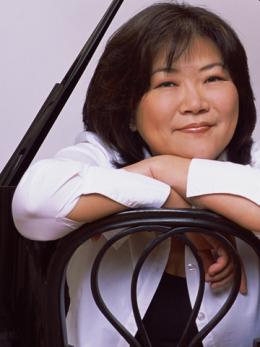
At 7:30 pm BlueWater Chamber Orchestra directed by Daniel Meyer will present “Honor, Hope and Gratitude: Tender reflections on a challenging year.” The online program features Frederick Chopin’s Piano Concerto No. 1 with Angela Cheng as soloist (pictured), as well as music by Arvo Pärt,, Ralph Vaughan Williams, George Walker, Edward Elgar, Gerald Finzi, Florence Price, and Jean Sibelius. Pre-recorded at the Maltz Performing Arts Center. Tickets are available online.
IN THE NEWS:
We were saddened to learn that composer and electronic music pioneer Joel Chadabe passed away at his home in Albany, New York on May 2 at the age of 82. A graduate of Yale whose musical interests were grounded in jazz and opera, his musical career took a turn when in 1962 he was asked to run the electronic music studio at the State University of New York, Albany. Read about his fascinating life and contributions to the field in his New York Times obituary.
TODAY’S ALMANAC:
Why are the deaths of rock stars so often shrouded in mystery, making the circumstances of their passing fodder for the check-out line tabloids? Is Elvis really dead? What was happening during Prince’s final days?
On May 27, 1840, Italian violinist, violist, guitarist, and composer Niccolò Paganini died of larynx cancer in Nice, France at age 57. Interestingly, he was born on October 27 — Born and died on the 27th — uhmmmm?
During his life Paganini achieved rock star status as the most celebrated violin virtuoso of his generation. In fact, his talent was so far beyond his peers, rumors flourished that he had made a pact with the devil.
A child prodigy, he had a breakdown while on tour at age 15. He was a heavy drinker, gambler, and womaniser. Physically, he was tall and thin, with hollow cheeks, pale skin and thin lips, and long, thin fingers. During performances he often flailed about on stage — his nickname was ‘Rubber man.’ And since he died without receiving the last rites, and because of his rumored association with the devil, he was denied a Catholic burial in Genoa. Did Paganini make a pact with the devil? Click here to read the story behind the music and here to listen to Augustin Hadelich play the Caprice No. 17 accompanying the video Fantasia dei Gatti.
May 27 also marks the passing of Italian experimental composer Luciano Berio in 2003 in Rome. A leader in the realm of electronic music, in 1955 he co-founded Studio di Fonologia in Milan. He served as Composer in Residence at Tanglewood and held teaching positions at Mills College, the Juilliard School, and was director of the electro-acoustic division of IRCAM in Paris. In 1994 was named Distinguished Composer in Residence at Harvard. Click here to read more about his life and musical output and here to listen to Jennifer Koh play Sequenza VIII for solo violin.
Today’s births include American composer, lyricist, and writer for musical theater Harold Jacob “Hecky” Rome in 1908 in Hartford, Connecticut. He studied architecture and law at Yale University. After graduating he worked as an architect in New York City and pursued his musical interests by arranging for local bands and writing for revues at Green Mansions, a summer resort in the Adirondacks. Rome made his Broadway debut in 1937 as co-writer, composer, and lyricist for Pins and Needles. Click here to listen to It’s Better with a Union Man from that show.
And in 1928 Scottish composer Thea Musgrave was born in Barnton, Edinburgh. A student of Nadia Boulanger, she also studied with Aaron Copland at Tanglewood. In 1970 she was named Guest Professor at the University of California, Santa Barbara, and from 1987 to 2002 was Distinguished Professor at Queens College, City University of New York.
Musgrave’s catalogue includes the Concerto for Orchestra (1967), Concerto for Horn (1971), and the oboe concerto Helios (1994), in which the soloist represents the Sun God. The visual arts have been a constant source of inspiration for Musgrave. The Seasons was the result of a visit to New York’s Metropolitan Museum of Art, and Turbulent Landscapes, commissioned by the Boston Symphony, depicts paintings by J. M. W. Turner.
Her operas and music theater works often have historical figures as central characters including Mary, Queen of Scots (1977), Harriet Tubman (Harriet, the Woman called Moses, 1984), and Simón Bolívar (1993).
When asked by Tom Service of the BBC about being a ‘woman composer,’ Musgrave replied, “Yes I am a woman, and I am a composer. But rarely at the same time.” When asked what advice she would give to young composers she said, “Don’t do it, unless you have to. And if you do, enjoy every minute of it.”
Click here to learn more about Thea Musgrave and here for a performance of Night Music (1968) played by the London Sinfonietta under the direction of Frederik Prausnitz.
