

by Daniel Hathaway
 TONIGHT’S CONCERT AGENDA:
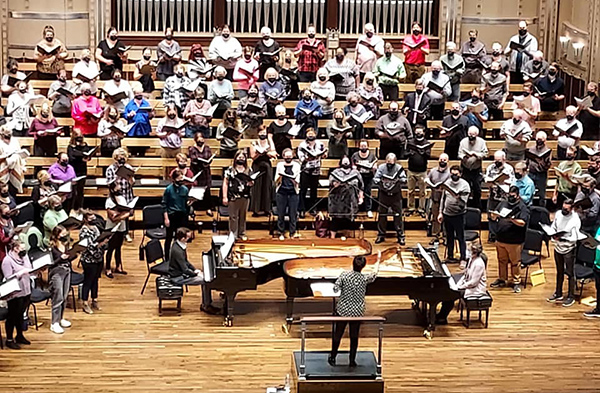
Though without the services of The Cleveland Orchestra, the Cleveland Orchestra Chorus performs live for the first time since March of 2020 tonight at 7 in Mandel Hall at Severance. The four hands of pianists Daniel Overly and Carolyn Warner will stand in for the instrumentalists, using Johannes Brahms’ own arrangement for two pianos. Lisa Wong will be on the podium, and soprano Andrea Carroll and baritone Chris Kenney will be the soloists.
And tonight at 7:30 pm, pianist Jean-Louis Haguenauer of the Jacobs School of Music at Indiana University will play a guest recital in Oberlin’s Warner Concert Hall. The program includes Webern’s Variations, Op. 27, J.S. Bach’s Overture in the French Style, BWV 831, Haguenauer’s own I can’t breathe — in solidarity, and Schubert’s Sonata in A-flat, D. 959. Catch the performance in person, or watch the webcast.
Details in our Concert Listings.
NEWS BRIEFS:
It’s bad news when the Taliban come calling. The Afghan all-female Zohra Orchestra fled the country in advance of their arrival and are now rehearsing and performing in Qatar. Read the Yahoo News story here.
The Summit Choral Society wants its furloughed members and interested new singers to know that the Metropolitan Chorus is back in business, with rehearsals to begin on Tuesday, November 2. Read about the adult ensemble and register here.
Burning River Baroque announces the release on various streaming sites of its CD, Love Poems in Times of Climate Change, featuring soprano Malina Rauschenfels and harpsichordist Paula Maust in music by Dawn Sontag. The ensemble reminds us that although original music is more widely available now than in pre-internet days, a Spotify stream will pay the musicians “somewhere between $.003 and $.0084.” That suggests that a donation is in order.
TODAY’S ALMANAC:
Starting new jobs on October 28: Giovanni Pierluigi da Palestrina as organist and choirmaster of St. Agapito Cathedral in the Italian town of Palestrina in 1544, and John Dowland as “Musician for the Lutes” at the English court of James I, in 1612.
American composer and conductor Howard Hanson was born on this date in 1896 in Wahoo, Nebraska, 26 years after its founding by Czech, German, and Scandinavian settlers (and named after the eastern wahoo, a shrub indigenous to the area). Tapped by industrialist George Eastman in 1923 to be the second director of his new Eastman School of Music in Rochester, New York, Hanson served the school for 40 years, during which he was also prolific as a composer. (Speaking of music schools, a charter was granted to another famous institution, the Juilliard School in New York City, on this date in 1926, the successor to the Institute of Musical Art where Hanson had studied in 1912).
As a conductor, Hanson led the premieres of many American works including William Grant Still’s Symphony No. 1 Afro-American, which debuted on this date in 1931. His own Symphony No. 2, subtitled “Romantic” was commissioned by Serge Koussevitzky to mark the 50th anniversary of the Boston Symphony, who premiered it in November of 1930. One of his most popular works, it’s recently been arranged by Cameron Carpenter for his innovative International Touring Organ. Have a taste here.
On this date in 1909, violinist Joseph Gingold was born in Russia. A year ago, Jarrett Hoffman profiled Gingold, who served as concertmaster of The Cleveland Orchestra for thirteen years. Read that Diary entry here.
And October 28, 1925, saw the opening of the Elizabeth Sprague Coolidge Foundation series at the Library of Congress in Washington D.C. Coolidge was responsible for the commissioning of a large body of chamber music, as chronicled in this 2016 Interlude article in the series, “The Great Women Artists Who Shaped Music XX.”
