


by Daniel Hathaway
 CONTINUING THE CONVERSATION:
Two recent online articles explore the issue of built-in racial discrimination in classical music.
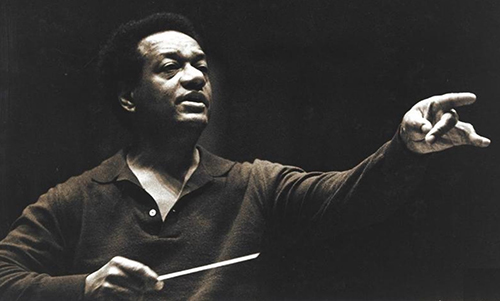
In a WQXR editorial, Philadelphia Inquirer critic David Patrick Stearns traces the later careers of Black conductors who were prominent during the 1970s in “America’s Lost Generation.”
And in “The Last Water Fountain,” a long article on San Francisco Classical Voice, Mark Macnamara considers the persistent issue of systemic racism in the classical performing arts.
OPERA UNDER THE BIG TOP:
Opera Atlanta will present nine performances each of its October and November titles — Pagliacci and the The Kaiser of Atlantis — to live audiences of 240 in an airy circus tent set up on a baseball diamond, with a maximum of 13 orchestral musicians. Read the ArtsAtl article here.
EVENTS STREAMED AND LIVE:
Our pandemic standbys — WCLV and the MET Opera — are on duty as usual today, WCLV with Johann Strauss Jr. waltzes and Beethoven’s Seventh Symphony on Lunchtime with The Cleveland Orchestra, and the MET with Alban Berg’s Lulu during its 20th century opera week.
And a head’s up: on Friday evening at 7 in St. Peter’s Church in Canton, harpist Parker Ramsay will present the first local, live performance of his transcriptions of Bach’s Goldberg Variations. Ramsay, who recently received his artist diploma from the Oberlin Conservatory, recorded the work in the chapel of King’s College, Cambridge, where he previously served as organ scholar. The CD will be released on September 18 on the King’s College label.
TODAY’S ALMANAC:
Speaking of the harp, the famous Franco-American harpist, composer, and pedagogue Marcel Grandjany was born on this date in Paris in 1891, and continued his career in the U.S. beginning in 1940. In this documentary video, Grandjany shows us his approach to playing and teaching the instrument.
And on this date in 1987, American composer Morton Feldman died in Buffalo, NY, where he taught at the University after spending his first 47 years working in his family’s children’s coats business.
A friend of John Cage and other avant garde composers, Feldman began his compositional career writing “indeterminate music” transmitted in unconventional, sometimes graphic scores, and after 1977 turned to quiet works of extraordinary length.
CIM New Music Ensemble members Madeline Lucas, flute, Shuai Wang, celesta, and Brian Sweigart, percussion, played his more-than-four-hour work For Philip Guston in Cleveland on March 31, 2012, in conjunction with an exhibition of monumental wooden sculptures by Ursula von Rydingsvard, the last concert to take place in MOCA’s midtown location.
I stopped in to hear part of that performance after covering another event, and wrote in a review:
During the half hour I sat in the main space, the keyboardist would play a soft cluster of notes, answered by a soft note from the flute and a single stroke from the percussion, followed by a soft cluster from the keyboard, a soft note from the flute and a single stroke from the percussion, followed by… When this slow sequence was interrupted and the percussionist played many (slow) repetitions of the same marimba note, it seemed like a seismic musical shift, but then the original material came back again.
For a taste of that work, watch a video of a 55-minute excerpt from a performance on November 2, 2014 by flutist Claire Chase, keyboardist Sarah Rothenberg, and percussionist Steven Schick, in Houston’s Rothko Chapel on the Da Camera chamber music series.
And here’s a shorter Feldman work from 1970 — before he embarked on his extended duration pieces: his The Viola in My Life 2 performed by the CIM New Music Ensemble in Mixon Hall on April 2, 2017.
