


by Daniel Hathaway
 HAPPENING TODAY:
Today is Earth Day 2025. There are numerous ways to observe this year’s theme, “Our Power, Our Planet,” with its focus on renewable energy and encouraging people to take action for the environment. Cleveland Metroparks suggests 50 Ways to Celebrate Earth Day at Home.
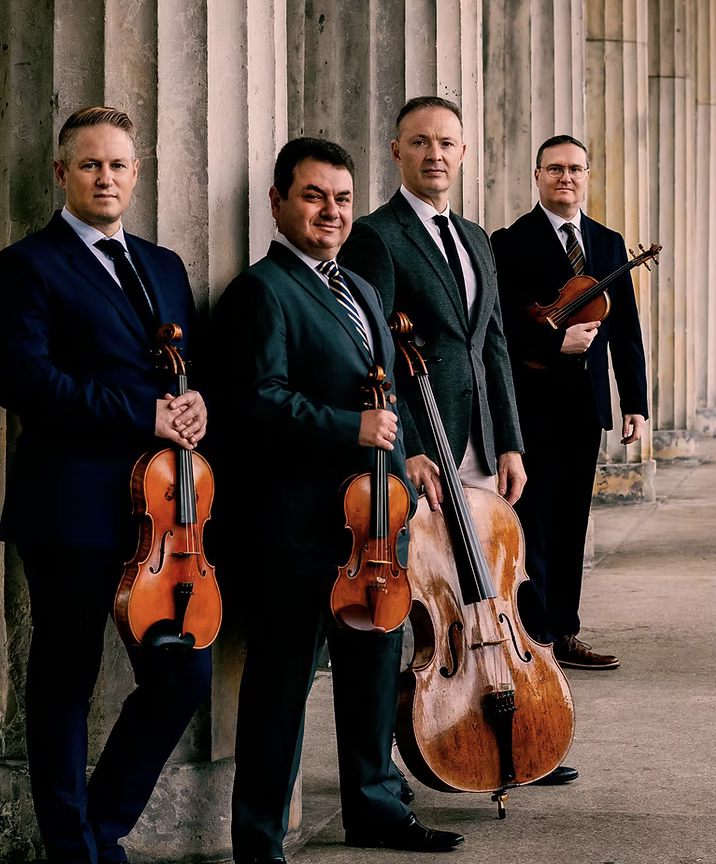
To mark its 75th Anniversary, the Cleveland Chamber Music Society has booked Gartner Auditorium at the Cleveland Museum of Art for five evenings and has engaged the Jerusalem Quartet (pictured) to play all fifteen of Dmitri Shostaktovich’s string quartets in chronological order, creating something of a timeline of the composer’s life in Joseph Stalin’s Soviet Union. The second program tonight at 7:30 includes Quartets 4-6, and will be preceded by a 6:30 lecture by James Wilding.
And to mark the 200th Birthday of the City of Akron, Tuesday Musical has organized a Bicentennial Concert tonight at 7:30 in E.J. Thomas Hall. The program features the brass and percussion sections of The Cleveland Orchestra in the world premiere of Peter Boyer’s Festive Fanfare, plus works by Giovanni Gabrieli and Modest Mussorgsky.
For details of these and other events, please visit our Concert Listings page.
ANNOUNCEMENTS:
The Cleveland Museum of Art has announced that its Solstice Event will return on Saturday, June 21 from 7:00 pm to 12 midnight. The evening combines music, art, dance, and projections, and features performances by international bands on the museum’s outdoor south terrace and nationally recognized DJs in the Ames Family Atrium. All-inclusive tickets go on sale for members at 9:00 am on Monday, April 28, followed by the public sale at 12:00 Noon on Tuesday, April 29. This event is for guests 21 or older. “Early ticket purchasing is recommended as this event is expected to sell out.”
TODAY’S ALMANAC:
By Mike Telin
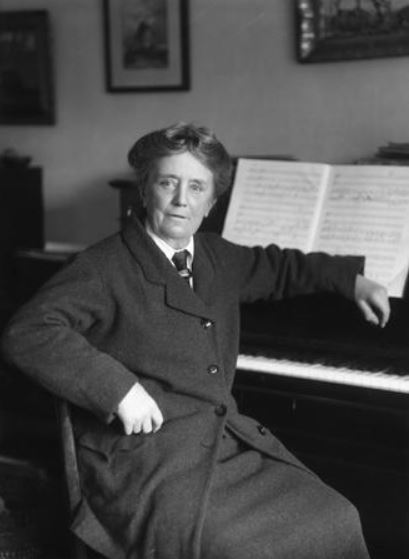 Today we’ll celebrate a true maverick of the music world, Dame Ethel Mary Smyth. Born on this date in 1858 in Sidcup, Kent, England, Smyth was a noted composer during her lifetime. Her catalogue includes songs, works for piano, chamber music, orchestra, chorus, and operas. Still her compositions were often criticised for not measuring up to those of her male counterparts. In spite of being marginalised, she was the first female composer to be granted a damehood, the equivalent for women of a knighthood.
Smyth began studying composition with Alexander Ewing at age seventeen. After a long battle with her father, she was granted permission to further her studies at the Leipzig Conservatory, where she became a student of Carl Reinecke and later privately with Heinrich von Herzogenberg. While in Leipzig she was introduced to Dvořák, Grieg, Tchaikovsky, Clara Schumann, and Brahms.
Smyth’s compositions of note include a Concerto for Violin, Horn and Orchestra, the Mass in D and two operas. The Wreckers is thought to be the “most important English opera composed during the period between Purcell and Britten,” and for more than a century, Der Wald was the only work by a woman composer to be produced at the Metropolitan Opera.
In 1910, Smyth put composing aside and joined the Women’s Social and Political Union (WPSU), which advocated for women’s suffrage. Giving up music for two years to devote herself to the cause, she was often seen in the company of the movement’s leader, Emmeline Pankhurst. And Smyth’s The March of the Women became the anthem of the suffragette movement.
In 1912, Pankhurst incited WPSU members to throw stones at the windows of all politicians’ houses who opposed a woman’s right to vote, which led to the arrest and imprisonment of over 100 women.
Throughout her life Smyth was active in sports. An avid equestrian and tennis player in her youth, she was also a passionate golfer and a member of the ladies’ section of Woking Golf Club. After her death in 1944 at the age of 86, her brother spread her ashes in the woods near the club. Click here to watch The North American Co-Premiere of Dame Ethel Smyth’s The Prison (A Mini-Documentary). It’s well worth ten minutes of your time.
