


by Daniel Hathaway
 TODAY’S CONCERTS
For a change. each of the two concerts on today’s calendar can be attended in-person, following whatever protocols are being observed in their venues.
At noon, harpist Juan Riveros plays French music by Gabriel Fauré, André Caplet, and Jean-Michel Damase on the Tuesday noon series at the Church of the Covenant in University Circle.
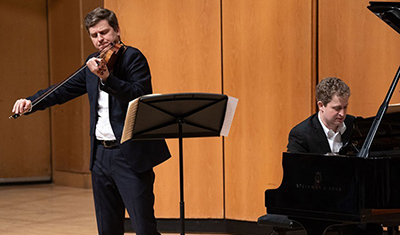
At 7:30 this evening, violinist James Ehnes and pianist Andrew Armstrong finally have the opportunity to complete their three-concert Beethoven Sonata series with a recital on the Cleveland Chamber Music Society series in St. Paschal Baylon Church in Highland Heights. The final program includes the second and third Sonatas of Op. 30, and the much later Sonata in G, Op. 96. You’ll need tickets to attend in person, but a live stream is free. Details in our Concert Listings.
NEWS BITS:
The Lumière Quartet has won the Silver Medal in the Junior Division of the Fischoff Competition. The ensemble — Célina Béthoux, Moonhee Kim, Henry Rogers, and Ania Lewis — has been coached at the Cleveland Institute of Music by Si-Yan Li and Jessica Lee.
Naxos will release a new CD of Margaret Brouwer’s chamber music later this year. The recording will include her Rhapsodic Sonata, Declaration, The Lake, I CRY, and All Lines are Still Busy, performed by mezzo-soprano Sarah Beaty, tenor Brian Skoog, violinist Mari Sato, violist Eliesha Nelson, and pianist Shuai Wang.
Brouwer writes, “We recorded most of the music in CIM’s Kulas Hall in early January. Then in February, in true pandemic fashion, the mezzo-soprano recorded the vocal line of Declaration remotely in Los Angeles while I produced the recording session on FaceTime from Cleveland! This technology worked great and we were able to capture a beautiful recording even though the musicians were in different states.”
INTERESTING READS:
Sunday’s New York Times featured an article by David Allen about conductor Artur Rodzinski, who led The Cleveland Orchestra from 1933 to 1943. Read The Conductor Who Whipped American Orchestras Into Shape here. (“Possessing an ‘enormous’ vocabulary of Polish profanity that he unloaded on musicians, as Time magazine reported, Rodzinski was also rumored to conduct with a revolver in his pocket.”)
And today’s Times prints Anthony Tommasini’s review of the MET Opera’s first live concerts since the shutdown. “Members of the Met’s orchestra and chorus, conducted by its music director, Yannick Nézet-Séguin, and joined by four soloists, twice presented a 45-minute program for an audience of 150.
“The location wasn’t the company’s home at Lincoln Center; instead, the concerts were held at the Knockdown Center, a door factory turned rough-hewed art and performance space in Queens.”
Artist managers act as liaisons between performing artists and their ultimate audiences. Billboard magazine takes a look at IMG Artists and Opus 3, who are redefining the landscape since Columbia Artists suddenly folded in 2020. Read Pulling Back the Curtain on Alexander Shustorovich, Classical Music’s International Man of Mystery here.
TODAY’S ALMANAC:
Let us now praise famous musicians who arrived or departed on May 18.
First, two German composers. Johann Froberger was born on this date in 1616 in Stuttgart, and Georg Böhm took his leave in Luneburg in 1733.
When not in the service of the noble families of Stuttgart, Froberger traveled throughout Europe, establishing himself as a virtuoso organist and harpsichordist, and was the inventor of the dance suite that served the formal needs of composers well into the 18th century. He also pushed the Arca Musarithmica, an early A.I. device that assisted in the creation of music.
Watch French harpsichordist Jean Rondeau perform Suites by Froberger — and by Louis Couperin, whose music he influenced — in a live broadcast from Salle Cortot in Paris in 2020, and read more about the Arca Musarithmica here.
Böhm was working for the French-influenced court in Luneburg when Johann Sebastian Bach was a teenaged chorister at a church down the street. Enjoy two of Böhm’s engaging works played on the Schnitger organ in Groningen by Wim van Beek. We’ll start with his multi-sectioned Präludium in g, then move on to his variations on Freu dich sehr, o meine Seele — the next-to-last variation introduces some stunning blue notes into the harmony.
Two basses come up in today’s list: the birth of Ezio Pinza in Rome in 1892, and the death of Dietrich Fischer-Dieskau in 2012. We featured the latter in an earlier Diary, so we’ll move on to Pinza, who, despite never having learned to read music, enjoyed a long and distinguished opera career beginning in Milan under Toscanini and continuing at the MET in New York.
Watch some rare video of Pinza rehearsing for a Bell Telephone Hour program in 1947, and recall his second career on Broadway in clips from Rodgers & Hammerstein’s South Pacific, where he appeared opposite Mary Martin as the French planter Emil de Becque.
German composer and conductor Gustav Mahler died in Vienna on this date in 1911, leaving nine-and-a-half monumental symphonies that were performed during his lifetime, but languished until their revival later in the century, notably by Leonard Bernstein. The works suited the conductor’s extroverted personality, as can be witnessed in this 1973 performance of No. 2, the “Resurrection” Symphony, at Ely Cathedral. (In 2018, the film of the performance was screened at Ely, preceded by interviews). I had the unforgettable experience of singing the work with Bernstein and the Boston Symphony at Tanglewood in the early 70s.
The roots of Mahler’s music are explored by Bernstein’s spiritual successor, Michael Tilson Thomas, in two episodes of Keeping Score with the San Francisco Symphony.
Finally, on this date in 1975, American composer and arranger Leroy Anderson died in Woodbury, Connecticut. Long associated with Arthur Fiedler and the Boston Pops, the Harvard grad was famous for such light classics as Bugler’s Holiday, played here by Cleveland Orchestra principal trumpet Michael Sachs with the UCLA Wind Ensemble and two of his young colleagues. Occasionally, Anderson aspired to more ambitious works. Watch a rare performance of his Piano Concerto here.
