




by Daniel Hathaway
NEWS BRIEFS:
 Poiesis Quartet wins at Banff
The Violin Channel reports that the Poiesis Quartet has won first prize in the 2025 Banff String Quartet Competition.
“Comprising violinists Sarah Ying Ma and Max Ball, violist Jasper de Boor and cellist Drew Dansby, The Poiesis Quartet are former Grand Prize winners of the Fischoff National Chamber Music Competition and winner of the 2024 Concert Artists Guild Competition.
“They currently serve as Graduate Quartet-in-Residence at the University of Cincinnati College-Conservatory of Music, studying with the Ariel Quartet. As graduates of Oberlin Conservatory, they were previously mentored by Sibbi Bernhardsson of the Pacifica Quartet and the Verona Quartet.”
Read the story here.
TODAY’S ALMANAC:
Today we look back on the life of Rudolf Bing (pictured below), who died on this date in 1997. The famed general manager of the Metropolitan Opera oversaw the company’s move to Lincoln Center in 1963.
 The “dapper and acerbic” Bing never shied away from conflict, even with international opera stars. In 1958, he canceled the contract of soprano Maria Callas over a disagreement, but spent years convincing her to come back. She eventually returned to the Met seven years later in the title role of Tosca, which would mark the end of the 42-year-old soprano’s stage career.
In a review for the performance, New York Times journalist Harold Schonberg described New York City’s excitement over the return of Callas (pictured below):
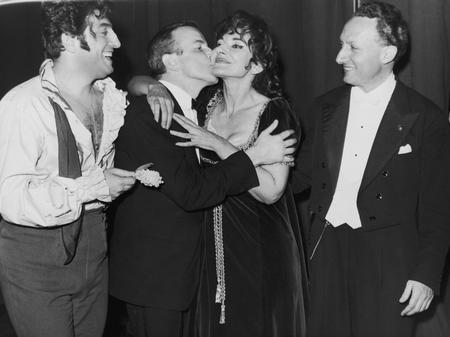 Hours before the curtain went up, the street outside the opera house looked like one of the circles of Dante’s Inferno. […] The picketers were being jostled by citizens pleading for tickets, at any price. Some bore plaintive signs: ‘A single ticket, please.’
Another person Bing clashed with was Cleveland Orchestra conductor George Szell, who left the Met in 1954 after an argument over his contract. Someone commented afterwards that Szell was his own worst enemy, to which Bing famously replied: “Not while I’m alive.”
At his retirement, Bing wrote in the New York Times that someone once said his job was the third most difficult after president of the United States and mayor of New York — and they “don’t have to deal with prima donnas. To put it another way, they don’t know — nobody knows —the Traubels I’ve seen,” he wrote, referring to the Wagnerian soprano Helen Traubels, with whom he clashed over her desire to sing in night clubs.
Despite Bing’s tenuous relationships with some well-known figures, he was also renowned for integrating the Met’s artist roster and nurturing the careers of singers such as Leontyne Price, who became one of the first African American singers to perform for the company in a leading role. In 1950, while facing some backlash over announcing he would hire singers regardless of race, Bing wrote to a disgruntled subscriber: “I am afraid I cannot agree with you that as a matter of principle, Negro singers should be excluded. This is not what America and her allies have been fighting for.”
