

by Daniel Hathaway
 ANNOUNCEMENTS:
The Music Settlement announces that registration is currently open for all its programs, including private music lessons, the Suzuki program, ensembles, and group classes. View the Fall Course Catalog here.
Tuesday Musical announces that all tickets are now on sale for TMA’s 2025-26 Akron Concert Series — including soprano Renée Fleming, jazz and classical saxophonist Branford Marsalis, a 300th anniversary celebration of Vivaldi’s The Four Seasons by France’s Les Arts Florissants, and Christmas with Cantus. Click here for more information.
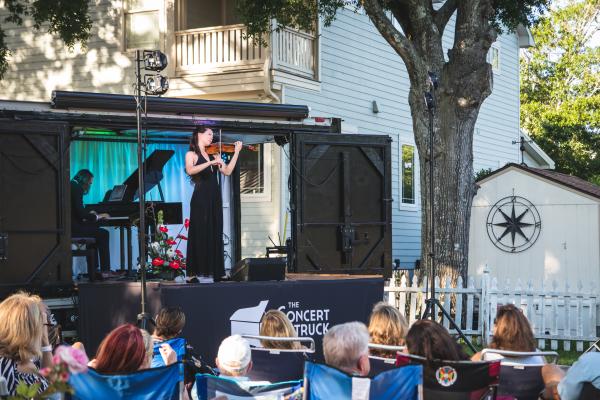
More from Tuesday Musical: The Concert Truck — a traveling music venue (pictured) complete with its own lights, sound system and piano — is rolling into Greater Akron neighborhoods in late August for a series of free outdoor concerts. Presented by Tuesday Musical, the genre-bending concerts will feature classical, jazz, world music, Broadway show tunes, and more performed by pianists Susan Zhang and Maxim Lando.
“Local musicians will perform before and during some of the concerts. No tickets needed. Simply come, bring seating and picnics if you wish, and enjoy the music.” Click here for the schedule.
TODAY’S ALMANAC:
On this date in 1655, German instrument maker Johann Christoph Denner was born in Leipzig. Often credited with the invention of the clarinet — well, he did add a register key to the chalmeau, a single reed instrument with many historical antecedents — Denner’s innovations helped pave the way for the future development of one of the most versatile instruments in the woodwind family.
The clarinet achieved an important level of sophistication during Mozart’s time, as his concerto and quintet for the instrument demonstrate. They were written for Anton Stadler, the composer’s favorite clarinettist, but the concerto can hardly have had more loving treatment than it did in the hands of Franklin Cohen and his “all-star” ChamberFest Orchestra in 2015. Watch the performance here.
And since the instrument comes in all sizes from the shrill, E-flat clarinet to the subterranean contrabass, it has inspired various arrangements like the Orchestra Siciliana di Clarinetti-Choir’s version of Gustav Holst’s Suite in F for military band.
And on August 13, 1900, English musicologist Sir George Grove died in London at the age of 79. Trained as an engineer, Grove’s love for music got him appointed director of orchestra concerts for the Great Exhibition of 1851 at the Crystal Palace in Hyde Park, London. He continued administering a concert series there after the building had been moved to Sydenham, and crafted admirable program notes for the benefit of amateur listeners. “I wrote about the symphonies and concertos because I wished to try to make them clear to myself and to discover the secret of the things that charmed me so; and from that sprang a wish to make other amateurs see it in the same way.”
One thing led to another, and Groves was invited by the publishers Macmillan and Company to produce a musical encyclopedia. Grove’s Dictionary of Music and Musicians was eventually issued by Macmillan in alphabetical volumes over a dozen years, ending in 1889.
One of Grove’s passions was the music of Schubert, then little appreciated in England. He was instrumental in discovering the score and parts for the incidental music to Rosamunde, the 1823 play by Helmina von Chézy, during an exploratory visit to Vienna in 1867. In honor of that find, listen to a studio recording of excerpts from Rosamunde with George Szell and the Royal Concertgebouw Orchestra made in Amsterdam in December, 1957.
Grove ended his career as director of the refounded Royal College of Music. His Encyclopedia lives on — online.
