

 by Daniel Hathaway
TODAY’S EVENTS:
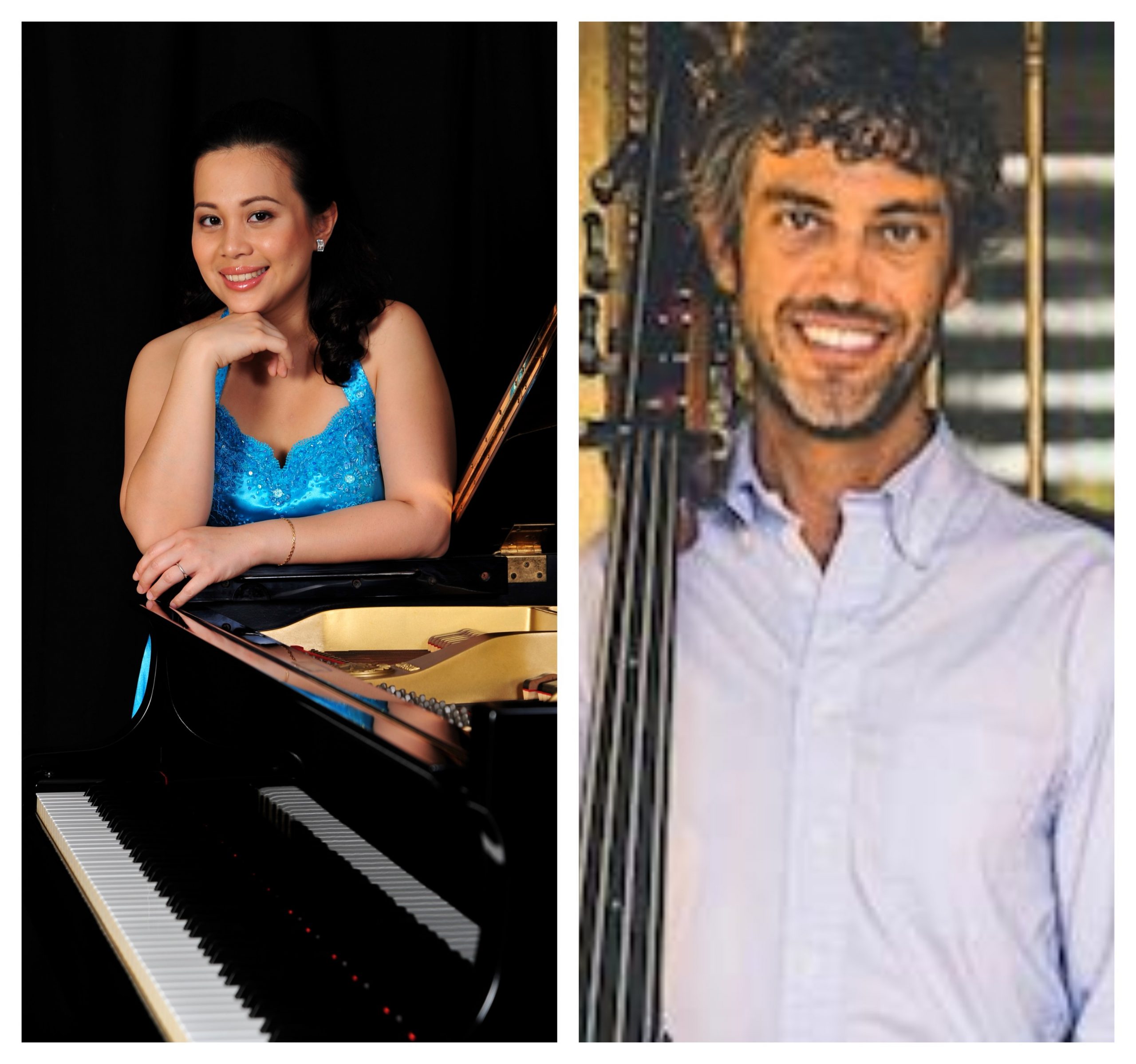
The noon hour on Wednesday will feature Shaker Heights High School Chamber Orchestra on the Trinity Cathedral Brownbag Series (both in person and online), and Youngstown State faculty pianist Cicilia Yudha at the Butler Institute of Art. This evening, Cleveland Orchestra double bassist Scott Dixon joins pianist Alicja Basinska for a CIM Faculty Recital of music by J.S. Bach and Serge Koussevitzky (himself a bass player), including orchestral excerpts by Mozart, Beethoven, and Britten, and back to Youngstown, the Dana Ensemble will play fourteen selections from the mythical Great American Songbook arranged by Dave Morgan and featuring guest vocalist Evelyn Wright and trumpeter James Suggs.
NEWS BRIEFS:
Oberlin’s Campus News reports that The Society of Women Organists in London has selected three organ works by Visiting Professor of Organ Christa Rakich for inclusion in their Anthology of Women Composers for Organ. The Royal College of Organists and the American Guild of Organists will join in the SWO’s celebration of Play-a-Woman-Composer Sunday on March 6. Church organists are encouraged to play works by women, record, and upload to social media with the hashtags #WomanComposerSunday and #SWomenOrganists. Rakich’s works are available here.
INTERESTING READS:
Simon Woods, President & CEO of the League of American Orchestras, “shares key strategies for leading orchestras in an ever-evolving world.” Watch Woods in conversation with Arts Journal’s Aaron Dworkin here.
TODAY’S ALMANAC:
On this date in 1964, The Beatles made the first of three appearances on The Ed Sullivan Show, attracting an estimated television audience of 73 million viewers for their American debut in a set that lasted about eight minutes. Watch an excerpt here.
The Liverpudlians would go on to revolutionize popular music, reinventing themselves more than once without losing their fan base, and venturing beyond the boundaries of pop to harvest inspiration from a variety of sources.
One Beatle, Paul McCartney, dabbled in orchestral music in 1991 when the Royal Liverpool Philharmonic Society offered him a commission to mark its 150th anniversary. The result was his Liverpool Oratorio, written in collaboration with Carl Davis, and premiered by the orchestra with singers Kiri Te Kanawa and Willard White, along with the choir of Liverpool Cathedral.
Although the piece was performed globally after its premiere, critical reception tended toward the negative. As Philip Henscher mused in a Guardian article,
One of the reasons such enterprises often fail so dramatically — and it’s very difficult to think of any that have lasted more than a couple of performances — is that their composers rarely have the technical ability to record and convey their intentions with any accuracy.
Many rock musicians can’t read music and have what strikes most classical musicians as rather a loose conception of authorship, relying on amanuenses to transform vague ideas into detailed life. In the world of popular music, such transcribers, arrangers or “producers” have always done a great deal more than the public suspects.
Most of these pseudo-classical works are actually written by teams of professional composers, working on what may be very approximate ideas. … Carl Davis “collaborated” on Paul McCartney’s Liverpool Oratorio — a process eye-openingly described at the time: “Unable to read music, McCartney hums, sings or plays the piano while his collaborator jots down the notes (‘Ah, that’s better – C sharp!’).”
Reviewing the oratorio for the New York Times, Edward Rothstein wrote:
The music’s innocent sincerity makes it difficult to be put off by its ambitions. But the oratorio suggests that the kind of musical and emotional simplicity that make a pop hit can seem barren in the concert hall.
The tale is told of George Gershwin approaching Arnold Schoenberg for composition lessons. “Why do you want to be an Arnold Schoenberg?” the Serialist supposedly responded. “You’re such a good Gershwin already.” As soon as I got home and played Sergeant Pepper in glad relief, I imagined Benjamin Britten saying something similar to the composer of Liverpool Oratorio.
Speaking of Schoenberg, his student, Austrian composer Alban Berg, was born in Vienna on this date in 1885. Berg is credited with humanizing his mentor’s 12-tone compositional system, overlaying it with a veneer of expressive Romanticism. His fame is inversely proportional to his output, which includes two operas — Wozzeck and the unfinished Lulu — a violin concerto, and some smaller works.
Alas, in May of 2020, the pandemic resulted in the cancellation of Cleveland performances of the two-act concert version of Lulu, starring Barbara Hannigan, which was to have anchored The Cleveland Orchestra’s “Censored: Art and Power” Festival.
The BBC highlighted Berg’s life in a documentary, and ChamberFest Cleveland included his Adagio for violin (Diana Cohen), clarinet (Franklin Cohen), and piano (Roman Rabinovich) on a concert in CIM’s Mixon Hall on June 21, 2018. That movement was extracted from Berg’s Concerto de chambre for piano, violin, and 13 instruments. And Pierre Boulez chose Berg’s Der Wein to open the 2011 Salzburg Festival with soprano Dorothea Roeschmann and the Vienna Philharmonic.
Hungarian composer, pianist, and conductor Ernst Von Dohnányi died in New York on this date in 1960 at the age of 82. Grandfather of Cleveland Orchestra music director laureate Christoph, Ernst (Erno) was an important figure in the Hungarian resistance movement against the Nazis. He moved to Florida after the War and taught at Florida State University in Tallahassee for ten years.
Two early works suggest the range of Dohnanyi’s compositional style: on the one hand, his Piano Quintet No. 1 in c, here played by the Cleveland Quartet and Barry Snyder, and on the other his Variations on a Nursery Tune (the same song Mozart later used). It’s subtitled, “For the enjoyment of humorous people and for the annoyance of others.” The composer plays it here at the age of 79 with Sir Adrian Boult and the Royal Philharmonic Orchestra.
