




by Daniel Hathaway
 ON TODAY:
Faculty and student musicians at Youngstown State and Oberlin are featured in a trio of performances today.
YSU’s Music at Noon features select woodwinds from the Dana School of Music.
This evening, the Dana Trio — Misook Yun, soprano, Sean Yancer, horn, and Caroline Oltmanns, piano — perform “Beyond Auf dem Strom,” featuring commissioned music by James Wilding, Margaret Griebling-Haigh, Cara Haxo, and Elliot Bark, and the preview of a work by Andres Weinkemeyer in advance of its future premiere.
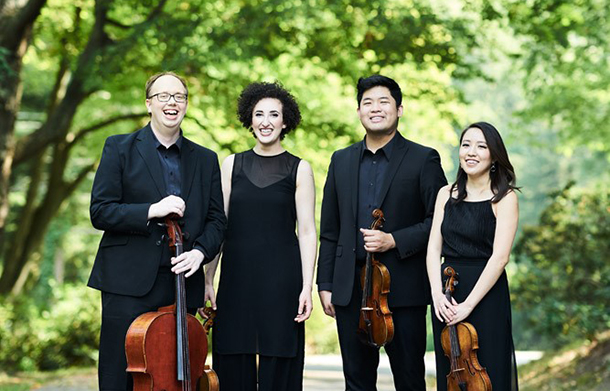
And an Oberlin Faculty Recital by the Verona Quartet (pictured) — Jonathan Ong and Dorothy Ro, violins, Abigail Rojansky, viola, and Jonathan Dormand, cello, with pianist Peter Takacs — includes Shostakovich’s String Quartet No. 9 and Dvořák’s Piano Quintet No. 2, with an introduction by Professor Vladimir Ivantsov of the Russia and East European Studies Department. You can watch a live stream.
Details in our Concert Listings.
TODAY’S ALMANAC:
Midwives, maternity wards, and morticians have almost nothing of interest to report for this date in classical music history, although secretaries of state and the patent office have recorded three events on March 30 that have affected the future in various ways.
On this date, the Handel and Haydn Society was founded in Boston in 1815, Philadelphia stationer Hyman L. Lipman registered a patent for a pencil with an eraser attached in 1858, and U.S. Secretary of State William H. Seward signed the Alaska Purchase treaty in 1867.
Wanting to be accurate and thorough, we always check out dates before setting electrons in motion and choosing music to celebrate milestones. So we were surprised to read on bach-cantatas.com that “The Handel and Haydn Society was founded as an oratorio society in Boston on April 20, 1815, by Gottlieb Graupner, Thomas Smith Webb, Amasa Winchester, and Matthew S. Parker, a group of Boston merchants and musicians who were eager to improve the performance of choral music in a city that, at the time, offered very little music of any kind.”
Pressing the search further, we learned from a New York Times article marking the 200th anniversary of the Society, that “The society was born from the peace festivities after news reached Boston of the end of the War of 1812, when musicians presented highlights from “The Creation” and Handel’s “Messiah.” After newspaper correspondents wrote of a need to hear more European works, a group of 44 amateur choristers and instrumentalists formed the Handel and Haydn Society, on April 13, 1815.”
Then there’s this notice from the City of Boston: “The exhibition The Handel and Haydn Society: Bringing Music to Life for 200 Years opens at the Boston Public Library’s Central Library in Copley Square in the Cheverus Room on Tuesday, March 24, and runs through Saturday, September 5….The opening date of the exhibition coincides with the 200th anniversary of H+H’s founding and “Handel and Haydn Society Day” in the City of Boston.”
Well, if you’re over 200 years old, what do those few days’ difference matter? We’ll just pretend it’s H+H’s 207h Birthday and list some interesting facts about the organization.
- The Society, the oldest continuously performing organization in the U.S., made its debut on Christmas Night of 1815, when a chorus of 90 men and 10 women sang at King’s Chapel.
- The Society saw the first American edition of Handel’s Messiah into print in 1816, and gave the U.S. premiere of the work in 1818, followed by Haydn’s The Creation in 1819.
- The organization sought to commission a work from Beethoven around 1823, but the project never came to fruition.
- Fast forwarding, Handel and Haydn underwent a sea change in the 20th century when it began adopting historically informed performance practices under Thomas Dunn at the behest of Boston Globe critic Michael Steinberg, and Christopher Hogwood transformed it into a professional chorus and period instrument ensemble beginning in 1986.
Check our H+H’s COV-19 Era Messiah for Our Time (Part I and Hallelujah Chorus), led by Ian Watson, to see how a 200+ year old organization adapts to new realities. There are 183 other videos on the organization’s YouTube channel to enjoy as well.
Russia’s decision to sell Alaska to the U.S. for $7.2 million (roughly $.02 per acre) reflected circumstances that sound all too familiar. Finally pushed through after delays caused by the U.S Civil War, that deal would relieve Russia — struggling with debt from the Crimean War — of the cost of maintaining the territory.
Thinking of Alaska brings up the name of its celebrated sometime resident, composer John Luther Adams, who was inspired by its natural beauty to create soundscapes that captured aspects of life in the North.
Click here for a performance of The White Silence by the Oberlin Contemporary Music Ensemble led by Timothy Weiss, and here for Wind in High Places by the No Exit New Music quartet (Cara Tweed, Mari Sato, James Rhodes, and Nicholas Diodore) recorded live at Kent State’s Ludwig Recital Hall in November, 2019.
Adams talks about his 2014 installation Veils and Vesper at St. John’s Episcopal Church in Ohio City in conjunction with a performance sponsored by the Cleveland Museum of Art. Click here to watch the clip.
And that pencil-plus-eraser innovation? Celebrate National Pencil Day today with a brief, two-minute video produced by CBS Sunday Morning that reminds us of the ubiquity of that writing device, and updates the Hyman Lipman story with the sad decision by the U.S. Supreme Court that his patent was invalid because it merely joined two previous inventions together.
So be it, but the ability to erase one’s mistakes within seconds of making them remains something of a miracle. Other means of communication require the publishing of retractions — like this one by the New York Times printed yesterday in its Corrections column:
An article on Sunday about an influx of federal funds to New York during the pandemic misstated the dollar amount of the infrastructure bill. It is $1 trillion, not $1 billion.
Seems like a paltry error until you realize that
In the American system one billion is 1,000,000,000 and a trillion is 1,000,000,000,000 so one trillion is one thousand times one billion. In the British system one billion is 1,000,000,000,000 and one trillion is 1,000,000,000,000,000,000 so one trillion is one million times one billion.
Published on ClevelandClassical.com March 23, 2022.
