

by Daniel Hathaway
TODAY ONLINE:
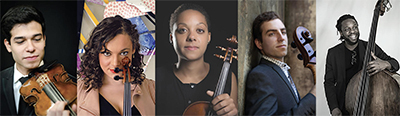 Tuesday Musical sometimes presents on other days of the week — like today, Wednesday, when the Akron organization brings the Sphinx Virtuosi to E.J. Thomas Hall for an in-person concert. “Land of the Free” features music by Xavier Foley, Coleridge-Taylor Perkinson, Samuel Barber, and Andrea Casarrubios, ending with the finale from Dvořák’s “American” Quartet.
And North Coast Winds — Kimberly Zaleski, flute, Adrian Gonzalez, oboe, Ben Chen, clarinet, Emily Shelley, horn, and Arleigh Savage, bassoon — live stream a free program tonight from the Maltz Performing Arts Center.
Casting a wider net, today at noon, Kirill Gerstein talks with NY Philharmonic CEO Deborah Borda on the subject of “Unexpected Solutions—A Consideration of Positive Outcomes and Potential Growth Arising from the Pandemic,” Philadelphia Chamber Music Society hosts the Jasper Quartet and soprano Sarah Shafer, the Orchestra of St. Luke’s pairs Samuel Coleridge-Taylor’s Clarinet Quintet with Chopin’s Second Piano Concerto (with Jeremy Denk at the keyboard), and the Baltimore Symphony brings its brass section out of storage for music by Adolphus Hailstork, Karel Husa, Einojuhani Rautavaara, Florent Schmitt, Michael Daugherty, and Benjamin Britten.
Details in our Concert Listings.
TODAY’S ALMANAC:
Today’s honorees are Dutch organist, harpsichordist, and composer Jan Pieterszoon Sweelinck and American composer and pianist William Bolcom.
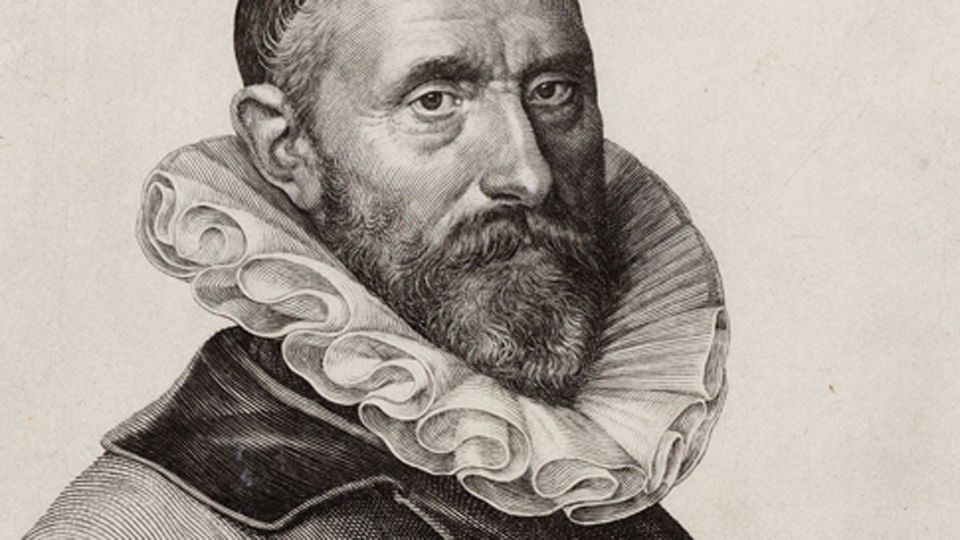 16th century birth records are less dependable than death certificates. Although our main reference for the Almanac tells us that Sweelinck was born on this date in 1562 in Amsterdam, other sources place that event vaguely during April or May, and in the town of Deventer. And if contemporary sources aren’t all that accurate in dating events, they’re not so dependable in spelling names either: our birthday boy is variously known as Swelinck, Zwelinck, Sweeling, Sweelingh, Sweling, or Swelingh. He wasn’t alone: there are said to be some 80 variant spellings of Shakespeare, who was also born in the 1560s.
More importantly, 2021 marks the 400th anniversary of his death on October 16, 1621, so we’ll talk today about the keyboard works for which he’s best known, and save his vocal works for October.
Sweelinck was associated with Amsterdam’s Oude Kerk for 44 years, where he succeeded his father as organist at the age of 14. During his tenure, the religious establishment changed drastically, from Catholic to Calvinist to Lutheran, calling for major alterations in his musical duties.
Calvinists prohibited instrumental music in their services, subsisting on a diet of Genevan psalm tunes sung in unison without accompaniment. Sweelinck was thus on the payroll of the City of Amsterdam and organs in churches were owned and maintained by city authorities. His duties included improvising on psalm tunes and providing music between services, especially on rainy days when the burghers of the city conducted their business and tourists visited.
Oberlin will mark the 400th anniversary of Sweelinck’s death with a week-long Sweelinck Studies course from June 14-19 that will examine the influence of a composer known during his lifetime as “The Orpheus of Amsterdam” and the “German Organist Maker” (details here).
Straddling as he did the Renaissance and Baroque periods, Sweelinck had a strong hand in creating what would become the North German organ style.
Jacques Van Oortmessen performs a selection of Sweelinck’s organ works here on the instrument in the Grote Of St Janskerk, Schiedam, and Jean Rondeau plays his Fantasia cromatica on a harpsichord tuned in mean tone here.
Some of Sweelinck’s most popular keyboard works are variations on secular songs. Matthias Havinga plays Mein junges Leben hat ein End on the organ in Amsterdam’s Westerkerk, rebuilt by Flentrop Orgelbouw in 1989-92 using the situation of 1686/1727 as a point of departure. And Matteo Imbuno performs Onder een linde groen on the Jürgen Ahrend and Gerhard Brunzema transept organ in the Oude Kerk, built in the mid-1960s (note the graphics of Amsterdamers wandering in the church during the music).
William Bolcom was born in Seattle on this date in 1938. During his long career on the faculty of the University of Michigan (1973-2008) he effortlessly navigated his way between the worlds of concert music and cabaret, writing nine symphonies, a dozen string quartets, four volumes each of Gospel Preludes for organ and cabaret songs, and four major operas for Lyric Opera Chicago.
Here’s a selection of cabaret songs performed by Bolcom’s wife, mezzo-soprano Joan Morris, pianist Logan Skelton, drummer Andrew Grossman, and the University of Michigan Symphony Band. And here’s an example of his piano rags — Spencer Myer plays his Graceful Ghost.
Bolcom appears in this profile, along with Morris, to talk about being an American composer, and an episode of “Laughter at the Happy Hour” featuring both musicians celebrates Morris’s birthday with a gift to their audience. Morris explained, “One thing I loved about the Hobbit books is that on their birthdays, hobbits give presents to other people instead. So that’s what this program will be.”
A long-term project, Bolcom’s desire to set the complete texts of William Blake’s Songs of Innocence and Songs of Experience, was 25 years in the making. In 2004, Naxos Records produced a recording made in Hill Auditorium featuring almost the entire music department of the University of Michigan, led by Leonard Slatkin. It won four Grammy Awards in 2006. Listen here.
