


by Daniel Hathaway
 IN THIS EDITION:
. a diverse mix of performances this afternoon and this evening
. the almanac notes an entrance and an exit
TODAY’S EVENTS:
At 12:00 pm, the Trinity Brownbag Concert features César Franck’s Piano Quintet in his 200th birthday year. Violinists Mari Sato & Andrew Sords, cellist Henry Peyrebrune, and pianist Elizabeth DeMio. Trinity Cathedral, 2230 Euclid Ave., Cleveland. Freewill offering.
Four free events begin at 7:30 pm:
The University of Akron Wind Symphony, Galen Karriker, conducting, performs at Guzzetta Recital Hall in Akron.
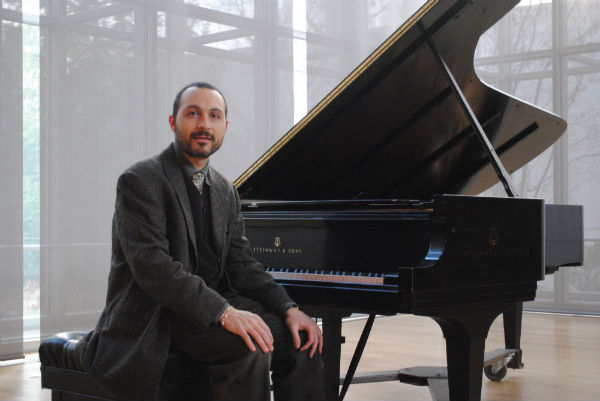
A CIM Faculty Recital features pianist Antonio Pompa-Baldi (pictured) in Mario Castelnuovo-Tedesco’s La Sirenetta e il Pesce Turchino, Ottorino Respighi’s “Andante Espressivo” from Violin Sonata in b (trans. A. Pompa-Baldi), Howard Ferguson’s Piano Sonata in f, and Roberto Piana’s Glances on the Divine Comedy, Part I. Mixon Hall, reservations required.
Down the street at Severance Music Center, Carlos Kalmar leads the Cleveland Institute of Music Orchestra in Ligeti’s Atmosphères, Ginastera’s Variaciones Concertantes, and Brahms’ Symphony No. 4.
In Oberlin, faculty members David Bowlin, violin, and Tony Cho, piano, perform Charles Ives’ Violin Sonata No. 2, Gabriel Fauré’s Violin Sonata No. 1 in A, and Sergei Prokofiev’s Violin Sonata No. 1 in f, Op. 80 in Kulas Recital Hall. Click here for live stream.
TODAY’S ALMANAC:
A death and a birth stand out among the events that occurred on this date in classical music history.
The death: Mexican composer Silvestre Revueltas in 1940 in Mexico City. Revueltas was championed by composer Carlos Chavez, who invited him to serve as his assistant conductor of the National Symphony Orchestra of Mexico until the two had a falling out over a commissioned work. His visit to Spain during the Spanish Civil War, sponsored by a leftist organization, ended with the victory of Francisco Franco, as did his musical career in Mexico not long afterward.
Revueltas, a member of a remarkable artistic family, is probably best known today as the composer of Sensemayá, based on the eponymous Cuban poem by Nicolás Guillén, which uses an Afro-Caribbean chant to evoke the ritual of killing a snake. A close runner-up is his suite La Noche de los Mayas, arranged from a film score. Click here to watch a performance by Semyon Bychkov and Cologne’s WDR Symphony from 2010.
The composer was also known for his sense of humor. Héctor Palencia Alonso cites his cameo appearance as a bar pianist in the film ¡Vámonos con Pancho Villa! for which Revueltas wrote the score. He’s playing La Cucaracha when shooting breaks out and holds up a sign reading “Please don’t shoot the pianist”.
And the birth: American composer and pianist Eleonor Sandresky in 1957. She describes herself on her website as “piano goddess, composer, inventor of the Wonder Suit, producer of film with live orchestra concerts, founder of the MATA Festival, and pianist with the Philip Glass Ensemble since 1991.”
Wonder Suit? She explains that further.
Working at the forefront of avant-garde concert-as-theater, Sandresky reinvented herself in 1999 as the original Choreographic Pianist with her groundbreaking composition A Sleeper’s Notebook (1999–2003), in which she explores her deep interest in how motion translates to emotion through sound. Out of this work, she invented The Wonder Suit, a remote set of wireless sensors worn and used to trigger sonic events through movement during live performance. These sonic events range from discrete processes to surface manipulations of pitch, and build on the concepts and ideas in her choreographed works. She has created large-scale works for The Suit, including A Space Odyssey (2016), which incorporates found sounds from NASA as a basis for the composition.
Explore a variety of Sandresky’s work in this YouTube playlist.
