

by Daniel Hathaway
 ON THIS WEEKEND:
Les Délices continues its live, premiere run of the Baroque opera The White Cat on Saturday at 3 and 7:30 and Sunday at 3 at the Breen Center, and CIM Opera Theater and New Music Ensemble repeat their Pocket Operas program on Sunday at 4 in Mixon Hall.
Orchestra concerts this weekend include the Akron Symphony with the flamenco dance Alice Blumenfeld and the Korean Three Drum Dancers (E. J. Thomas Hall Saturday at 8), and Lauren Berry and Connor Bogart solo in Broadway favorites with Carl Topilow and Cleveland Pops at Severance.
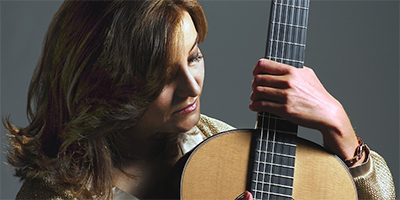
Visiting musicians will be hosted by the Cleveland Classical Guitar Society (Berta Rojas, pictured, Saturday at 7:30 at Plymouth Church) and No Exit (The Unheard-of Ensemble exploring climate change with composer Christopher Stark and video artist Zlatko Ćosić at Spaces Gallery Saturday at 8).
On Sunday at 1 at the Cleveland History Center, the Cleveland Arts Prize will celebrate African American History and Culture and its own 60th anniversary with pianist Dianna White-Gould, violist Christopher Jenkins, cellist Kahri Joyner, poet Raja Belle Freeman, and tenor Cornelius Johnson. The weekend concludes Sunday at 4 with Stars in the Classics’ spring cabaret at the Church of the Western Reserve.
Consult our Concert Listings for details.
ALL POINTS BULLETIN: ROJAS’ GUITAR STOLEN:
The Paraguayan guitarist, scheduled to play a recital for the Cleveland Classical Guitar Society this Saturday evening, has announced on her Twitter feed that her guitar, “La Rojita,” built by Michael O’Leary in 2008, was stolen yesterday at 3:41 pm from 3120 Bridge Ave. Cleveland. She will perform on an instrument loaned by Colin Davin, but guitarists are asked to keep a look out.
WEEKEND ALMANAC:
On this date in 1842, the New York Philharmonic Orchestra gave its debut concert to some 600 patrons in the Apollo Rooms in lower Manhattan (some sources give the date as April 5), making the ensemble the oldest orchestra in the United States.
The organization’s complex history, including mergers with the New York Symphony, the New/National Symphony, and its summer seasons at Lewisohn Stadium is richly chronicled in a Performance History database that documents “all known concerts of all of these organizations, amounting to more than 20,000 performances.
The New York Philharmonic Leon Levy Digital Archives provides an additional interface for searching printed programs alongside other digitized items such as marked music scores, marked orchestral parts, business records, and photos.”
If you’d like to go down a fascinating rabbit hole, start your journey here.
To recall a tragic event, on this date in 1951, Russian pianist Simon Barere died of a cerebral hemorrhage at the keyboard in Carnegie Hall while performing the Grieg Concerto with Eugene Ormandy and the Philadelphia Orchestra in a concert organized by the American Scandinavian Foundation. As a result, New York Times critic Olin Downes found himself writing an obituary rather than a review on the newspaper’s front page on April 3, 1951.
Mr. Barere appeared to be in top form. His entrance solo was brilliantly delivered. But presently, this writer was puzzled by the pace of his performance, which seemed excessively fast. Then comes the passage, after the violoncellos have announced the second theme, of developments discoursed between the piano and the orchestra.
A moment later, it seemed as if Mr. Barere were bending over to one side, listening with special attention to the instruments as he matched his tone with theirs. In another moment his left hand fell from the keyboard, and in another second he fell senseless from the stool to the floor.
His end was that of a great and modest musician, one of the leading interpreters of this day and it was not inglorious. Others might wish such a thrilling exit from life while nobly making music. Mr. Barere was indeed at the height of his art when the summons came.
As it happened, this was the first performance of the Grieg Concerto which Mr. Barere had ever given, or prepared to give. He had been asked only last February to learn the work for this concert. His opening measures, to say nothing of his high international reputation, would have constituted sufficiently impressive demonstration of the fact that he had been more than ready for a great performance.
That same front page carried news on a brighter subject. In an article titled “Met to Enter TV and Seek Sponsors,” Howard Taubman reported that
The Metropolitan Opera has set up a television department, which will prepare special productions for telecast.

Perhaps?
Published on ClevelandClassical.com April 2, 2022.
