

by Daniel Hathaway
 HAPPENING THIS WEEKEND:
On Saturday at 7:30 pm, Jedidiah Rellihan leads the Oberlin College Singers in arrangements and original works by Moses Hogan, William Grant Still, Eric Whitacre (with violinist Jasmine Tan), Alice Parker, and Eric William Barnum in Fairchild Chapel (you can attend free or catch a live stream).
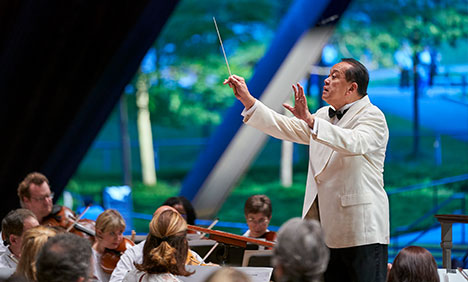
On Sunday at Blossom, conductor Jahja Ling (pictured) extends his 35-year relationship with The Cleveland Orchestra to 36 in an all-Brahms concert featuring violinist Sayaka Shoji, who has soloed with CityMusic Cleveland. Mike Telin had interesting conversations with both of them earlier this week — read the previews here (Ling) and here (Shoji).
And on Sunday at 7:30 pm, you can spend a night at the movies with Gerhardt Zimmerman and the Canton Symphony in Massilon’s Jackson Amphitheater.
For details of all events, visit our Concert Listings.
R.I.P. MICHAEL MORGAN, 63
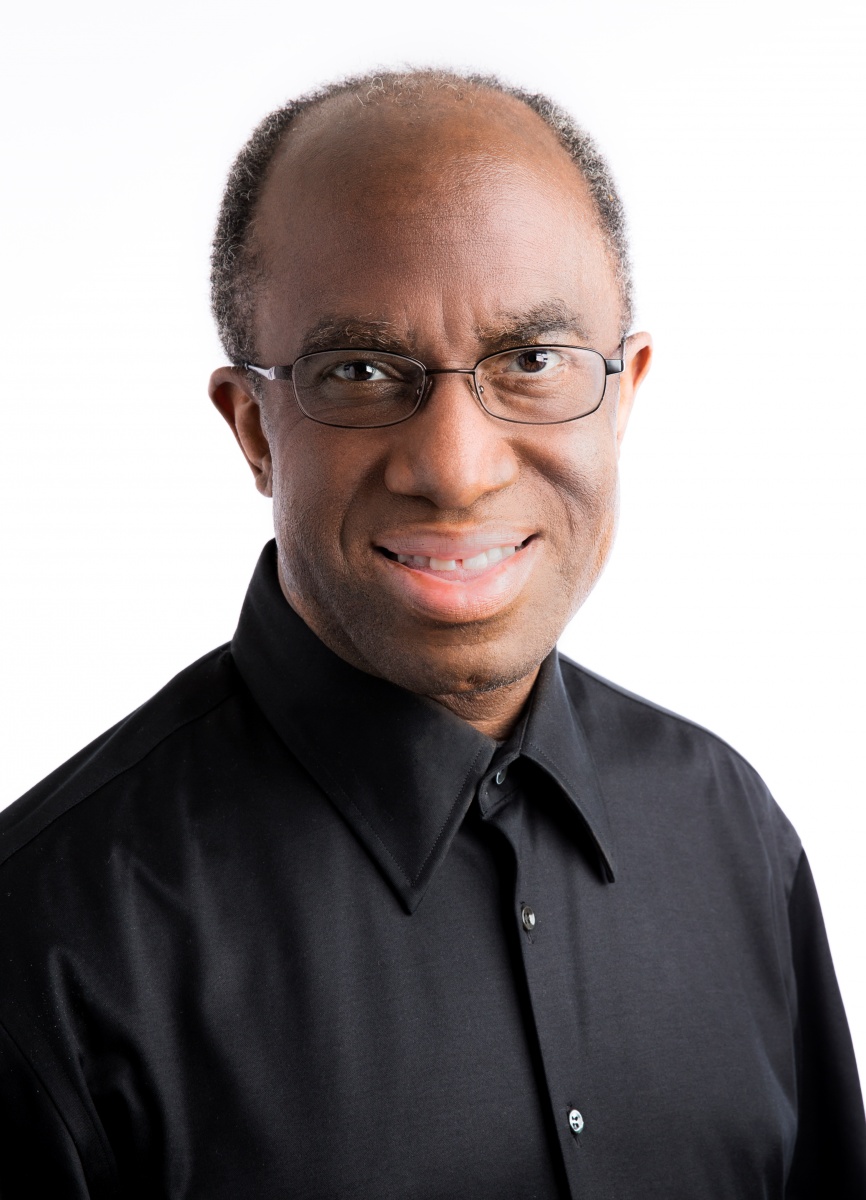 Oakland East Bay Symphony conductor Michael Morgan, who led the California ensemble beginning in 1991 and was an impassioned advocate for classical music, died at an Oakland hospital on August 20 from complications of a kidney transplant he received on May 30. Morgan studied composition at the Oberlin Conservatory but never took a degree. He worked with Seiji Ozawa and Leonard Bernstein at Tanglewood, and became apprentice conductor with the Buffalo Philharmonic in 1979, followed by posts as assistant to Leonard Slatkin in St. Louis in 1982, and to Sir George Solti in Chicago in 1986. Read an obituary by Tim Page in The Washington Post.
THIS WEEKEND’S ALMANAC:
This is a busy weekend in music history at both ends of the life cycle. First, the births:
On August 21, 1893, French composer Juliette Marie Olga Lili Boulanger was born in Paris, American soprano Queena Mario (née Queena Tillotson) made her first vocalizations in Akron in 1896, English mezzo-soprano Janet Baker debuted in 1933 in Hatfield, Yorkshire, and two celebrated choral conductors first saw the light of day — English-born Hugh Ross in Langport in 1898 and American Gregg Smith in Chicago in 1931 — a third, Walter Schumann, took leave of his profession in Minneapolis in 1958. Add to that list American composer Lansing D. McLoskey, who arrived more recently — in 1964 in Cupertino California.
Turning the calendar page to August 22, birthdays include French composer Achille-Claude Debussy in St. Germaine-en-Laye in 1862, English composer and longtime York Minster organist Edward Cuthbert Bairstow in Haddersfield in 1874, German avant-garde composer Karlheinz Stockhausen near Köln in 1928, and German tenor-turned-pop star Peter Hofmann in 1944 in Marienbad.
Let’s raise a glass to two of the more complex figures in this weekend’s honors list — those whose careers can’t be encapsulated in a phrase or two.
Like Queena Mario, a lyric soprano who sang with the Metropolitan Opera Company from 1922 to 1938 and passed to her reward in New York City in 1951 at the age of 54. As her obituary in the New York Times notes, she began her career in New York as a writer, penning columns for several daily newspapers, which earned her enough cash to take singing lessons. Despite two unsuccessful auditions at the Metropolitan Opera, after singing with the San Carlo company and San Francisco Opera, she made her debut at the Met on Thanksgiving Day, 1922 as Micaela in Carmen, later becoming famous for her portrayal of Gretel in the Humperdinck classic. On the side, while teaching at Curtis and Juilliard, she reintroduced herself as a writer with three murder mysteries, Murder at the Opera House, Murder Meets Mephisto, and Death Drops Delilah. Something about opera companies seems to inspire homicide…
Or like German tenor Peter Hofmann, who decided to take singing lessons while serving as a paratrooper, continued his studies at the Karlsruhe Conservatory, and cemented his identity as a Wagnerian tenor when he appeared as Siegfried in Wuppertal in 1974 and later in the same role at Bayreuth in 1976. The latter was also notable for reasons other than vocal prowess. As Barry Millington wrote in The Guardian,
Hofmann, bronzed, bare-chested and in tight trousers, singing opposite the equally attractive Jeannine Altmeyer in a white nightdress, brought a sexual electricity to the scene that was rare in those days. As one mildly shocked veteran observer noted at the time: “They couldn’t keep their hands off each other.”
. . .
Well-upholstered sopranos and tenors might continue to stalk the operatic stage, but with the filming of performances becoming increasingly popular, it was the likes of Hofmann and Altmeyer that were now in demand.
Like Thomas Quasthof, whom we referenced in yesterday’s Diary, Hofmann left the world of opera for pop music, also for vocal reasons, releasing such albums as Peter Hofmann Singt Elvis Presley (1992), and for musical theater, appearing for 300 performances in the title role of Phantom of the Opera.
Finally, this is a good time to get to know Lansing McLoskey, first through his faculty bio on the website of the Frost School of Music at the University of Miami. He prefaces it with two quotations:
Music is the only art form with equal power to move the mind, heart, soul, and pelvis. I have an insatiable and omnivorous appetite for music, and am as moved by Berio’s Sinfonia and DuFay’s Nuper rosarum flores as I am by a J.S. Bach cantata. In my lessons, I may reference Steve Reich, Machaut, William Schuman, Claude Vivier, Miles Davis, Radiohead, Jimi Hendrix, and The Ramones…in the same lesson.
Debussy perfectly encapsulated my feelings when he said “Music in its essence is not a thing that can be poured into a rigorous and traditional mold. It is made of colors and rhythmical beats. All the rest is fraud, invented by cold-blooded imbeciles riding on the masters’ backs.”
Here’s a sampling of his music: This Will Not Be Loud and Relentless (2017), performed and commissioned by Passepartout Duo (Nicoletta Favari, prepared piano & Christopher Salvito, percussion), #playlist (2018) for reed quintet (English horn, clarinet, alto sax, bassoon, bass clarinet), premiered by Splinter Reeds on April 13, 2019 at the Frost School of Music (the bassoonist is Oberlin’s Dana Jessen), and the first movement of his Zealot Canticles, performed by The Crossing, Donald Nally, conducting.
