


by Daniel Hathaway
 EVENTS THIS WEEKEND:
Visiting artists include cellist Seth Parker Woods (with the Oberlin Sinfonietta on Friday), Broadwas and jazz singer Aisha de Haas (with Cleveland Pops on Friday), conductor Klaus Mäkelä (with The Cleveland Orchestra on Saturday and Sunday, Mahler Symphony No. 5).
Local soloists and ensembles on Saturday feature organist Todd Wilson (Lake Erie College), the Akron Symphony’s Gospel Meets Symphony (pictured), and on Sunday, Cleveland Ballet and Inlet Dance Theatre (with The Cleveland Orchestra at Severance), Heights Chamber Orchestra (with trumpeter Ron Goldberg in Cleveland Hts.), and Steven Plank’s Cleveland Consort of Voices (at the Church of the Saviour).
And two organizations are raising a toast to Valentine’s Day: M.U.S.i.C. (Musical Upcoming Stars in the Classics) in Pepper Pike, and The Cleveland Opera (formerly Opera Circle, in Shaker Hts.)
See our Concert Listings for details.
ALMANAC FOR FEBRUARY 10-12:
by Jarrett Hoffman
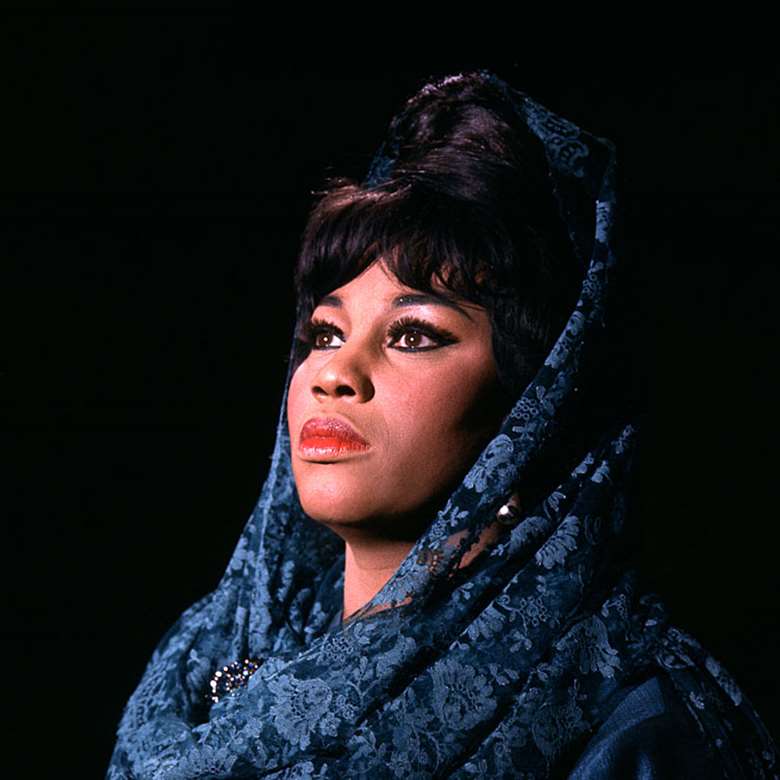 Leontyne Price — considered one of the greatest sopranos in history, and the first African-American vocalist to reach international acclaim in opera — turns 96 on February 10. She was born in 1927 in Laurel, MS.
There are many lenses through which to examine her career, including the racially motivated obstacles she overcame, which could constitute a whole article. But it’s also important to simply appreciate her artistry. In an article for NPR published on Price’s 90th birthday, Tom Huizenga wrote, “Over years of interviewing singers and critics, whenever Price’s name comes up, something special happens. The talk turns to that powerful, gleaming voice and the strength of her artistic convictions, even in the face of adversity.”
That article contains thoughts on Price from soprano Jessye Norman, baritone Sherrill Milnes, and critic Tim Page. Norman reflected on being in middle school, when she first heard Price sing through a record her brother brought home:
Hearing this voice — this vibrant, beautiful, soaring, amazing voice, on whatever that stereo equipment was at the time, was quite overwhelming. I used to sit — very often alone — just listening to the sound and wondering what she really looked like and what her friends were like and what it must it be like to carry such an instrument around in one’s own body.
One recording that stood out in Norman’s mind was of Price singing Il trovatore with frequent collaborator Herbert von Karajan at the Salzburg Festival (listen here).
…that is truly, truly, truly great singing. And because it is what it is, it is more than simple singing. It is much more than that. Whatever those words should be, I don’t have them this moment, but it’s far more than singing.
Listen to that recording, especially towards the end, to discover what a perfect description that is.
Norman concludes her thoughts thus:
I hope that at this point in her life, that she’s able to understand and appreciate the amazing artistic life that she shared with the world.
Happy 96th
by Mike Telin
 On February 11, 1847, Thomas Alva Edison, the inventor of the phonograph, was born in Milan, Ohio. Of course, Edison is responsible for inventing many things that make our lives more pleasant, including the incandescent light bulb, the motion picture camera, and the fluoroscope, as well as improving the telegraph and telephone. Click here for a list of his 1,093 patents.
Of all his inventions, Edison’s favorite was the phonograph, which came about from his work on the telegraph and the telephone when, in 1877, he discovered a way to record sound on tinfoil-coated cylinders. He set the invention aside for ten years, and when he returned to work on his phonograph, he began using wax cylinders.
And what were the first words Edison recorded on his new machine? Click here to listen to him recite “Mary had a little lamb” (recorded in 1927 for the 50th anniversary of his invention). Upon hearing his voice Edison said “I was never so taken aback in my life — I was always afraid of things that worked the first time.”
Edison believed the phonograph would eventually be used for letter writing and dictation, phonographic books for blind people, a family record — recording family members in their own voices — music boxes and toys, clocks that announce the time, and a connection with the telephone so communications could be recorded. Click here to visit the informative entries about Edison on the Library of Congress website.
Always striving to improve on things, Edison was once asked to give his opinion on the role that physics and mechanical instruments will play in the future. “A great deal — an enormous part,” the inventor responded. “The present instruments of the orchestra are very crude. Take the violin for instance. Don’t tell me that even the best violin cannot be improved. One of the worst things in all music is the E string on the violin.” Click here to read the interview titled New Aspects on the Art of Music.
So happy birthday Mr. Edison! Without you, nothing I’ve written about in this article would be possible.
I leave you with an inspiring quote by Thomas Edison. “Our greatest weakness lies in giving up. The most certain way to succeed is always to try just one more time.”
by Daniel Hathaway
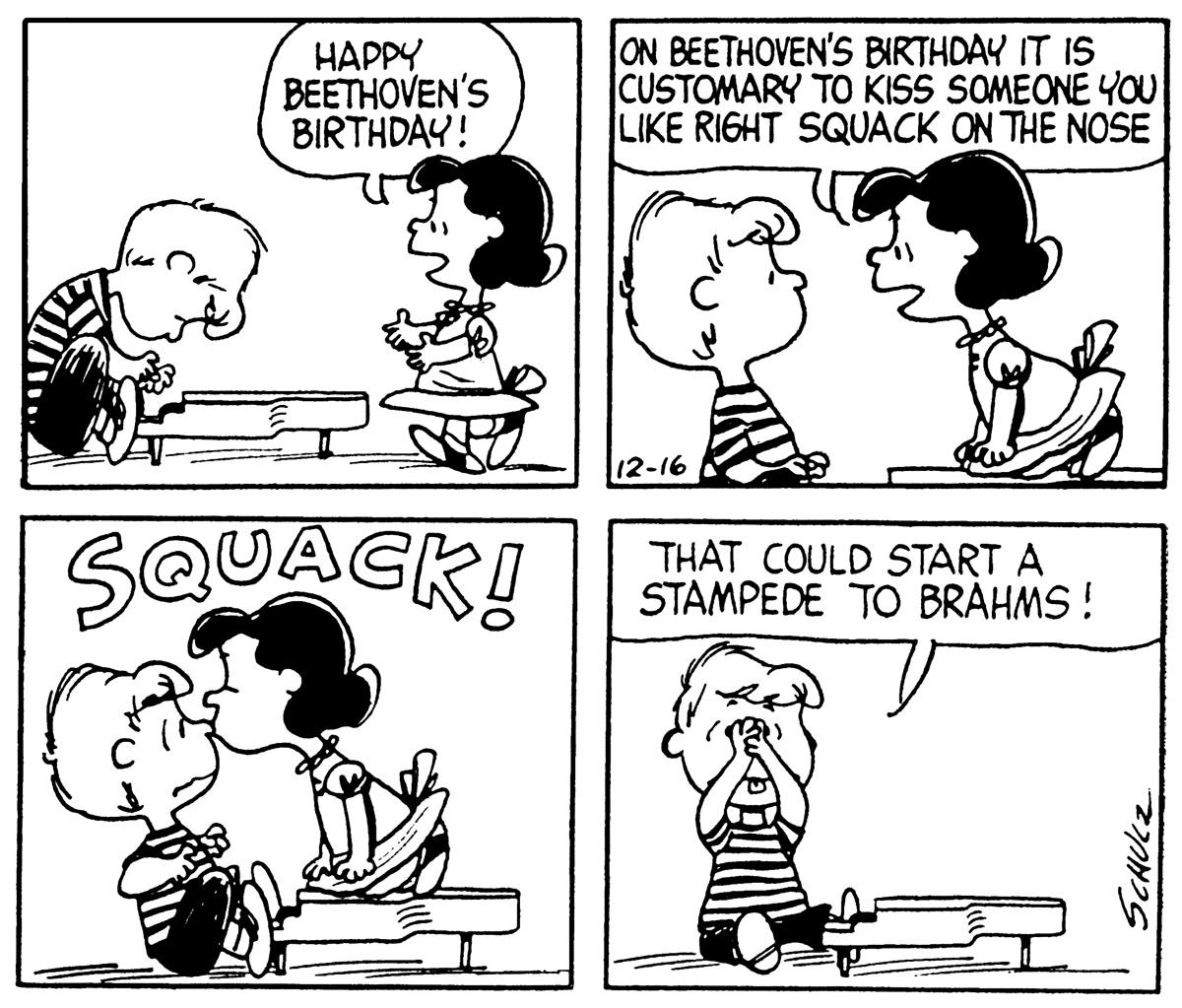 And on February 12, 2000, Charles Schulz’s last Peanuts comic strip was published only hours after the cartoonist’s death in Santa Rosa, California. Among his famous, precocious characters was the Beethoven-loving pianist Schroeder, who first appeared in May of 1950, but who didn’t get his piano until September of that year. (Brahms was actually Schulz’s favorite composer.) Click here to read the New York Times article Listening to Schroeder: ‘Peanuts’ Scholars Find Messages in Cartoon’s Scores.
