

by Daniel Hathaway
 In this entry:
Weekend events:
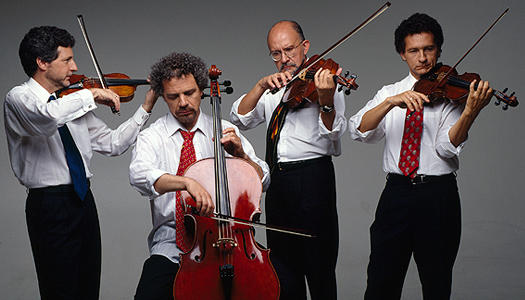
Catch these final performances: Mahler & Ravel at Severance with Stéphane Denève, soprano Fatma Said and The Cleveland Orchestra, The Wedding March and Sunrise from the Cleveland Silent Film Festival with the Mont Alto Motion Picture Orchestra, Handel’s Israel in Egypt from Apollo’s Fire, Six Micro Operas over two nights from BW and Cleveland Opera Theater, the re-emergence of Arts Renaissance Tremont with the Cavani Quartet and pianist Michelle Cann featuring music by Florence Price, plus Mexico City’s Cuarteto Latinoamericano (pictured) in Youngstown, the Cleveland Orchestra Youth Orchestra with trumpeter Dasara Beta, Heights Chamber Orchestra, and jazz at the Fine Arts Association in Willoughby. Details in our Concert Listings.
Interesting Reads:
Critic Mark Swed considers the career of timpanist, percussionist and composer William Kraft, who died last week at the age of 98.
“For Kraft, percussion instruments produced the kinds of sounds that color our existence, while the emphasis on rhythm could illuminate interpersonal musical interactions. In his role as timpanist in the L.A. Phil, he provided the heartbeat of the orchestra, and in his politically themed works, he expanded that notion to having percussion signify the heartbeat of a just society.” Read the article here.
Musical conspiracy theories, anyone? Van Magazine’s Hugh Morris explores the notion that listening to music pitched at 432 Hz. rather than the industry standard of 440 Hz. (or the common early music standard of 415 Hz.) makes everything better.
“Its lore has all the hallmarks of your archetypal conspiracy theories. No one version dominates, but most accounts include a selection of the following tropes: Tuning to A=440 Hz is: evil, a lie, something that was promoted by the Nazis to brainwash the masses, not in tune with the rhythm of the universe, capable of unleashing inner turmoil, and coordinated by a nefarious cabal of businessmen.
“Tuning to A=432 Hz is: beautiful, spiritual, peaceful, historically legitimate, full of healing powers, capable of aligning the chakras, and what Verdi would have wanted.” Read The Pitch of Living here.
This Weekend’s Almanac:
Musical luminaries born on February 19 include composer, conductor, and writer Arthur Shepherd (in 1880 in Paris, Idaho), American oboist and composer Alvin Etler (in 1913 in Battle Creek, Michigan), and composer Gyorgy Kurtag (in 1926 in Lugo, Romania). And on that date, British composer Sir Hamilton Harty wrote finis (in 1941 in Brighton, England.
On February 19, Austrian pianist and composer Carl Czerny greeted the light of day in Vienna in 1791, while Australian composer and pianist Percy Grainger and Japanese composer Toru Takemitsu took their leave of this world in 1961 and 1996 in White Plains, New York and Minato, a ward of metropolitan Tokyo, respectively.)
As a conductor, Harty was associated with the Hallé Orchestra in Manchester from 1920 to 1933, and noted for his interpretations of the music of Berlioz. Many orchestra musicians grew up playing his Handel editions, and George Szell based his version of the Water Music suites on Harty’s model. Here’s an historic recording of the Elgar Cello Concerto featuring William Henry Squire and the Hallé from 1930, reproduced on an EMG Model Xb “Oversize” gramophone.
Czerny was a star pupil of Beethoven and a prolific composer in his own right who in turn taught Franz Liszt. For a taste of his own works, here’s a recording by the Ulster Orchestra led by Jurjen Hemple of his Symphony No. 1.
Grainger joined a group of musicians in a lifelong quest to rescue British and Scandinavian music from central European influences, largely through the use of folk music, though he also dabbled in mechanical music-making (including recording piano rolls of his compositions and arrangements.) A documentary, “The Noble Savage: Percy Grainger revealed,” gives an extensive look at his career and legacy. Watch it here.
Arthur Shepherd gets the most attention today because of his prominence in Cleveland’s musical community for three decades. Born into a Mormon family, he graduated from the New England Conservatory in 1897 and moved to Utah to reorganize and conduct the Salt Lake Symphony.
After returning to teach at NEC and serving in World War I, Shepherd was hired by Nikolai Sokoloff as his assistant conductor and program annotator in 1920. Though he moved across the street in 1927 to lecture in music at Case, he held on to his program annotating job until 1930, while also serving as music critic for The Cleveland Press. He became chair when music gained departmental status at Case in 1928, “inaugurating a 20-year program of experimental opera,” according to the Encyclopedia of Cleveland History,
Listen to Shepherd’s Symphony No. 1, “Horizons” here in a recording by the Cleveland Orchestra under Louis Lane made from a radio broadcast, and here to a playlist of selected chamber works by Shepherd featuring pianist Grant Johanssen and The Abramyan String Quartet.
