



by Daniel Hathaway
WEEKEND HIGHLIGHTS:
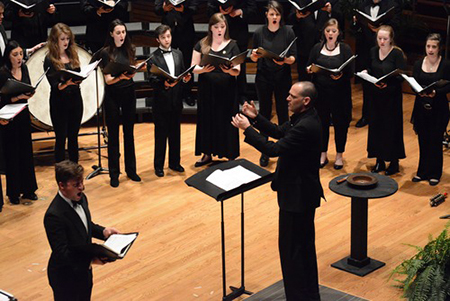 April brings showers and the annual Baldwin Wallace Bach Festival in Berea. Music director Dirk Garner leads the three major festival concerts, beginning on Friday with a “Concerto Countdown” of Johann Sebastian Bach’s concerti for four, three, and two harpsichords. On Saturday at 2, he conducts BWV: Cleveland’s Bach Choir in Arvo Pärt’s Berliner Mass and Magnificat, and the Festival culminates on Saturday with the Bach Festival Orchestra, and BW Motet Choir performing J.S. Bach’s Mass in g & Magnificat. Evening concerts are at 7 in Gamble Auditorium, the afternoon performance in Lindsay-Crossman Chapel.
There are four concerts to highlight on Sunday. At 3:30 pm The Cleveland Women’s Orchestra plays its 91st Anniversary Concert under Eric Benjamin at Severance Music Center with pianist Angelin Chang. At 4 pm – Linking Legacies, a collective of African-American classical musicians, raises awareness of local African-American composers with historical significance in First Church of Christ, Scientist in Rocky River.
On Sunday at 4, Sounds of St. James offers an afternoon of Sacred Music performed by the Case Western Reserve University Early Music Singers, Elena Bailey, director, the Aeterna Chamber Choir, James Flood, director, and guests in St. James Church in Lakewood.
And at 4:30, Steven Smith and the Cleveland Chamber Symphony collaborate with Cleveland Contemporary Ballet for the world premiere of Margaret Brouwer’s City Life and her Mandala, & Inner Voices at Disciples Church in Cleveland Heights.
ANNOUNCEMENTS:
Piano Cleveland has named the thirteen young artists who will be invited to Cleveland in July for the Semi-Final Round of the Cleveland International Piano Competition for Young Artists: three contestants from the Rising Star Division (ages 10-12) and five pianists from each of the Junior (ages 13-15) and Senior (ages 16-18) Divisions. All Semi-Finalists will have the unique opportunity to perform solo recitals and collaborate with professional chamber musicians.
Six finalists — three from the Junior Division and three from the Senior Division — will participate in a one-of-a-kind Masterclass with Jean-Yves Thibaudet, as well as perform concerto movements with The Canton Symphony Orchestra.
The Semi-Final and Final Rounds will take place from July 24 – August 1, 2026.
WEEKEND ALMANAC:
 Today, let’s visit the career of composer and music critic Herbert Elwell, who passed away in Cleveland on April 17, 1974 at the age of 75.
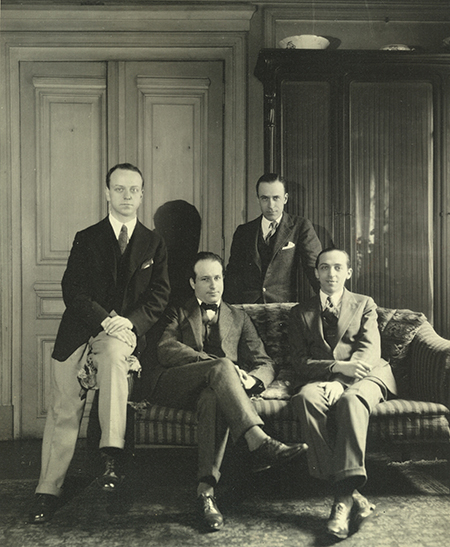
Born in Minneapolis, after studies with Ernest Bloch, Elwell was among the first American students of Nadia Boulanger in France along with Aaron Copland, Walter Piston, and Virgil Thomson (pictured chez Boulanger, L-R: Thomson, Piston, Elwell, Copland). He joined the composition and theory faculty at the Cleveland Institute of Music from 1928-1945, then taught at the Oberlin Conservatory for nine years.
Among the conductors who championed Elwell’s orchestral compositions were Rodzinsky, Stokowski, Steinberg, and Hanson, and he was awarded the first Cleveland Arts Prize for Music in 1961.
Elwell served as music critic for the Cleveland Plain Dealer from 1932-1964, and participated in the University of Southern California’s Project for the Training of Music Critics, a program that brought dance and music critic Wilma Salisbury to The Plain Dealer. Salisbury wrote Elwell’s bio for the Arts Prize, which is full of pithy Salisburyisms.
During the reign of George Szell, Elwell did not hesitate to take the imperious music director to task. In one review, he described Szell’s Germanic interpretation of Debussy’s La Mer as Das Mer.
One of Elwell’s earliest pieces, Quintet for Piano and Strings (1924), won more praise in Paris than George Gershwin’s Rhapsody in Blue, which premiered on the same concert.
One of the most enduring images of Elwell was penned in 1964 by a Plain Dealer editorial writer, who characterized him as “raconteur, linguist, teacher, and, although Minneapolis-born, possessor of a certain Old World charm that gives a vague impression that he is carrying a walking stick and wearing an Inverness cape. Herb Elwell . . . a man apart.”
Click here to listen to what is said to be one of Elwell’s most popular scores, the suite from his ballet The Happy Hypocrite (1925) as performed by the Cleveland Pops Orchestra conducted by Louis Lane “from a long out-of-print LP released in 1961 and never transferred to CD. At the time of this recording, the Cleveland Pops Orchestra was essentially the same as the Cleveland Orchestra.”
