



by Daniel Hathaway
WEEKEND HIGHLIGHTS:
 FRIDAY
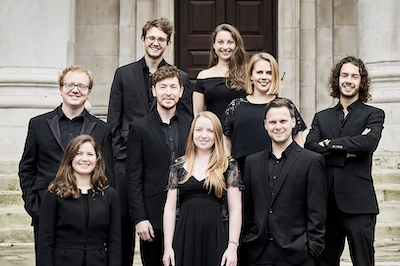
No Exit Presents pianist Jenny Lin & electronic artist Draka Andersen performing a new score to the 1984 restoration of Fritz Lang’s movie Metropolis (7 pm at Heights Arts) • the Helen D. Schubert Concert Series presents Siglo de Oro (pictured), the adventurous, London based early music vocal ensemble (7:30 at Cathedral of St. John the Evangelist).
SATURDAY
M.U.S.i.C Stars in the Classics features love songs, dances and Romantic music (7:30, Church of the Western Reserve) • Wit’s Folly plays Serenades for Flute and Strings (7 pm at Praxis Fiber Workshop, repeated Sunday at 4 at St. Noel, Willoughby Hills) • The Cleveland Orchestra plays an American music program including Samuel Barber’s Knoxville: Summer of 1915 conducted by Barbara Hannigan, with Johanna Wallroth, soprano (7;30 at Severance Music Center, repeated Sunday at 3).
SUNDAY
Tri-C Classical Piano Series hosts the Genova and Dimitrov Piano Duo (2 pm in Tri-C Metropolitan Campus Auditorium) • Heights Chamber Orchestra presents Travis Jürgens, conductor, and Kira McGirr, mezzo-soprano, program to include Stravinsky’s Octet & Libby Larsen’s Raspberry Island Dreaming (3:30 at St. Ann Church) • The Cleveland Opera & Cleveland Women’s Orchestra presents Triumphs and Tribulations of Love, Eric Benjamin, conducting, with Dorota Sobieska, soprano, and Andrzej Stec, tenor (4 pm at First Baptist, Shaker Heights) • Keith Fitch conducts the CIM New Music Ensemble with Andrew Rindfleisch, guest composer (4 pm in Kulas Hall) • and Arts at Holy Trinity features organist Rees Taylor Roberts, organ, in a program including works by the late Stephen Griebling (4 pm at Holy Trinity Lutheran, Akron).
For details of these and other classical music concerts, visit our Concert Listings.
TODAY’S HEADLINES:
Why classical music should stop trying to be pop (The Guardian)
Leonard Slatkin named music director in Nashville for the third time (Nashville Scene)
WEEKEND ALMANAC:
February 13 marked the baptism of Spanish composer Fernando Sor in Barcelona in 1778, the final curtain call of German composer Richard Wagner in Bayreuth in 1883, and the birth of American composer George Kleinsinger in 1914.
Sor is well-known to classical guitarists, who have probably improved their playing technique through the composer’s pedagogical works. Watch Jason Vieaux giving a lesson here on Sor’s Etude No. 6 in D, which requires “a spidery left hand.” And listen to Judicaël Perroy, who teaches at the San Francisco Conservatory and has performed in Northeast Ohio, play Sor’s Fantaisie élégiaque, Op. 59.
Wagner’s music is so ubiquitous that it hardly needs an introduction, and probably the less you know about the composer’s personal life, the better. Fans of Wagner’s Ring Cycle of operas who would prefer hearing the music without singers have former Cleveland Orchestra music director Lorin Maazel to thank for assembling The Ring Without Words. Reviewing Maazel’s Telarc recording with the Berlin Philharmonic, a Gramophone critic wrote, “…audiophiles who like blazingly spectacular sound and plenty of adrenalin flowing in the music-making, should find this worth trying. Certainly the heavy brass sounds are very tangible.” Listen here.
And George Kleinsinger, born on this date in 1914 in California, was responsible for writing an unforgettable tune for the children’s classic Tubby the Tuba. Paul Tripp wrote the story in 1942 while serving in the Army, and Kleinsinger supplied Tubby’s luminous melody for a recording in 1946 that sold eight million copies. Read the story behind the story in a Library of Congress publication, and watch a performance by Arthur Fiedler and the Boston Pops narrated by Julia Child here.
