

by Daniel Hathaway
WEEKEND HIGHLIGHTS:
 Just back from heading up the jury for the Chopin Competition in Warsaw, pianist Garrick Ohlsson turns his formidable interpretive powers to the music of Wolfgang Amadé Mozart in performances of the Viennese genius’s Concerto No. 23 with Franz Welser-Möst and The Cleveland Orchestra. The concerts on Saturday at 7:30 and Sunday at 3 in Mandel Concert Hall at Severance Music Center will also include Tyler Taylor’s Permissions, and Robert Schumann’s Symphony No. 3, “Rhenish.” Tickets are available online.
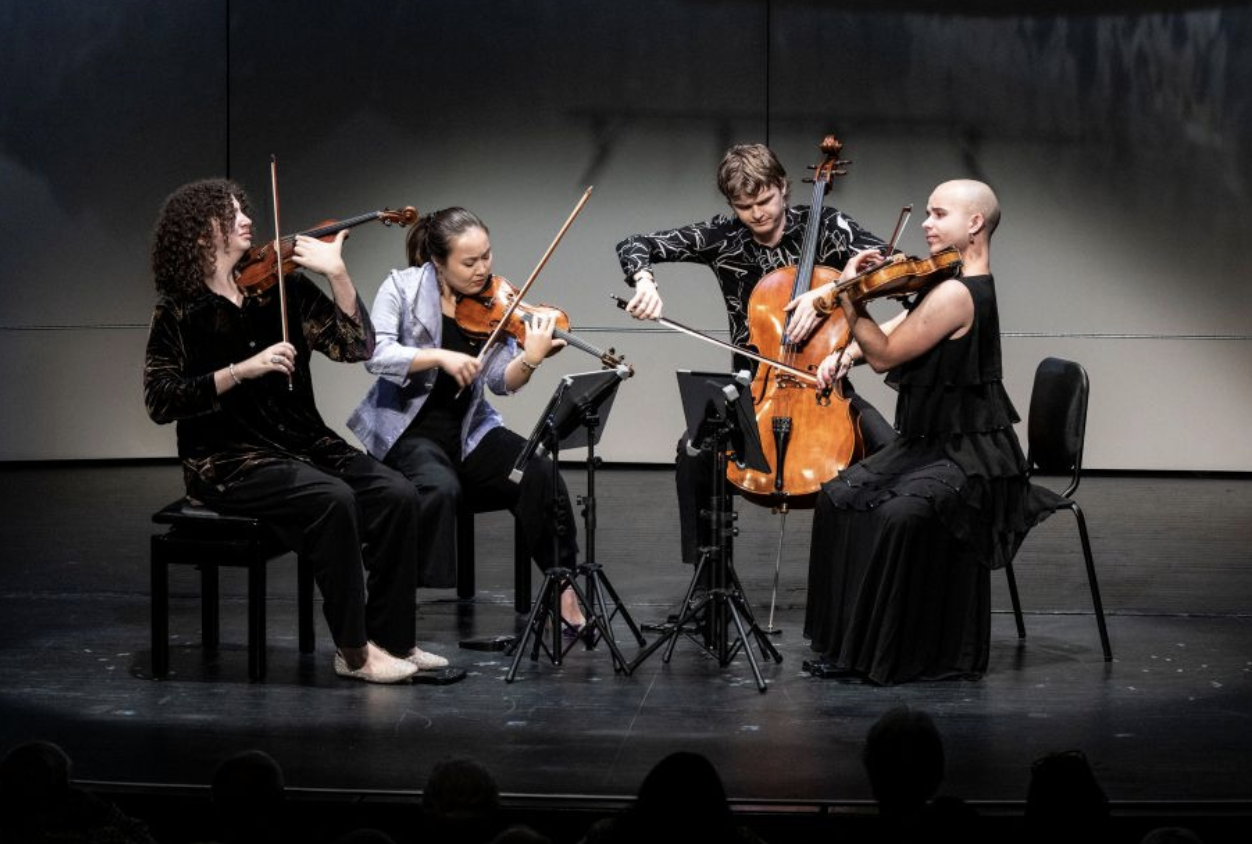
The Poesis Quartet (pictured) — violinists Sarah Ma and Max Ball, violist Jasper de Boor, and cellist Drew Dansby — return to their ensemble’s birthplace at the Oberlin Conservatory this week for coachings and a performance of John Adams’ Absolute Jest with Raphael Jiménez and the Oberlin Orchestra on Friday at 7:30 in Finney Chapel. Jiménez has more contemporary music planned for this program, including Carlos Simon’s Fate Now Conquers, Angelica Negrón’s Campos Flotantes, and Zhou Tian’s Transcend. It’s free, and will also be live streamed.
On Saturday at 4, the Fryderyk Chopin Institute of Ohio will present soprano Małgorzata Trojanowska with pianists Jiana Peng and Konrad Binienda in Songs of Poland, including selections from Fryderyk Chopin’s Polish Songs, Op. 74, Karol Szymanowski’s Kurpian Songs, Op. 58, and Jan Ignacy Paderewski’s Four Mélodies, Op. 7, in Harkness Chapel, 11200 Bellflower Road, Cleveland. Tickets are available online.
And on Sunday at 4, Canadian-born concert organist Ken Cowan, who is professor of organ at the Shepherd School of Music at Rice University in Houston, will play a recital dedicating the newly-restored 1924 Votteler-Holtkamp-Sparling pipe organ in St. John Cantius Church, 906 College Ave., in Cleveland. Free admission. Click here to watch Cowan demonstrate the great organ of the Cathedral of St. John the Divine in New York.
For details of these and other classical events, visit the ClevelandClassical.com Concert Listings.
HONORED:
 Oberlin’s Campus Digest reports that Professor of Conducting Tim Weiss has won the 2025 Ditson Conductor’s Award, “the oldest continuing honor recognizing distinguished contributions to American music. Established by Columbia University in 1945, the Ditson has been presented to luminaries including Leonard Bernstein, Marin Alsop, John Adams, Christoph von Dohnányi, and Robert Spano ’84.”
Composer and longtime Weiss collaborator Augusta Read Thomas will present the award on Saturday during the Contemporary Music Ensemble’s performance in Warner Concert Hall.
WEEKEND ALMANAC:
It’s time for the annual celebration of Hallowe’en, and probably also time to put that apostrophe back in its name, which is a contraction of “All Hallows Eve,” or the day before the Christian feast of All Saints’ Day. So on Friday there will be “ghoulies and ghosties, and long-leggedy beasties, and things that go bump in the night” out and about, and on Saturday, holy people to remember.
A variety of scary mix tapes is available, but Dark Classical, one of the better collections to listen to on Hallowe’en, will give you an hour and 45 minutes worth of thrills and chills while you’re waiting to pass out sugary treats.
Everyone has their own favorite hair-raising music, and comments on the aforementioned collection have lamented the omission of Mussorgsky’s Night on Bald Mountain, and proposed adding Schnittke’s Requiem, and the “Dance of the Knights” from Prokofiev’s Romeo and Juliet.
My own recommendation for generating goose bumps is “Satan’s Dance” from Ralph Vaughan William’s Job: A Masque for Dancing, based on drawings by William Blake (above, Satan smiting Job with boils). The composer dedicated his 1930 work to conductor Sir Adrian Boult, who leads it here with the London Philharmonic at the age of 83. (Satan enters around 4:12).
On the All Saints’ Day side of the weekend, you could hardly do better than listen to the third movement of Heinrich Schütz’s Musikalische Exequien, a setting of the Song of Simeon (Nunc Dimittis) overlaid by a trio of soloists singing “Blessed are the dead that die in the Lord, for they rest from their labors.” Follow the score in this performance by Philippe Herreweghe and La Chapelle Royale. Incidentally, Schütz died on October 31 in 1672.
On this weekend in 1517, the German Augustinian monk and university professor Martin Luther nailed his 95 Theses to the door of the Castle Church in Wittenberg, an act that many regard as the beginning of the Protestant Reformation. Luther, a complicated figure who composed his own music and set vernacular hymn texts to secular tunes, has inspired many documentaries. Here’s one by PBS travel guru Rick Steves, himself a Lutheran of Norwegian extraction.
That leads us to the later German organist, composer, and choral conductor Hugo, who died at his own hand in Berlin on November 1, 1942. Though he suffered depression over the fate of his colleagues during the Third Reich, as Nick Strimple writes in Choral Music in the Twentieth Century, “it appears that he saw the futility of attempting to serve both God and Nazis, and came to terms with his own conscience unequivocally.”
Distler wrote a great deal of neo-Baroque music for organ and choirs. A work particularly suitable for this Hallowe’en/All Saints’ weekend is Distler’s Totentanz, a 14-movement choral cycle based on poetry by Angelus Silesius. Between the movements, Distler interleaved a friend’s paraphrases of poetry from the Lübecker Totentanz, “a dialogue in Middle Low German between Death and its victims.” The Netherlands Chamber Choir performs the 1934 piece here.
