


 by Daniel Hathaway
PERFORMING THIS WEEKEND:
FRIDAY: The Baldwin Wallace Symphony Orchestra plays Tchaikovsky & a premiere by faculty composer Carolyn Borcherding | The Cleveland Orchestra opens its season with Franz Welser-Möst (pictured) on the podium for the U.S. Premiere of Bernd Richard Deutsch’s Urworte, Richard Strauss’ “Dance of the Seven Veils” from Salome, and Maurice Ravel’s Boléro | Timothy Weiss conducts the Oberlin Sinfonietta with faculty clarinetist Richard Hawkins, in Michel van der Aa’s Hysteresis, Dorothy Chang’s Three Windows, Sofia Gubaidulina’s Concordanza, and a new work by Aaron Nichols | and CUSP hosts Matthew Ryals and the piano, harp, and electronics trio of Grace Harper, Stephan Haluska, and Boris Oicherman at Gallery 33.
SATURDAY: M.U.S.I.C. Stars in the Classics hosts a Classical Cabaret at Praxis Gallery | The Cleveland Orchestra repeats Friday’s program | Cleveland Jazz Orchestra presents “Totally Trumpet with Terell Stafford at the Maltz | and Cleveland Silent Film Festival screens F.W. Murnau’s Faust (1926) with a live heavy metal score by The Silent Light at the CIA’s Cinematheque.
SUNDAY: The Cleveland Orchestra repeats its weekend program | Music at Bath presents The Zerbo Brothers performing on West African Instruments | And Music from the Western Reserve hosts pianist Theron Brown at Christ Church, Hudson.
WEEKEND ALMANAC:
Two American musical scholars and a pair of contemporary composers share birthdates on September 28, and a British musical humorist bade adieu to the world of classical music, leaving it a bit less serious about itself than before.
Donald J. Grout, born in 1902 in Rock Rapids, Iowa, and H. Wiley Hitchcock, who wrote the first entry in his own bio in 1923 in Detroit, left indelible marks on classical music as author and editor, respectively, of A History of Western Music (known to generations of students simply as “Grout”), and The New Grove Dictionary of American Music.
American composer Vivian Fine came onto the scene in 1913 in Chicago, and Chinese-American composer Huang Ruo followed in 1976 on Hainan Island off the southern coast of China.
Fine was a protege of Ruth Crawford, who introduced the young composer to Henry Cowell and his circle. She later became a member of Aaron Copland’s Young Composers Group, and helped found the American Composers Alliance. She became one of New York’s go-to performers of contemporary piano music in the 1930s. Fine later joined the faculty of Bennington College in Vermont, where she died at the age of 86 from injuries sustained in a motor accident.
As a composer, Vivian Fine seemingly brought a unique style to each of her works, many of which conveyed a sense of humor and fun. For just two examples, click here to hear her Missa Brevis per quattro violoncelli e voce registrata (1972) performed by mezzo-soprano Jan DeGaetani with cellists Eric Barlett, David Finckel, Michael Finckel and Maxine Neuman, and here to listen to her Songs and Arias (1992), performed by the Luna Nova Ensemble (Robert Patterson, horn, Gregory Maytan, violin, and Craig Hultgren, cello).
After entering the Shanghai Conservatory at the age of 12, Huang Ruo studied at the Oberlin Conservatory and at Juilliard. He was one of the original founders of the International Contemporary Ensemble (ICE).
Click here to watch violinist Jennifer Koh play his A Dust in Time (Passacaglia for Solo Violin), and here to watch Wu Wei and Friederike Richter perform his Wind Blows in a version for sheng and piano. There’s also a version for oboe and orchestra, performed here by García-Cano with Muhai Tang and the Beijing Symphony.
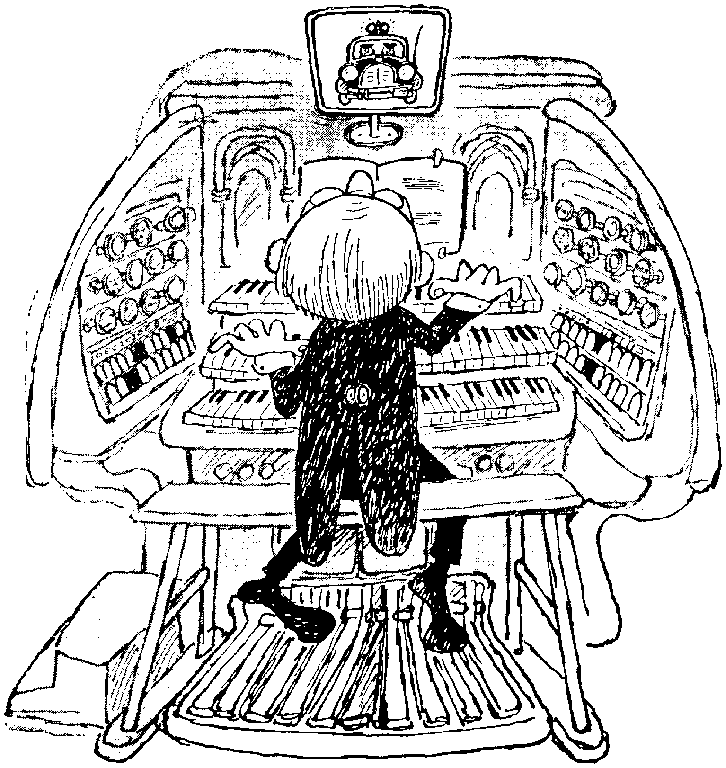 Doubling back on the notion of “music that conveys a sense of humor and fun,” we can mark the finale of English humorist, musician (he played tuba), and cartoonist Gerard Hoffnung (self-parodied left) in London on this date in 1959. Who can forget the several iterations of the Hoffnung Festival — evenings of musical parody — at the Royal Festival Hall in the 1950s? Click here to visit Hoffnung: A Last Encore, a 1973 double album of excerpts of Hoffnung’s humorous speeches and interviews. “This album brings together all of the BBC Archive material in existence, much less, alas, than one would have wished due to Gerard Hoffnung’s untimely death at the age of 34 in 1959.” And click here to watch how excerpts from the Hoffnung Festivals translate to an audience in Prague (or do they?)
