

by Daniel Hathaway
 EVENTS THIS WEEKEND:
The calendar is loaded, and if you can make it to all of these performances, you possess special powers of teleportation (and we’d like to talk to you…).
On Saturday, Oberlin Jazz Ensemble plays Finney Chapel at 7:30 pm, the Akron Symphony begins its season with music by Dvořák, Perry, Ellington, Price, and Beethoven at 8 in E.J. Thomas Hall, and at the same hour, the next concert in Apollo’s Fire’s Violin Fantasy set takes the Baroque Orchestra to St. Paul’s in Cleveland Heights, while The Cleveland Orchestra repeats its Messiaen, Ravel, and Mussorgsky program under Thierry Fischer with Tom Borrow at the Steinway, and Oberlin Opera gives the third of four performances of Handel’s Acis & Galatea in Hall Auditorium (you’ll love what Johnathan Field has done with the Cyclops!)
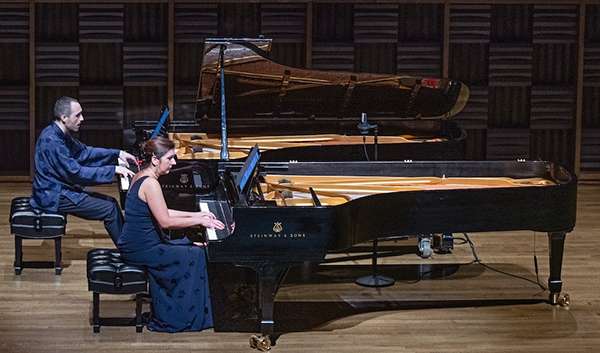
Sunday’s agenda continues the runs of programs by Apollo’s Fire, The Cleveland Orchestra, and Oberlin Opera, and adds Christa Rakich’s Organ Rededication (2 pm at West Shore Unitarian Universalist), a Cleveland Winds concert (3 pm at CSU), the Cleveland Women’s Orchestra (3 pm at the Maltz, PAC), classical guitarist René Izquierdo (3 pm at the Butler Institute in Youngstown), Prism Percussion (4 pm at Holy Trinity Lutheran in Akron), and duo-pianists Antonio Pompa-Baldi & Emanuela Friscioni (pictured, 5 pm on the Music From the Western Reserve series at Christ Church, Hudson).
That busy day continues into Sunday evening with Local 4 Music Fund’s Nine Lives Project (7 pm at Tri-C Metro Auditorium), as well as with the 7 pm premiere of Quinn Mason’s Irish Dance Suite by Gerhardt Zimmerman and the Canton Symphony.
Details in our Concert Listings.
NEWS BRIEFS:
On November 10, Cuyahoga Arts and Culture announced the awarding of grants totalling $11,613,452 to 249 Cuyahoga County nonprofit organizations in 2022 through its General Operating Support, including for the first time Cleveland Ballet, Cleveland Classical Guitar Society, Collective Arts Network and Doan Brook Watershed Partnership. Read more here.
Project Support grants ranging from $800 to $18.333 went to 169 organizations for a total of $1,198,438.
CAC’s new Cultural Heritage grant program provides flexible funding for organizations that primarily represent culturally-specific populations. Eleven such organizations will share $215,014 during this funding cycle.
INTERESTING READS:
More than a few sparks were flying back and forth between music critics and presenters this week on the subject of diversity in programming. The New York Times ran a response by artistic directors Wu Han and David Finckel to Javier C. Hernández’ assessment of the Chamber Music from Lincoln Center season, and Bay Area critic Joshua Kosman followed up with an interview with the pianist and cellist in the San Francisco Chronicle. Read Wu Han and Finckel here, and Kosman here.
THIS WEEKEND’S ALMANAC:
Italian opera composer Gioachino Rossini wrote his last act in Paris on November 13, 1868, having retired early after composing 34 operas between 1810 and 1823. He spent much of the next 40 years dining off his fame — and judging from his increasing corpulence, off such creations as Tournedos Rossini. One of his few late career works is the Petite messe solennelle for choir, piano and harmonium — neither small nor solemn, despite the title. Click here to watch a performance by the Czech Philharmonic Choir led by Paolo Gatto and featuring soprano Patricia Janečková.
And on November 13 (or was it the 14th?), 1943, NY Philharmonic assistant conductor Leonard Bernstein got his big break when guest conductor Bruno Walter fell ill and Bernstein filled in on a few hours notice.
In 1989, Bernstein recalled his debut:
“When it came to the time — that very day — all I can remember is standing there in the wings shaking and being so scared. There was no rehearsal. I had just come from seeing Bruno Walter, who very sweetly and very quickly — wrapped up in blankets because he had the flu — went over the score of Don Quixote with me. He showed me a few tricky spots where he cut off here but didn’t cut off there; here you give it an extra upbeat, and so on…. The time seemed to hang heavy till 3:00 p.m., even though I had to go over some of the tricky spots in Don Quixote with the cello and viola soloists and the concertmaster. The thing that was obsessing me, possessing me, was the opening of the Schumann overture, which is very tricky because it starts with a rest — the downbeat is a rest. If they don’t come in together, the whole concert is sunk. I mean, I can’t once go ‘bop, bop, bop,’ and make sure they can do it. So, this was like a nightmare. I had to go on and do, untried, this thing of such difficulty. You know, I’ve heard other people come to grief in that opening bar. Then I finally went and talked with the guys and they said, ‘Good luck.’ [Philharmonic manager] Bruno Zirato said, ‘Hey, Lenny. Good luck, baby.’ Oh, he was very fatherly and gave me big bear hugs. And that was about it.”
On November 14, 1905, violist da gamba and conductor August Wenziger was born in Switzerland. As one of the first specialists on the gamba, he taught at the Schola Cantorum Basiliensis, and was tapped to lead the new Oberlin Baroque Performance Institute for its first eighteen summer seasons.
BPI co-founder Catharina Meints Caldwell recalls those 18 years in detail in her memoir, subtitled The Wenzinger Years.
Click here to listen to an early recording of Telemann’s Wassermusik on the Deutsche Grammophon Archiv label, when the secrets of the Baroque oboe were still being discovered.
