

by Daniel Hathaway
 EVENTS THIS WEEKEND:
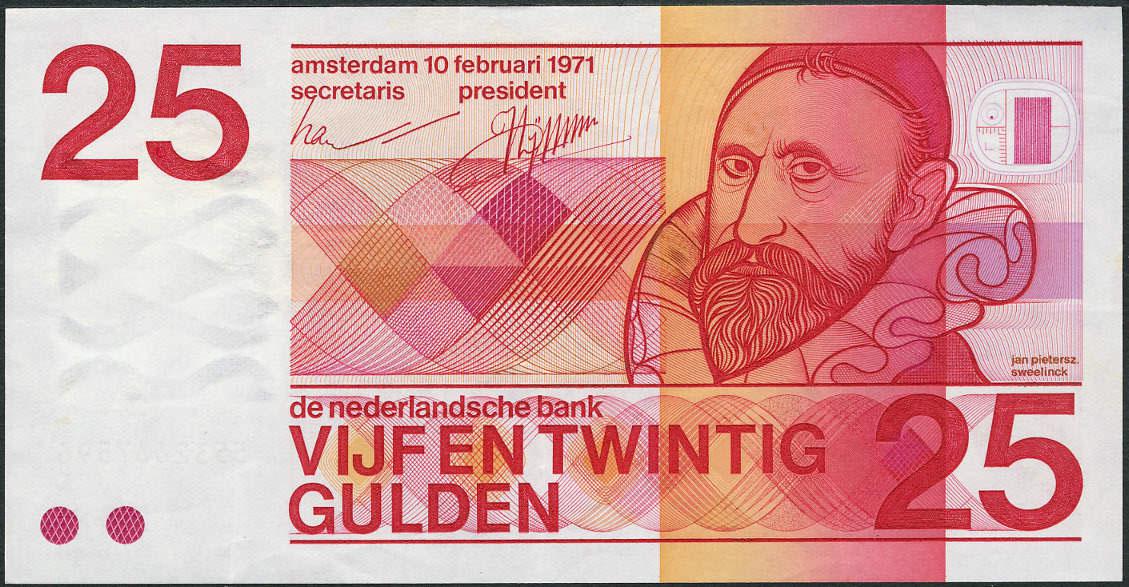
Saturday is the 400th anniversary of the death of Dutch composer and organist Jan Pieterzoon Sweelinck (read more in the Almanac below), an occasion to be marked by a 4:30 pm Oberlin historical keyboard faculty and guest recital in Fairchild Chapel. The recital is part of the 40th anniversary celebrations of the John Brombaugh meantone organ. See the detailed program and connect to a live stream here. (The Dutch government has honored the composer on a 25 guilder banknote, above.)
Also happening on Saturday: Carousel with the Chagrin Valley Studio Orchestra (repeated on Sunday), and the first of two Cleveland Philharmonic concerts in Westlake (the second is on Sunday at Cleveland State University).
Sunday is busy. Franz Welser-Möst leads The Cleveland Orchestra with cellist Alisa Weilerstein performing a Joan Tower concerto, and Joela Jones, the Orchestra’s keyboard principal playing her last concert before retiring. Harmonia features East European folk music at the Maltz PAC. The Parma and Suburban Symphonies play fall concerts in Parma Heights and Beachwood. And Dallas Symphony organist Scott Dettra solos with the Youngstown Symphony at Stambaugh Auditorium.
Details in our Concert Listings.
NEWS BRIEFS:
Expanding on its earlier article about travel visa problems experienced by the Danish Quartet, today’s New York Times print edition chronicled recent cancellations by conductor Thomas Dausgaard, pianist Leif Ove Andsnes, Russian singers in the Met Opera’s Boris Godunov, and the Academy of St. Martin in the Fields (a 10-city tour), as well as some cliff-hanger situations involving such artists as Lang Lang.
“Even in normal times, it can be difficult for visiting artists to obtain the visas they need to perform in the United States. Now they face even longer lines and staff shortages at American embassies and consulates around the world. The earliest available appointments for visa interviews in some cities are for next spring, months after some artists have scheduled performances.” Read the article here.
Another Times article that appears in print today follows up on the recent controversy involving University of Michigan distinguished composition professor Bright Sheng. Read Jennifer Schleussler’s A Blackface ‘Othello’ Shocks, and a Professor Steps Back From Class here, and a Times opinion piece, What I See in the Latest Blackface ‘Scandal,’ by John McWhorter here.
The Oberlin Conservatory is beginning a multi-year partnership with the Detroit Chamber Winds and Detroit’s Carr Center to commission composers to “explore the African diaspora through the lens of contemporary American chamber music.” Resonate will result in performances of works by Courtney Bryan, Michael Frazier, Adolphus Hailstork, Nathalie Joachim, George Lewis, Patrice Rushen, and Pamela Z. at the participating institutions, including Bowling Green State University College of Musical Arts, the University of Michigan School of Music, Theatre and Dance, the Michigan State University College of Music, and Western Michigan University School of Music. Read a story by Cathy Parlow Strauss here.
WEEKEND ALMANAC:
On October 16 1621, Dutch organist and composer Jan Pieterszoon Sweelinck died in Amsterdam, where he spent his entire career, although his fame spread elsewhere. He was known in Germany for his mentoring of young organists and in England for his keyboard compositions, which found their way into the Fitzwilliam Virginal Book. (A modern edition of this vast collection of keyboard music was co-edited by British musicologist William Barclay Squire, who was born on October 16, 1855.)
Sweelinck was employed by the city rather than by the Oude Kerk, where he played, and which shunned organ music in services. His duties included improvising on Dutch psalm tunes and hymns at other times.
Take a deep dive into the composer’s keyboard music with a 6-½ hour recording by Daniele Boccaccio, who plays three historical German organs: the 1678 Arp Schnitger instrument in the Johanneskirche, Oederquart, the 1612-1613 Fritz Scherer organ in the Marienkirche, Lemgo, “and an instrument of unknown manufacture from around 1550 in the Andreaskirche, Ostönnen.” The harpsichord is a copy of a 1679 instrument by Jan Couchet.
Check today’s Concert Listings for a 4:30 pm Oberlin faculty recital commemorating the 400th anniversary of Sweelinck’s death (live stream available).
More recently, American conductor Henry Lewis was born in Los Angeles on October 16, 1932. Lewis joined the double bass section of the L.A. Philharmonic at the age of 16, making him the first Black musician to play in a major symphony orchestra, and he later became the first Black symphony orchestra conductor in the United States. He was Zubin Mehta’s assistant in L.A. from 1961-1965, and took the reins of the New Jersey Symphony from 1968-1976, where he expanded the ensemble’s activities in New Jersey’s working class neighborhoods and gave performances with his wife, Marilyn Horne. Among his other firsts, he was the first Black conductor to appear with the Metropolitan Opera in 1972.
Click here to watch a half-hour educational program, The Symphony Sound with Henry Lewis and the Royal Philharmonic.
