


by Stephanie Manning
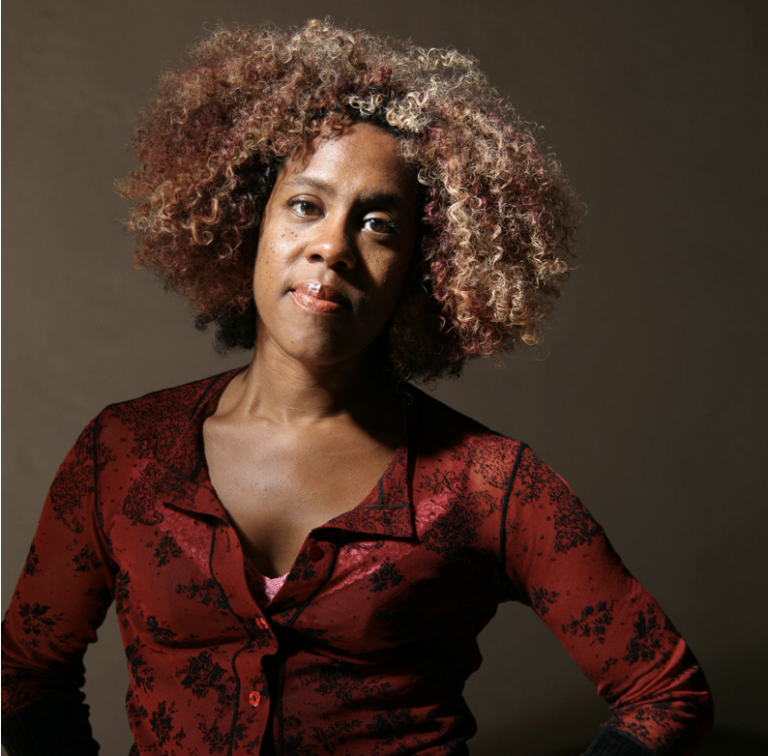 Errollyn Wallen is many things — composer, vocalist, and published author, just to name a few. But you could also say she’s a little bit of a psychic.
As the sky outside the floor-to-ceiling windows in Mixon Hall rapidly darkened with storm clouds on June 18, she launched into her song “Tree.” “I’m perplexed by rooted trees,” she crooned over pizzicattos from her accompanying string quartet, as lightning flashed and the real-life trees bent and twisted in the fierce wind.
Shortly after, ChamberFest co-artistic director Diana Cohen stopped the concert to make a rare request: that everyone in the room make their way down to the Cleveland Institute of Music basement to shelter from the storm. This unusual little detour was just one way the Wednesday evening program lived up to its name, “Mood Swings.”
“You know, I have a song called ‘Don’t Panic,’” Wallen said with a laugh once the concert resumed about ten minutes later. The British composer started writing songs as a way to keep a diary and to write poetry — her first song, “What’s Up, Doc?,” “just sort of tumbled out,” she explained. The selections from The Errollyn Wallen Songbook she brought to ChamberFest provided an intimate, fascinating perspective on her musical voice.
Rather than use an operatic style, her voice gives these songs more of an indie, singer-songwriter feel. Sitting alone at the piano, she mused about the art of songwriting in “What Shall I Sing?,” spun out an improvisatory interlude during the melancholy “Rain,” and flipped into falsetto for the gentle “My Feet May Take A Little While.”
Violinists Francesca dePasquale and David McCarrroll, violist Emad Zolfaghari, and cellist Oliver Herbert then joined Wallen onstage, elevating the performance even further with arrangements like the lush “Guru.” Although the piano had previously overbalanced Wallen’s singing at times, the string quartet had no such issue, and her voice became much easier to hear during selections like the contemplative “On the Mountain.”
She then stepped away from the piano completely to sing “Dido’s Lament” from Purcell’s Dido and Aeneas. This famous aria came across compelling and distinct in her plaintive voice, and the strings echoed her grounded delivery. “North” then ended her set on a spirited note, with running piano phrases and accented strings evoking Wallen’s memories of her visit to Norway.
Before intermission, two pieces by Mozart and Strauss played into the Festival’s theme of “Lost and Found.” The recently unearthed Ganz kleine Nachtmusik, written by a young Mozart, is perfectly pleasant, even if the circumstances of its discovery might be more exciting than the music itself. Still, McCarroll, Herbert, and violinist Kristin Lee, cheerfully played with dynamic contrast and full of the boundless energy of childhood.
Strauss was also quite young when he wrote his Piano Quartet in c minor, which carries much more of a Brahmsian influence than Strauss’ own, yet-to-developed voice. Again, the engaging qualities here came less from the composition and more from the performance itself, as Lee, along with pianist Roman Rabinovich, violist Milena Pajaro-van de Stadt, and cellist Raman Ramakrishnan acted as one unit with grand, sweeping melodies and crystal clear rhythms.
In the end, Wallen’s performance — and Mother Nature’s eventual interruption — remained the most memorable parts of the evening. “That was so exciting,” Wallen said with a grin once everyone had returned to their seats. “That’s going to be in my next book.”
Published on ClevelandClassical.com July 8, 2025.
Click here for a printable copy of this article
