



by Mike Telin
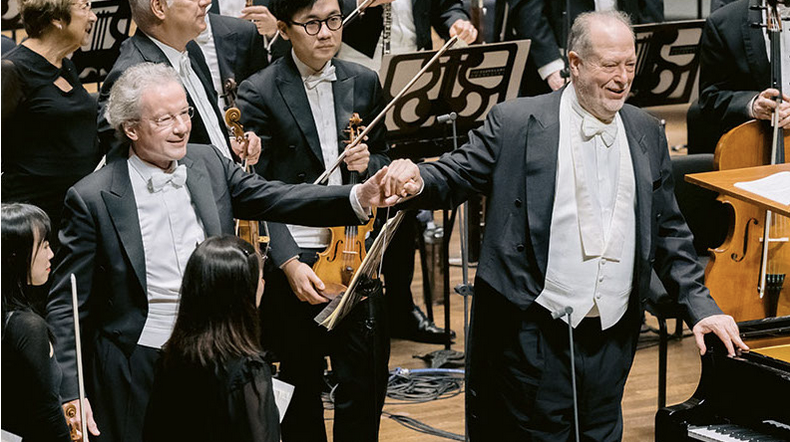 “The thing about playing Mozart concertos, especially with a great orchestra like Cleveland, is that when it goes well, it will leave me on such an adrenaline high I may not be able to sleep,” pianist Garrick Ohlsson said during a recent telephone conversation.
On Thursday, October 30 at 7:30 pm, Garrick Ohlsson will join Franz Welser-Möst and The Cleveland Orchestra at Severance Music Center for a performance of Mozart’s Piano Concerto No. 23.
“Like Shakespeare, Mozart can find the appropriate way to express the full range of human emotions. He can write the saddest music and the happiest music. He can write an aria for a servant who’s upset because she’s lost a pin. But unlike a 19th century composer, he doesn’t lay it on thick, he doesn’t do what the English call making heavy weather of it.”
What about the 23rd concerto pulls at the pianist’s heartstrings? “Quite a lot,” Ohlsson said. “I’ll start with the black pearl, which is of course the second movement. The Adagio, a slow Siciliano, is one of those minor key Mozart pieces which just tugs at your heart. You can’t believe that anything is quite so sad and at the same time so beautiful and graceful. It’s a heartbreaker.”
A compositional technique Ohlsson said that Mozart does better than anybody is to write a 12-bar statement for the piano and then have the orchestra enter with an entirely new theme. “The piano’s theme has a restrained poignancy, but the orchestra’s theme has a blatant emotional sadness. It’s almost like Puccini wrote it.”
The pianist noted that not only does the Adagio develop beautifully, it is also full of remarkable orchestral touches. “The most splendid is during the coda where the orchestra is playing pizzicato and the piano is playing sustained tones. It’s a magical moment of orchestration in a movement that is altogether incredible.”
Ohlsson also noted that the sound of the Concerto is colored by the fact that Mozart uses clarinets and omits oboes, giving the piece a more mellow timbre.
“Another thing about Mozart piano concertos is they’re always like little operas. And if you know Mozart operas you know there’s always another character coming in and singing in a different way. That happens to a degree in the first and second movement of No. 23, but the finale is like the end of act two of Marriage of Figaro where it just seems to go on and on — he gets so excited he can’t stop singing and dancing. Just as you wonder in the slow movement if anybody could really feel that sad, you wonder if anybody could feel so buoyantly joyful in the last movement.”
Has Ohlsson performed all of Mozart’s piano concertos? “Not all but most of them,” he said, adding that the first eight might be considered youthful works. “The concerto that really put the genre on the map is K. 271. Not that Mozart ever takes a false step, but if he had died before writing it we would have looked at the first eight concertos and said, ‘This is really lovely music, and it’s immensely promising and wonderful.’ But you wouldn’t say it’s by one of the greatest masters of all time. By the time he writes K.271 he certainly has arrived.”
Ohlsson noted that pianists have a lot of great music to play. “The repertory is astounding, actually. Somebody once said that if we had a worldwide catastrophe, and only Beethoven’s piano sonatas survived, we’d have an absolutely complete picture of the composer. Mozart wrote great piano sonatas, but if they disappeared and only the concertos survived, we’d still know Mozart’s full range.”
Mozart was one of Chopin’s two favorite composers. “He always said he didn’t care at all about the critics, but would like to know what Bach and Mozart might think of his work.”
Speaking of Chopin, I couldn’t let Ohlsson go without asking him what it was like to serve as the jury chair of the XIX International Chopin Piano Competition in Warsaw earlier this month — a competition he won in 1970.
“It’s complicated,” he said. “I’ve probably made 50 or 70 trips back to Poland in the intervening years, and every time I walk on that stage I feel like I have to win the Chopin Competition all over again. It’s like your own hometown, so even if you’re quite famous, the folks there remember you when you were nobody.”
In any case, what was it like to go back? “Incredibly different. In 1970 I was a 22-year-old kid who didn’t know anything. I didn’t know that I was going to be the winner either, but it put me on the map. Within two years I made my debut at practically every major music center in the world.
‘So It was an incredible honor to be the first non-Polish chair of the jury in a hundred years. I have to say that that’s really something, but they consider me sort of an honorary Pole.”
Ohlsson said that in 1970 the atmosphere in Warsaw was electric, and the entire country was consumed with the Competition. But now, due to technology, that electricity has gone worldwide.
“There’s a joke that everybody in Warsaw knows exactly how every note of Chopin’s Mazurkas should be played. The only people who don’t know are the jury. Everybody’s kind of an armchair quarterback.
“And because I’m so well known there people stop me on the street and say, “Mr. Ohlsson, what did you think about the left hand in that mazurka that so and so played?
“It’s always a specific comment about how you did something. People are really focused on the Competition and there was so much excitement about it. You know people were lining up at 1:00 AM to buy cancellation tickets. As one wag put it, ‘America has Black Friday, but Poland has the Chopin Competition.’ So you can get from my buzz that this was an incredible experience. I think you would agree that we had a lot of fine young pianists there — all highly accomplished and all hoping someday to play with The Cleveland Orchestra.”
This week’s program also includes Tyler Taylor’s Permissions and Robert Schumann’s Symphony No. 3, “Rhenish.” It will be repeated on Saturday, November 1 at 7:30 and Sunday November 2 at 3:00 pm. Tickets are available online.
Photo by Roger Mastroianni
Published on ClevelandClassical.com October 29, 2025.
Click here for a printable copy of this article
