



by Kevin McLaughlin
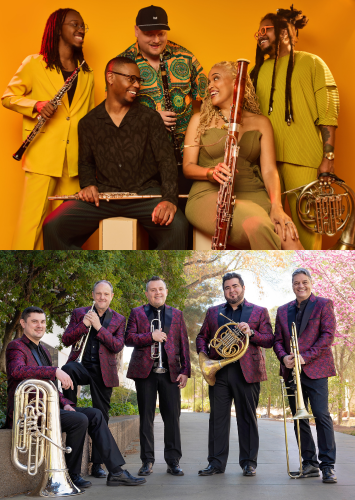 On the cold Tuesday evening of February 10, two venerable ensembles — the Imani Winds and Boston Brass — were brought together by Akron’s Tuesday Musical in E.J. Thomas Hall. The large audience was ready for something lively, and the players obliged, spending the better part of two hours passing enthralling music back and forth.
Outfitted in blue jackets, Boston Brass — José Sibaja and Jeff Conner (trumpets), Chris Castellanos (horn), Domingo Pagliuca (trombone), and William Russell (tuba) — introduced pieces and corrected each other’s pronunciation with good humor. “You may be wondering how guys in those jackets get work,” Conner quipped. José Sibaja, who grew up in Puerto Rico, took particular care with Spanish names, and was playfully merciless when his colleagues missed a vowel.
Dmitri Shostakovich’s Galop, one of the composer’s theater pieces from the 1930s, was up first. Articulation stayed clean even at the fast tempo, and the group reveled in the music’s dry humor. Sibaja and Conner impressed with their technical ease, while Pagliuca and Russell kept things grounded.
In Sibaja’s arrangement, which he pronounced correctly, Astor Piazzolla’s Verano Porteño unfolded as an elegant tango, its long lines passing fluidly between the players. Though solos went to Sibaja himself or Conner on flugelhorn, it was less a solo vehicle than a showcase for ensemble phrasing and blend
Imani Winds — Brandon Patrick George (flute), Mekhi Gladden (oboe), Mark Dover, (clarinet), Kevin Newton (horn), and Monica Ellis (bassoon) — took the stage to play three movements from Paquito D’Rivera’s Aires Tropicales, now a central work in the wind quintet repertory. This was chamber music at its best, relaxed and well-coordinated. George and Gladden beautifully shaped long lines, Dover contributed his usual assurance, Newton his characteristic lyricism, and Ellis lit the flame.
The combined ensembles returned for Leonard Bernstein’s “Maria” from West Side Story and an aria from Piazzolla’s María de Buenos Aires, both arranged by Pagliuca. Bernstein’s melody — always a lovely thing — moved naturally through the ensemble, while the Piazzolla drew a darker, more sustained sound.
The first half closed with Russell’s arrangement of the March from Paul Hindemith’s Symphonic Metamorphosis. Russell noted from the microphone that although the German work stood apart from the concert’s largely Latin focus, the idea of musical migration — composers and styles finding new homes — provided a connection. With brilliance edging out transparency and the brass often outweighing the winds, the first half came to a rousing close.
Following intermission, Imani Winds returned with Lalo Schifrin’s La Nouvelle Orleans, a two-movement work shaped by the composer’s long engagement with jazz and film music. Drawing on the New Orleans tradition of following a funeral dirge with dance music, the piece moved from a solemn procession to a celebration. The ensemble highlighted rhythmic precision and color, Ellis’s bassoon anchoring the texture while Dover’s clarinet soared freely and passionately.
Mark Dover’s arrangement of Stevie Wonder’s Overjoyed was one of the evening’s high points. The performance began simply, allowing the tune to settle in. Partway through, hornist Kevin Newton picked up a microphone and sang a chorus in a voice strikingly close to Wonder’s own. It was a lovely moment. Newton set the microphone down and rejoined his colleagues as though nothing unusual had happened.
Commissioned by the Ensembles for this tour, Arturo Sandoval’s Metales y Maderas (Brass and Woodwinds) brought all ten musicians together again, solos rising and falling over repeated jazz harmonies. Sibaja’s piccolo trumpet, clear and light, drew particular attention.
Boston Brass later returned alone for Sam Pilafian’s arrangements of Sway and Blues for Ben, the latter giving tubist William Russell room to display both agility and humor. As though the brass players’ enjoyment proved irresistible, Dover emerged from the wings to add a cool clarinet chorus.
The full ensemble returned for Castellano’s arrangement of Ernesto Lecuona’s Malagueña. The performance embraced the piece’s theatrical flair, with solos from Sibaja, Pagliuca, George, Gladden, Ellis, and others across both groups. The encore, When the Saints Go Marching In, was initiated by Sibaja and was quickly taken up by the rest, sending everyone out into the night smiling.
Published on ClevelandClassical.com February 18, 2026
Click here for a printable copy of this article
