

by Stephanie Manning
 This article was originally published on Cleveland.com
CLEVELAND, Ohio — When the lights dimmed in Mandel Concert Hall on Thursday night, April 30, audience members were greeted not by a stage full of seated musicians, but by a collection of empty chairs and stands, waiting for their players to file on from the wings. An unconventional beginning — but unconventional is what Jörg Widmann does best.
A conductor, composer, and clarinetist, Widmann is no stranger to Severance Music Center. He served as The Cleveland Orchestra’s Daniel R. Lewis Composer Fellow from 2009 to 2011, and his music has resurfaced in the Orchestra’s programs ever since. But this week marked his debut on the podium.
To celebrate the occasion, Widmann paired three works of his own, including a U.S. premiere, with Felix Mendelssohn’s Symphony No. 5, “Reformation.”
Entering from stage right with a dectet of musicians, he kicked things off with his “Fanfare for Ten Brass Instruments.” The five-minute work quickly established Widmann’s style. Dissonant, dense, and often competing ideas created a study in contrasts, from the high octaves of the trumpet section to the deep, insistent trombones and tuba.
For “Con brio,” Widmann took inspiration from Beethoven’s Seventh and Eighth Symphonies at the suggestion of conductor Mariss Jansons. With such an extended timbral palette — winds producing only the whooshing sound of air, and the rumble and clack of the timpani sticks — it initially felt unlikely that the piece could resemble both Widmann and Beethoven.
But he does straddle that line, bringing out sharp accents in the strings and introducing three-note figures in the brass that conjure the idea of Beethoven without directly quoting him.
Written in 2022 and receiving its U.S. premiere, “Dance macabre” was Widmann’s most recent work on this program. His approach to creating a dance of the dead fittingly begins with the twelve strikes of midnight, delivered menacingly from the deepest octaves of the piano.
At times the piece is a landscape of unsettled timbres, from muted low brass and funky percussion like the flexatone, waterphone, and vibraslap. But there are also sections where genuine dance tunes break through — like the melodramatic waltz kept sharply in time by the snare drum.
The celesta introduces a hauntingly peppy melody later echoed on the piano. As the piece — and the dance — neared their end, relentless bass drum beats and cymbal rolls brought it to a forceful conclusion.
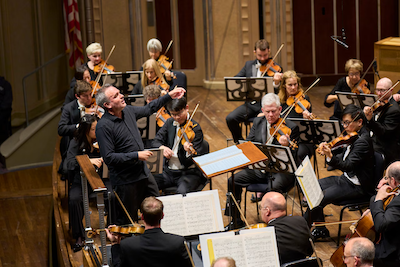
After a short break, Mendelssohn’s Fifth Symphony moved the tone far away from that vicious ferocity. Widmann seemed just as eager to conduct this as he had everything else — forgoing a baton, he used his arms for big, sweeping motions and often jumping up and down to emphasize a point.
He drew big dynamic swells from the Orchestra in the opening movement before delivering a charming and quaint Allegro vivace, clarinetist Afendi Yusuf’s rich sound soaring over the strings. In the third movement, Widmann took his time without over-indulging, and Joshua Smith’s refined flute playing led into the finale’s gorgeously layered Lutheran chorale.
Next week, Widmann will shed his (figurative) baton, picking up his clarinet to perform Olga Neuwirth’s Zones of Blue with Franz Welser-Möst and the orchestra. And just like this week, he will surely be enjoying every moment.
Photo by Roger Mastroianni
Published on ClevelandClassical.com May 6, 2026
Click here for a printable copy of this article
