

by Daniel Hathaway
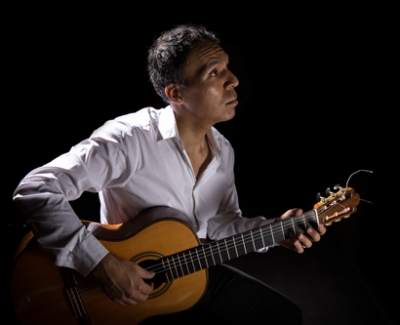 Maurice Ravel’s orchestration of Modest Mussorgsky’s 1874 piano suite Pictures at an Exhibition is ear-baggage for anyone who encounters Pictures in other arrangements. Thus guitarist Jorge Caballero and organist Jean-Baptiste Monnot gave us the intriguing opportunity to hear solo versions of Mussorgsky’s music adapted for plucked and winded instruments within 24 hours.
Caballero’s performance, part of the Cleveland Classical Guitar Society series at Plymouth Church in Shaker Heights on Saturday evening, November 12, used the transcription by Japanese guitarist Kazuhito Yamashita. Monnot’s recital in Gartner Auditorium at the Cleveland Museum of Art on Sunday afternoon, November 13, featured a transcription by his teacher, the flamboyant French organist Jean Guillou.
The two experiences were radically different. Caballero’s performance scaled the work down to chamber size, while Monnot’s expanded it to fit the resources of a large, American Classic-style organ. Both were remarkably colorful in their own way.
Caballero used a variety of techniques to vary the timbre of his instrument — sometimes bringing out its sonorous qualities, sometimes demonstrating its ability to produce contrasting, nasal sounds. His astonishing technique allowed him to produce expert layerings of melody and accompaniment as well as simulating sustained chords. Certain movements — “Baba-Yaga” and “The Great Gate of Kiev” — stretched the guitar to its limits. Others — “Tuileries” and “The Market at Limoges” — were sprightly and delightful. And Caballero reached into the instrument’s darkest sonic regions for “Catacombs.”
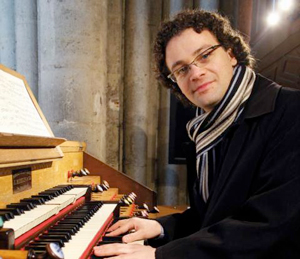 Monnot’s registrations on the Museum’s Holtkamp organ visited a constantly-changing palette of colors — sometimes in mid-phrase. His stop combinations favored hollow-sounding, nasal, and reedy timbres which made little attempt to replicate orchestral hues. Thunky principal stops set the mood for “The Old Castle,” and the organist drew murky, dark registers for the ponderous “Bydlo.” Like Caballero, Monnot has an abundance of technique to draw upon, and that came in handy when he had to deal with complex textures. But clipped phrases and extremes of articulation were sometimes distracting.
The other two works on Jorge Caballero’s program were his own transcriptions of works originally written for other musical media. He began with a finely-paced, ruminative performance of J.S. Bach’s Violin Sonata in a, BWV 1003, and continued with Alban Berg’s Piano Sonata, Op. 1, which sounded almost like experimental jazz when transferred to the guitar.
Monnot’s “Russian Fireworks” program was also totally devoted to transcriptions: Guillou’s reworkings of Prokofiev’s piano Toccata in d, Op. 11, and of Tchaikovsky’s Scherzo from Symphony No. 6, and Monnot’s own arrangements of Scriabin’s Etude in c-sharp, Op. 2, No. 1, and Prélude in a, Op. 11, No. 2.
The organist chose chiffy stop combinations with predominant quints for the Prokofiev, a perpetual motion piece, and flutes with intruding reed stops and high-pitched registers for the Tchaikovsky, giving both works the sense of being an entirely new piece rather than transcriptions. Monnot’s stop choices for the Scriabin pieces mixed foundations with reeds, producing some odd layerings of sound when the swell boxes opened and closed on some ranks and not others.
At the end of both well-attended performances, the audiences erupted in applause. Caballero and Monnot each demonstrated remarkable levels of technique and musicianship. Did the transcriptions from one medium to another work in every case? Perhaps not, but it’s illuminating from time to time to hear well-known music through fresh ears.
Published on ClevelandClassical.com November 22, 2016.
Click here for a printable copy of this article
