


by Mike Telin
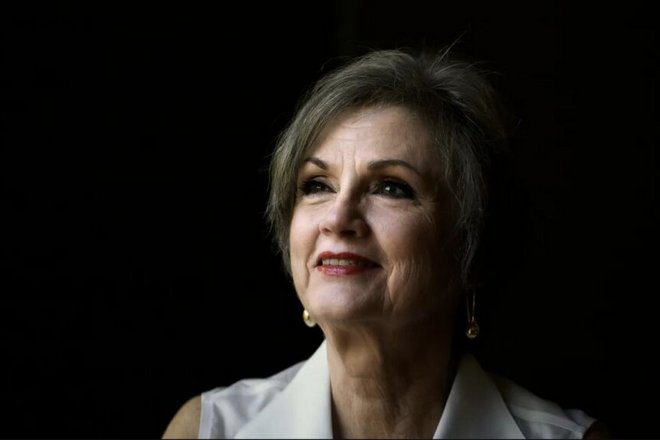 “When Frank Cohen called and said he had received an email from David Stern, I thought, oh my goodness,” composer Judith Markovich recalled during a Zoom conversation. “Frank told me that David had sent him a poem and it’s devastating. Frank said ‘Go to your email because you have to read it right now.’ And so I went to my computer and we read it — we were nearly in tears.”
On Friday, June 20 at 7:30 pm in Mixon Hall, ChamberFest Cleveland will present the world premiere of Judith Markovich’s Oh, my son… The program also includes Witold Lutosławski’s Variations on a Theme by Paganini, Bright Sheng’s Four Movements for Piano Trio, and Franz Schubert’s Cello Quintet in C major. Markovich will join pianist Eric Charnofsky for a pre-concert conversation beginning at 6:30 pm. Tickets are available online.
In his program notes, Donald Rosenberg writes that that the work emerged “from the longtime friendship between ChamberFest co-artistic director and clarinetist Franklin Cohen and the prominent doctor David Stern, both of whom had studied clarinet in New York with the noted teacher Leon Russianoff. Decades laters when the two friends were talking about the 2008 suicide of Stern’s son Alan, Cohen wondered if a musical work on the subject might be worth pursuing. Cohen told Stern he knew a composer who had also studied clarinet with Russianoff.”
Oh, my son… is inspired by the original verses of David Stern’s “proem” — a combination of prose and poetry — written in memory of his son. The work is scored for narrator/tenor, clarinet, violin, piano, and timpani. “David said that he wanted Frank and his family to play it. I thought, great. But I’ll tell you that as a new composer, I learned a lot from this project because David is brilliant. And his words are words that everyone can understand. But this was hard for David because he loves words and he will search until he finds the perfect word. And I wanted to honor them as much as I could.”
Markovich said that as a musician herself, writing chamber music is her favorite medium, but it was a challenge to figure out how to incorporate timpani into the piece. “At the beginning of one of the movements, the timpani gets a big solo, but it’s also used as the heartbeat throughout the whole piece. I’m really excited for the premiere — I can’t wait to hear it.”
Changing topics, I asked Markovich how she acquired the composing bug? “It’s funny because I didn’t start taking composition lessons until I was 65. But I remember showing this little thing that I had written for fun to my mentor David McKay and he told me, ‘you don’t know you’re a composer.’ And I said, ‘are you kidding me.’
Markovich said that at first she dedicated maybe four hours a week to studying the craft. “I’d have my lesson once a week, then a couple of times a week, then three times, and pretty soon I composed four hours every afternoon after that..”
 As time went on Markovich decided to attend a League of American Orchestras conference where she heard a talk by composer Joan Tower. “I walked up to her thinking to myself that I was absolutely crazy, but I said to her, ‘I would like to have a lesson with you.’ She looked at me and said, ‘well, where do you live?’ I told her I lived in the Nashville area, and she said, ‘I don’t do long distance.’ So I told her, ‘I can fly.’ And she looked at me, and said, ‘in that case…’
Markovich did travel to Tower’s home in New York and had lessons three days in a row, which she said were amazing. Although Markovich had many questions for Tower, there was one at the top of her list.
“I had just turned 71 and I didn’t want to start something new in my senior years and have it just be a nice little hobby. I want to leave a legacy. So I asked her, do you think it’s worth it? On our last day, after having listened to and worked on a bunch of things, she turned to me and said, ‘You asked me if I think it’s worth it. For you, absolutely.’ I felt this peace. It was like a verification of who I was inside. So I walked out of there having turned my life around. It gave me solid ground to walk on instead of sinking sand.”
An important piece of advice Tower gave to Markovich was to get her music off of her computer and let musicians play it. “The problem was that I had stopped playing the clarinet and hadn’t been involved in classical music for over 30 years. So I didn’t have connections. She told me to contact one of the local colleges and universities and you’ll get it played.”
It turned out that Tower was right about getting your music played. “All of a sudden I got an email from a violist, Brett Dubner. He said that he wanted to hear my piece for unaccompanied viola.” Markovich recalled. After he heard it he said, ‘I want to perform this. And I want you to write me a sonata that you can turn into a concerto.’ At first I thought, I don’t even know what it takes to write a sonata. But I wrote him a sonata that could be turned into a concerto.”
Another musician who emailed Markovich out of the blue requesting that she write a piece was Argentine classical guitarist Sergio Puccini. “He messaged me and said ‘I see you don’t have any works for guitar in your literature — I’d like you to write me something.’ I told him that I didn’t know how to write for the guitar, and he said, ‘Don’t worry, I’ll help you,’ so I wrote him a piece. For me, this is the power of God in my life.”
Click here to view Markovich’s substantial catalogue of works.
Published on ClevelandClassical.com June 16, 2025
Click here for a printable copy of this article
