

by Daniel Hathaway
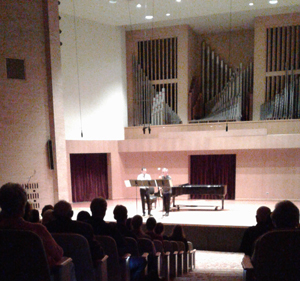 The fifth and final faculty concert of the 2017 Kent/Blossom Music Festival in Kent’s Ludwig Concert Hall on Wednesday evening, July 26, contrasted bracing 20th century music for wind duo with a heartwarming Romantic cello sonata. Oboist Frank Rosenwein, bassoonist Barrick Stees, and cellist Richard Weiss stepped out of their normal roles in The Cleveland Orchestra for the occasion, joined by KSU professor Jerry Wong, who contributed refreshingly varied mini-sonatas for solo piano.
One of more than 50 works Heitor Villa-Lobos dedicated to his long-time companion Mindinha, the Duo for oboe and bassoon was composed in 1957 but had to wait ten years for its debut performance in Rio. The piece, at 15 minutes’ duration, is what wind players call a “long blow,” but Rosenwein and Stees showed no signs of fatigue as they negotiated the technical demands of the piece. So continuously do the instruments play that there’s no time to turn pages. Instead, the score was laid out over a pair of music stands, the performers moving from left to right as the music scrolled onward.
The Duo is definitely 20th-century modern, with its spiky dissonances and healthy doses of atonality. It’s also colorful and sometimes humorous — as when Villa-Lobos has the oboe and bassoon chase each other like playful squirrels.
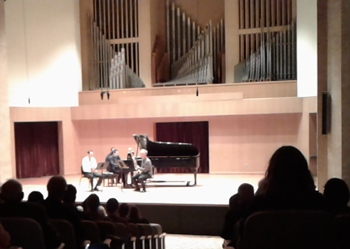 Arrangements of early Renaissance chansons for oboe, bassoon and piano might seem an unlikely endeavor, but Willard Elliot’s Suite of Six French Songs of the 15th Century is delightful on many levels. Elliot, who served as principal bassoon of the Chicago Symphony for 32 years, brings Stravinskian wit, mildly dissonant harmonies, and nicely varied textures to his reworkings of half-a-dozen obscure Gallic tunes. Rosenwein, Stees, and Wong communicated their charm in glowing performances.
Wong closed out the first half of the evening with George Rochberg’s Four Short Sonatas, explaining to the audience beforehand that they should think of Scarlatti’s short binary pieces rather than the full-blown, four-movement sonatas the title later implied.
More atonal than the works that preceded them, Rochberg’s pieces were in turn reminiscent of Baroque two-voice inventions, Bartók-like in their rhythmic complexity, or primarily violent and forceful, elements that Wong brought to the surface with confident virtuosity.
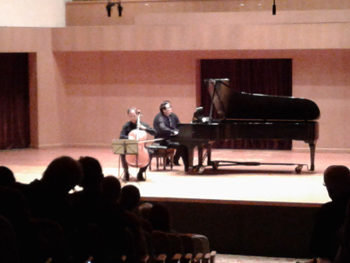 After intermission, Richard Weiss joined Jerry Wong in a vibrant reading of Brahms’s e-Minor Cello Sonata — a work whose original title read “Sonata for Piano and Violoncello” to point up the equal role the composer conceived for the two instruments. True to Brahms’s intentions, Wong and Weiss balanced their contributions admirably into a thrilling whole.
Brahms’s Second Hungarian Dance in an arrangement by Valter Dešpalj amounted to a programmed encore, ending the Kent/Blossom faculty series with an appropriate flourish. The nearly-full house obviously loved it.
Published on ClevelandClassical.com July 31, 2017.
Click here for a printable copy of this article
