

by Daniel Hathaway
 This article was originally published on Cleveland.com
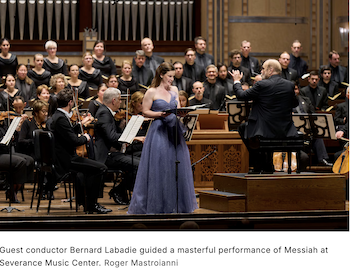
CLEVELAND, Ohio – On Thursday evening at Severance Music Center, guest conductor Bernard Labadie did far more than just hold the performance of Messiah by the Cleveland Orchestra, Chorus and solo quartet together, he led a surgically clean account of George Frideric Handel’s 1741 oratorio.
Like a London cabbie, Labadie knew all the available highways and byways for the two-hour musical journey and pointed out interesting sights we might otherwise have missed.
And to change metaphors, like a skilled restorer he gently removed layers of interpretive grime that has accumulated over the years from Handel’s score, allowing us to hear it with fresh ears. He also tucked in some surprises of his own for those of us who thought we knew the piece and how it should go.
Seated on a piano bench and wielding a baton, Labadie drew a full but lean, rhythmically sharp sound from the orchestra in the slow introduction of the opening Sinfony and shaped clear lines in the ensuing fugue.
Tenor soloist Andrew Haji sang reassuring words in Comfort Ye My people, and proclaimed hope with his clear, flexible voice in Every Valley Shall Be Exalted. In its first appearance, the Cleveland Orchestra Chorus, expertly prepared by Lisa Wong, extended Isaiah’s prophetic words with its light, transparent singing.
Bass-baritone John Brancy powerfully introduced the theme of judgment in Thus Saith The Lord, and countertenor Tim Mead, whose voice is strong from top to bottom, was fearsome in But Who May Abide the Day of His Coming. And He Shall Purify the Sons of Levi found the chorus luxuriating in long melismas.
When the scene changed from prophecy to fulfillment, soprano Liv Redpath’s gorgeous tone and elegant diction announced the birth of Christ to the shepherds, then commented on the event in Rejoice Greatly, a sparkling aria that showed her gift for effortlessly delivering long lines. Handel — always the theatrical composer — suggested that two trumpets playing at a distance should accompany the angels’ Glory to God, and so they did, from one of the boxes.
Part I ended with He Shall Feed His Flock, a lyrical, shared aria between countertenor and soprano, and the light-as-air chorus His Yoke is Easy.
Part Two, which begins with the sharp rhythms of Behold, the Lamb of God, deals with the passion and resurrection of Christ, a subject Handel, Labadie and Mead made much of. Mead was in his element as a narrator in He Was Despised, and all the elements built steadily to the triumphant Hallelujah! chorus.
Although Part Three can lose momentum after what has gone before, Labadie’s pacing isolated some of the most beautiful moments in Handel’s score: I Know That My Redeemer Liveth (sung with gorgeous phrasing by Redpath), the hushed, unaccompanied Since by Man Came Death (answered by a strong affirmation of the Resurrection), and the mystical Behold, I Tell You a Mystery and bass aria The Trumpet Shall Sound (boldly proclaimed by Brancy with a grand, flawlessly played solo by Michael Sachs).
A few judicious cuts by Labadie led straight to the concluding chorus and Amen double fugue, usually performed full tilt by orchestra and chorus. Here, the conductor’s final surprise involved tinkering with the dynamics to provide contrast between the sections of the fugue. That worked beautifully, drawing more than the usual attention to the structure of the finale. The large audience acknowledged this terrific performance with a well-deserved ovation.
Published on ClevelandClassical.com December 11, 2025
Click here for a printable copy of this article
