

by Daniel Hathaway
 Although Les Délices’ most recent subscription program actually featured music by composers from what is now the western part of the Czech Republic, it borrowed its marketing title from an American rock anthem and culminated in a major work by a celebrated Austrian.
Never mind a slight bit of confusion. “Bohemian Rhapsody,” which I heard on Sunday, October 19 in the agreeable space of West Shore Unitarian Universalist Church in Rocky River, provided the welcome opportunity to focus in on the classical oboe artistry of director Debra Nagy, and to make at least a nodding acquaintance with historical composers Franz Krommer, Georg Druschetzky, and Katerina Veronika Dusikova-Cianchettini (whose name should be appear on classical radio hosts’ audition scripts), as well as the more recent Nathan Mondry.
These composers were oppressed rather than inspired by Germanic culture, and that shows up in pieces like Krommer’s Quartet no. 2 in F for oboe & strings that opened the program with music lighter in concept and texture than similar German works. Nagy pointed up those qualities to delightful effect.
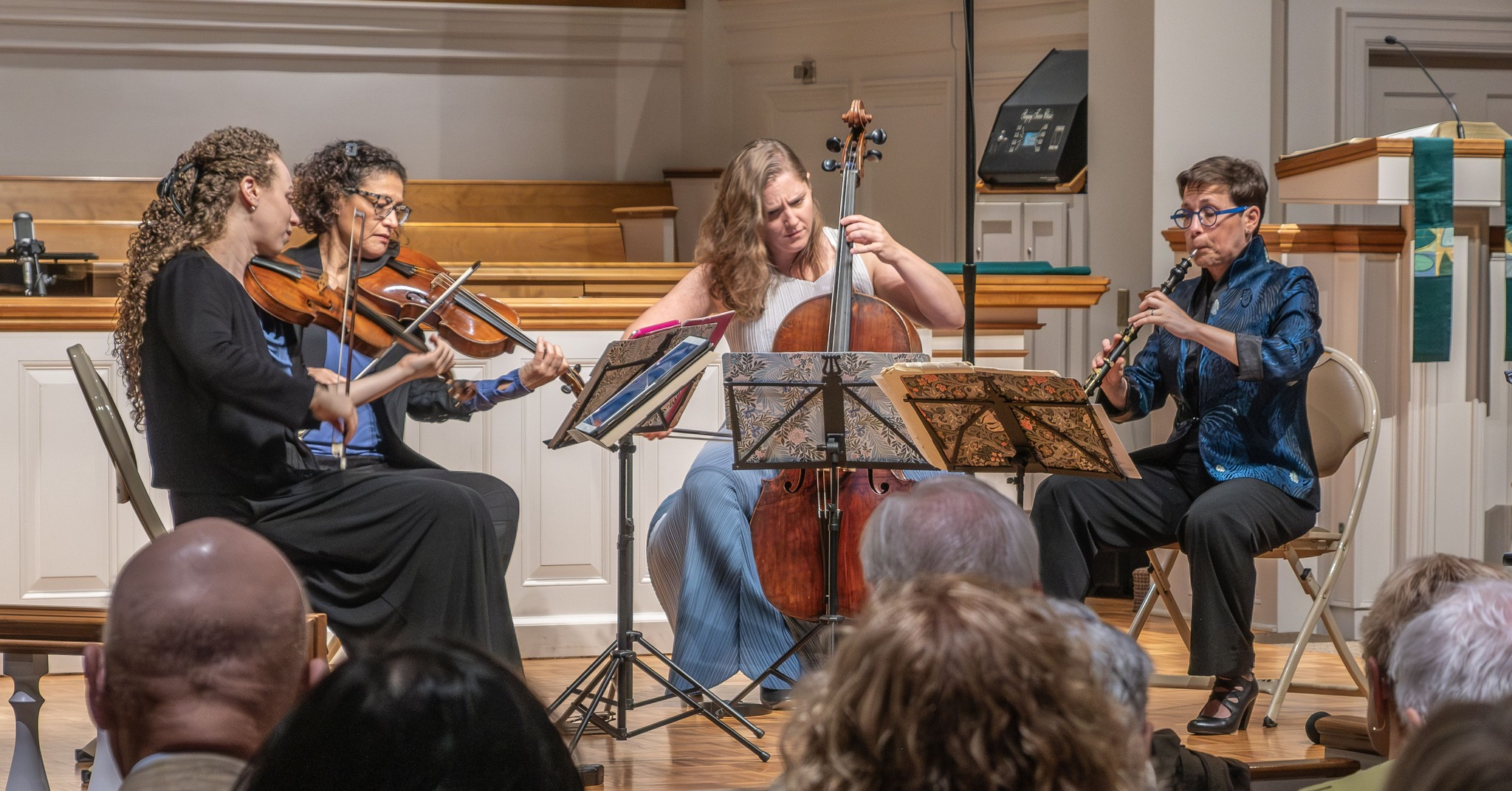
Here as throughout the afternoon, Nagy was supported by the nuanced playing of violinist Shelby Yamin, violist Yaël Semenaud Cohen, and cellist Rebecca Landell.
Nagy told the audience that after hearing his Quartet in G minor, she hoped that George Druschetzky would become everyone’s “new favorite composer.” Himself an oboist who was certified as a civic drummer and played for official events, Druschetzky authored some of the first concertos for timpani as well as a concerto for oboe and timpani.
After intermission, musical textures continued to grow lighter with keyboardist Nathan Mondry’s Folk Song Suite, comprising a Chorale (Mládi a láska), a charming fugue (Bývalost), and a Theme and Variations set in which a catchy tune was passed from player to player. Mondry writes new music in historical styles, and this enjoyable piece sounded like the real McCoy.
Even lighter fare came in the form of Dusikova-Cianchettini’s Two Waltzes and Air Russe, arranged by Debra Nagy for string trio. The former would make wonderful dinner music, and the latter features an ingratiating melody that gave violinist Shelby Yamin a moment in the spotlight.
Before closing with the major work of the afternoon — Wolfgang Amadé Mozart’s luminous Oboe Quartet — Nagy talked briefly about the classical oboe and how it differs in construction and playing technique from its Baroque predecessor that she normally plays. Then she proved her mastery over the difficult instrument with a stunning performance that overcame all the challenges that Cleveland’s fickle weather holds in store for double reed players.
The opening Allegro sparkled with beautiful lyrical lines. The Adagio, a virtual opera aria, featured long, liquid phrases, a magical cadenza, and a tricky concluding note. In the Rondo, Nagy’s amazing technical chops served her well as the music leapt from register to register, and for the second time, she nailed the final high note.
Photo from a previous performance.
Published on ClevelandClassical.com October 30, 2025.
Click here for a printable copy of this article
