

by Daniel Hathaway
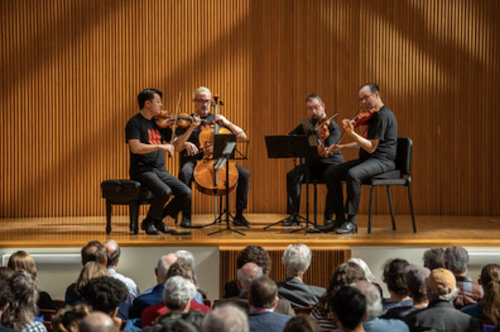 Three decades after its founding at the Oberlin Conservatory, the Miró Quartet celebrated that milestone by playing a complete Beethoven cycle in six concerts from October 10-12 in venues throughout the Lorain County campus.
That musical marathon of sixteen string quartets, performed in the order they were written, neatly coincided with Oberlin’s Homecoming Weekend, a nostalgic occasion for the Quartet’s founding members — first violinist Daniel Ching and cellist Joshua Gindele — as well as for Oberlin alumni in general, who helped swell the audiences for the well-attended Beethoven cycle.
Second violinist William Fedkenheuer and violist John Largess, who joined the ensemble a bit later, complete a well-oiled machine that has something distinct to say musically. They play as a single unit with a rich, blended sound and well-matched articulations, offering an experience that’s both exciting and transcendent.
These qualities were fully in evidence early on Sunday afternoon, October 12, when a large audience gathered in Warner Concert Hall to hear the sixth and final concert of the Beethoven cycle.
Showing no signs of fatigue, the Miró gave commanding performances of Quartets No. 15, Op. 132 (“Heiliger Dankgesgang”) and No. 13, Op. 130 (with its original finale, the Große Fuge Op. 133) — two big works both in length and emotional complexity.
Daniel Ching prefaced the performance by noting in his spoken remarks that Beethoven’s late quartets become his autobiography. Their spiritual quality came immediately to the fore in the beginning of Op. 130.
The second movement was like a pleasurable walk in nature. The Miró’s attacks and releases were perfectly in sync, an attribute that continued in the opening of the following adagio. Here they re-created Beethoven’s numinous experience at his recovery from a life-threatening illness, beautifully sustaining the music’s long, lyrical lines.
The group brought out all of the multiple moods during the marcia, making an exquisite transition into the concluding Allegro. The Presto was hair-raising.
 The Quartet injected a bit of levity at the start of the second half — making a costume change into Oberlin Conservatory t-shirts. Then William Fedkenheuer introduced what he called an audience participation pre-encore — a rousing performance of Happy Birthday to series organizer Sally Takada.
In the opening of No. 13 the Miró demonstrated their ability to shift musical moods on a dime. They brought a pure sound to the galloping presto and relaxed pulsing rhythms and pointed pizzicatos to their classy performance of the Andante..
The Danza was beautifully paced and the group’s soft playing in the Cavatina was simply gorgeous. Here Ching unleashed his inner-opera singer and Beethoven’s spirituality filled the hall.
Then the opening of the Große Fuge was like a bomb going off. Beethoven’s relentless dotted rhythms abounded, relieved only temporarily by a charmingly calmer slower section before the obsessive rhythmic figure returned.
Op. 133 is one of the composer’s most bizarre inventions — no wonder his publisher insisted that he provide an alternate ending to Op. 130. But on Sunday, the Miró attacked it with utter conviction, and may have given it its most persuasive performance ever.
Photos by Abe Frato.
Published on ClevelandClassical.com October 17, 2025.
Click here for a printable copy of this article
