



by Mike Telin
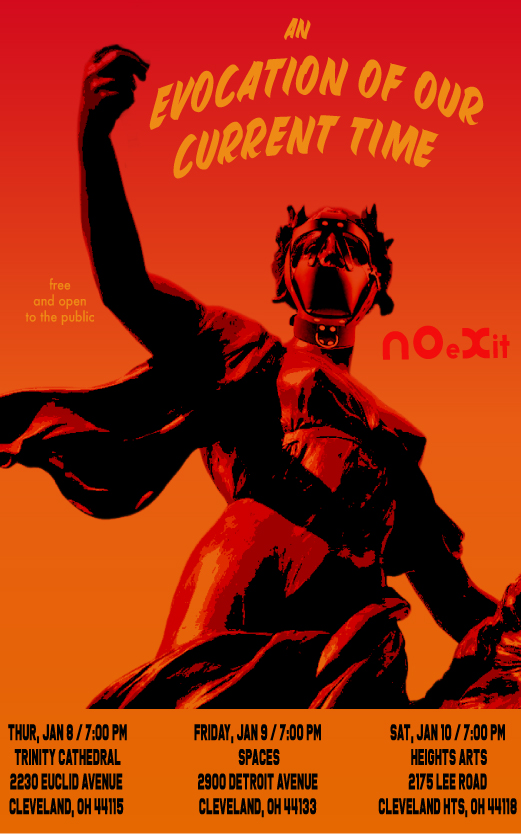 This week Cleveland-based No Exit and St. Paul-based Zeitgeist will continue their long-standing collaboration with “An Evocation of Our Current Time.” This 55-minute multimedia experience draws on improvisation, film, artificial intelligence, environmental manipulation, lies, magic, gaslighting and other forms of chicanery.
The 7:00 pm free performances are on Thursday at Trinity Cathedral, Friday at SPACES, and Saturday at Heights Arts.
No Exit’s Laura King spoke with artistic director/composer Tim Beyer about how the ensemble’s recent Surreality season reshaped their creative trajectory, why it’s important for artists to grapple with the foundational instability of “now,” and how audiences might react when confronted with a work that both mirrors and distorts the world we inhabit.
The interview is reposted with the permission of the ensemble and author.
Laura King: Tim, please talk about how Surreality reshaped your thinking about what a No Exit concert can be, and how An Evocation of Our Current Time has grown out of that evolution.
Tim Beyer: Early in the conceptual phase of putting together Surreality, one of the things that I thought a lot about was how Surrealism manifested itself in so many mediums and across so many disciplines. It wasn’t just visual art, or words on a page, or music, or theater. Many of the Dadaists and Surrealists incorporated a multidisciplinary approach, blurring the lines and fundamentally redefining the traditional conceptions of what art was.
I wanted to present something that was truly representative of that boundless scope and unrestrained creativity that was such a vital element of the Surrealist movement. So No Exit set out to create this very immersive series of programs, bringing many other artists and performers of various disciplines into the fold, creating these extraordinary environments where our audience could experience what we were presenting, and — by truly thinking about what we were doing in a very 3-dimensional way — giving a more complete multidimensional picture, a ‘total’ experience, if you will. I must say that Surreality was a really liberating experience for me personally. Truthfully, I hadn’t felt that level of joy in what I was doing for a long time.
And of course, once you begin coloring outside of the lines you start to see things differently. Surreality was creatively and conceptually a real breakout moment for No Exit. It really did get the ball rolling in a different direction for us. An Evocation of Our Current Time is a project that is definitely the result of our ‘evolution’ as you put it, an evolution that very much has its impetus in Surreality.
LK: You describe this concert program as integrating “film, AI, environmental manipulation, sleight-of-hand, misinformation, gaslighting, and other forms of chicanery.” What facets of our current moment are the players conspiring to evoke? Can you explain how and why music is such a potent medium for reflecting the instability of “now”?
TB: All the aforementioned elements are essentially a means of manipulation. We live in a time where we’re barraged daily with constant manipulation, an endless stream of falsehoods, alternative facts, self-serving narratives and so-called truths. The purpose of course is to influence and indoctrinate us; there is an agenda at work, whether in service of commerce, as a means of control, or to instill an ideology. We are all susceptible to these manipulations — it’s part and parcel of what we are as human beings. And in our current digital age, all these manipulations have been immensely amplified.
The thing is, it takes all but the smallest adjustment to our subjective reality to make someone who might otherwise be considered a perfectly ordinary and decent person adhere to and embrace some horrible beliefs and ideas. Once indoctrinated and convinced of the righteousness of these beliefs, it is all too easy for ordinary people to condone or commit horrible and evil acts. Just one little shift is all it takes. One tiny step. I think that most of us don’t want to think about how easy it is to shift our moral compass in such a way. There has never been a greater apparatus for fostering these little shifts in subjective reality than there is today. This is why I assign such great importance to the ways in which we are manipulated — the consequences can be and have historically been calamitous.
So, to get back to your question, this is the significance of incorporating misinformation, lies, gaslighting, etc. into this work. It serves a somewhat ironic dual purpose — to both expose the ways in which we are manipulated, and to enact our own form of manipulation. Looking at the much bigger picture, what we’re seeking to evoke is our real-time descent into cruelty, tribalism and the loss of a shared humanity.
Music, and I think this is true of the arts in general, is a powerful messenger. It has a singular ability to elicit a deep emotional connection, to reach parts of our psyche that would be difficult to access so completely and effectively via other means. While we often consider ourselves to be a species guided by logic and reason, at the end of the day, we’re emotional creatures. So being able to access this emotional part of ourselves is a powerful thing. I suppose this is the reason why leaders and governments disposed towards authoritarianism have always made such great efforts to suppress and censor art, while simultaneously using it themselves as a means of propaganda.
LK: Given the subject matter, do you expect audiences to feel illuminated, unsettled, overwhelmed, inspired, validated or experience other responses entirely? How do you see No Exit’s role — and your own role as composer/director — in confronting directly and making art about difficult subjects?
TB: To be honest, I don’t really know how I expect people to feel about this project. I can tell you how I feel about it. On some level, I suppose it is a form of catharsis. More than that, I feel a need to speak truth as I know it. Perhaps giving voice to truth in this way is ultimately impotent in its ability to change anything and, as I said, I don’t know how people will feel about it or what they’ll take from it. Nonetheless, I do think that it is an important journey to take.
As to the second part of your question, I think that oftentimes, especially with a project like An Evocation of Our Current Time that has the potential to be upsetting or contentious, our role is to be fearless, or to at least strive to keep our fear in balance. As musicians and composers, whenever you feel as if you’re venturing into uncertain waters or dealing with difficult and/or controversial subjects, it’s natural to be fearful about the outcome. What will people think? How will they react? Will it be any good? Might there be consequences? These days especially, so many of us are afraid. At the risk of sounding terribly pretentious, as an artist I think it is necessary to not be afraid, to commit fully to what you are doing, and to be willing to really throw it out there and be okay with the result, whatever that may be.
Published on ClevelandClassical.com January 5, 2026
Click here for a printable copy of this article
