



by Mike Telin
 In the first half of the 20th century, Cleveland was home to some of the most visionary and adventurous artists the United States has ever produced.
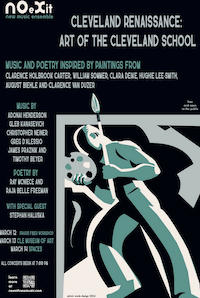
This week No Exit will present “Cleveland Renaissance: Art of the Cleveland School.” The program celebrates Cleveland School artists Clarence Holbrook Carter, William Sommer, Clara Deike, Hughie Lee-Smith, August Biehle, Clarence Van Duzer, and Charles Sallée. Their art has served as inspiration for new works by composers Adonai Henderson, Gleb Kanasevich, Christopher Neiner, Greg D’Alessio, James Praznik, and Timothy Beyer, along with new poetry by Ray McNiece and Raja Belle Freeman.
Performances begin on Thursday, March 12 at 7:00 pm at Praxis Fiber Workshop, 15301 Waterloo Rd., Cleveland. The program will be repeated on Friday, March 13 in Gartner Auditorium at the Cleveland Museum of Art, 11150 East Blvd., Cleveland (reserve free tickets online), and Saturday, March 14 at SPACES, 2900 Detroit Ave., Cleveland. All concerts are free.
No Exit’s Laura King spoke to three composers and poet Ray McNiece and asked them all the same questions: What Cleveland School artist or work did you choose, and what motivated you to make your choice?
Here are excerpts from their responses, reprinted with the permission of No Exit.
Adonai Henderson – Composer
I chose to represent Hughie Lee-Smith’s artistic work in Left Unsaid. His art realizes the complications and uncertainties of life, and he develops those feelings in moody or ambiguous landscapes. That portrayal of life spoke to me, and his use of whimsy in those surreal settings especially resonated with my own understanding of the world.
With that in mind, I dug into his portfolio and discovered his 1970’s work, The Confrontation, with its whimsical ribbons and warm beach breeze ladened with conflicting emotions. Everything about this painting clicked with my understanding of his work.
The piece focuses on two figures, likely around middle-school age, and on the emotions those two children are struggling with. Something has been said, or is about to be said, or perhaps needs to be said. And whatever that something is or was or will be, it will change the nature of their relationship. It’s an interaction that I see frequently as a teacher, and one that most of us must work through at some point in our lives.
Gleb Kanasevich – Composer
I chose Clara L. Deike’s painting, Shells. It was quite difficult for me to choose a specific painter or painting from the Cleveland School, because so many of them have quite an impressionist perspective. Aesthetically, my compositional work most closely overlaps with either impressionism or geometric abstraction.
In impressionism, I am very interested in finding a way forward through distortion of parameters: distorting an accepted reality forces us to reexamine what we think is real and reconsider the world as we know it in geometric abstraction—finding sensuousness in seemingly rigid and lifeless boundaries/lines, interaction of color, and allusion to perspective through angles and curves (an extrapolation on a traditional idea and technique).
What I find most profound in these respective styles/forms of visual art seems to be inverse on a technical level, however, it all actually relates to how we ultimately find meaning in life. It’s all about perspective and perception.
Greg D’Alessio – Composer
The artist I chose to work with was Clarence Holbrook Carter (1904-2000). The painting that first attracted me was Jane Reed and Dora Hunt (1941), an enigmatic, almost surreal image of two women seen from behind walking along a railroad track.
It took me a little while to parse out what was happening in the scene. One is carrying a basket and the other is stooping down as if to pick something up from between the tracks. Looking closer, it became clear that they were collecting coal that had fallen from the locomotives to use at home for fuel. It reminded me of a story my mother had told me of how my grandfather who worked for the railroad in the same part of the country as Carter’s painting (southern Ohio) used to have to walk the tracks making sure there was no debris on the rails whenever the owners of the line would be traveling through their area.
Ray McNiece – Poet
I chose William Sommer for his connection to Hart Crane, a poet from Cleveland who made his bones in Brooklyn, more specifically in the composition of The Bridge, his epic urban poem. In fact, a bridge figures prominently in the Sommer painting I chose, Brandywine in Winter, as the dark horizon line of the piece.
I also wrote my own version of the Bridge when I lived in an apartment overlooking the Detroit Superior Bridge, as did Crane regarding the Brooklyn Bridge. Crane was the last of the romantic era poets and bridged the gap between that era and the modernists.
I think he and Sommer shared the same perspective visually, rhythmically and tonally, which is why I’ll also be performing Crane’s Sunday Morning Apples, an ekphrastic piece based on a painting by Sommer and dedicated to him. In that poem he recalls Sommer’s “rich and faithful strength of line” which does indeed stand out in Brandywine in Winter.
Additional works on the program include:
Composer Chris Neiner’s Figures with Birds — After Figures with Birds (1925) by August Biehle
Composer James Praznik’s Anti-Fascist Triptych — After Anti-Fascist Triptych (1945) by Clarence Van Duzer
Composer Timothy Beyer’s The Japanese Bridge — After The Japanese Bridge (1913) by William Sommer
Poet Raja Belle Freeman’s Hi Stranger — After Bedtime by Charles Sallée
Published on ClevelandClassical.com March 10, 2026
Click here for a printable copy of this article
