



by Daniel Hathaway
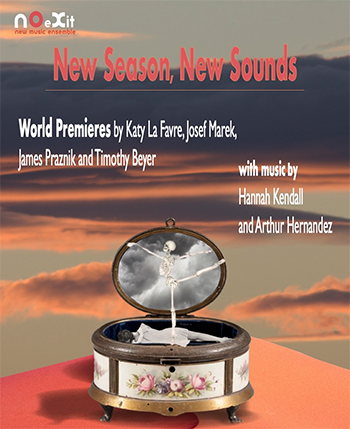 No Exit New Music’s events are like carefully curated art shows, and come complete with printed programs that more resemble exhibition catalogs than what you’d normally be handed at the door of a concert venue.
It takes some space to present the often complex back stories of contemporary works, and the ensemble’s triad of October programs, simply titled “New Season, New Sounds” was accompanied by a colorful, artsy, 39-page booklet that could become a collector’s item.
I joined a good-sized and enthusiastic audience to attend the third performance at SPACES Gallery on Saturday evening, October 19.
The format of the evening interleaved major works by Hannah Kendall, Josef Marek, Katy La Favre, and Arthur Hernandez, some conducted by Kent State professor Adam Roberts, with “Literary Interludes” composed by director Timothy Beyer and associate director James Praznik.
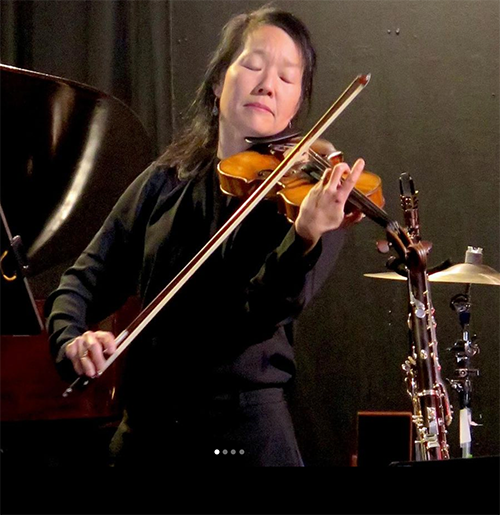 After winding up a quintet of pre-programmed music boxes, guest violin soloist Mari Sato led off with a dramatic performance of Kendall’s 2021 Tuxedo Crown: Sun King, a work that blends Afro- with Euro sensibilities and also calls on the violinist to vocalize. She pulled the work off with confidence and style.
The first Literary Interlude, Byers’ playful, tonal, and serene The Jungle, evoked by George Orwell’s Burmese Days and writings by others, also served as walk-on music for the ensemble.
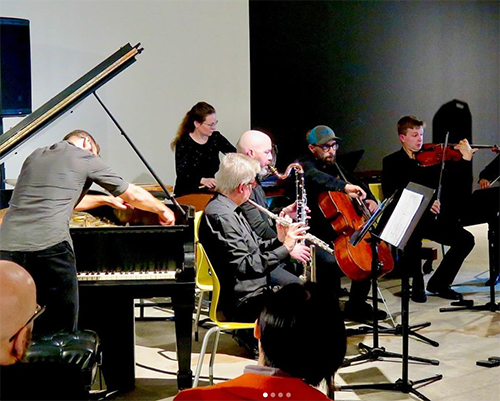
Marek’s 2019 ensemble piece Momenti discreti joins a series of the Czech composer’s pieces suggested by the sonnets of Petrarch, and is stylistically something of a throwback to the 1970s. Its slides, glissandi, and chord punches from the piano give way to the colors of alto flute, bass clarinet and snap pizzicati from the violin. The organized and interesting musical chaos made for a fun listening experience.
Praznik’s Literary Interlude The End, based on fragments from G Lyle’s Wake Up and Go to Sleep, begins with a keening screech and bursts of sound, then moves on to a long crescendo that ends in an abrupt halt.
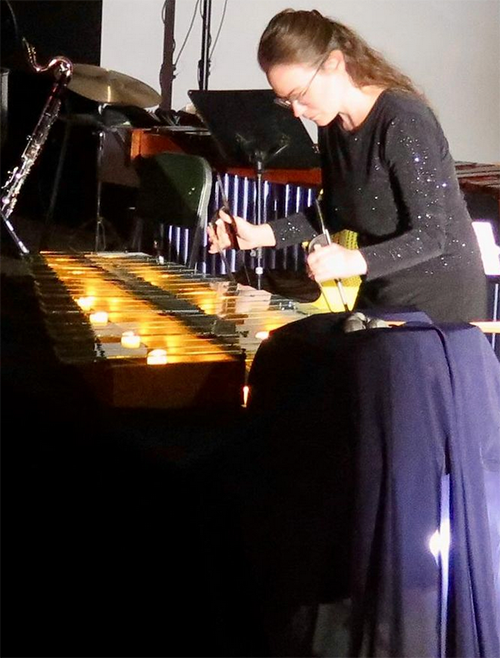 Katy La Favre recently joined No Exit as percussionist and composer. Her 2024 three-movement Speaking in Silence chronicles her childhood attempts to speak, an ability she eventually learned “through Jacques Cousteau’s magical world of whales and other sea creatures.”
The Whales led off, conjured by La Favre’s bowed strokes on xylophone keys. “Sinking Whispers” featured clusters of mallet notes that gradually increased in complexity. “Plus de Silence” introduced the glass-keyed Aquar. The mesmerizing piece was enhanced by electronic burbles operated by Praznik.
Arthur Hernandez’s 2017 The Desperation of Jesus Christ for piano quintet with clarinet was inspired by life-threatening illnesses the composer suffered, which led him to consider “the last days of Jesus Christ, and how in his darkest moments on earth, he despaired.” The atmospheric piece is full of long crescendos and diminuendos, ricochets in viola and cello, sustained tones in clarinet, and squealing violins. A lengthy and placid denouement went on seemingly forever.
Beyer’s final Literary Interlude was actually a postlude. The Land began imperceptibly and grew loud in the hard-surfaced gallery, bidding the appreciative audience good night after an eventful sonic journey.
Published on ClevelandClassical.com November 9, 2024
Click here for a printable copy of this article.
