


by Mike Telin
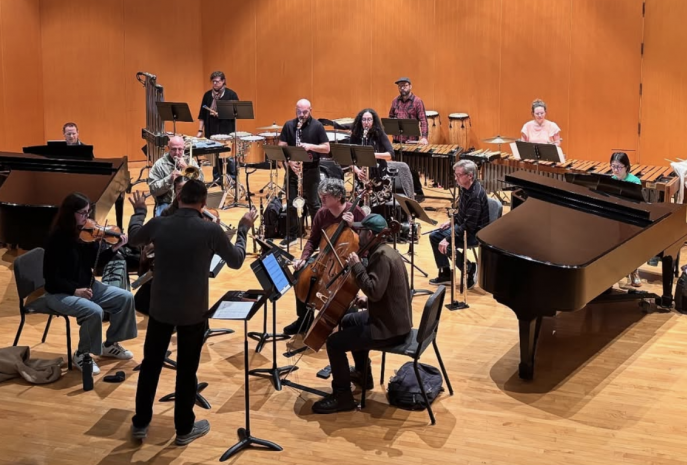 There was not an open seat to be had at Praxis Fiber Workshop on Saturday, October 25 when the adventurous new music ensemble No Exit began their 17th season with a program of four thoroughly engaging works.
As a prelude to the program, James Rhodes presented two movements from Garth Knox’s Viola Spaces, a collection of eight etudes each of which focus on an extended technique.
No. 2, “Ghosts,” examines the technique of sul tasto — on the fingerboard. Beginning with a pitchless bowing on the strings, Rhodes brilliantly produced spooky, breathy, brushing sounds. In No. 6, “Harmonic Horizons,” Rhodes took listeners on a tour of the instrument’s harmonic series. Here he produced an interesting mix of straight-tones, double-stops, trills, and slides in every register of the viola.
Geoffrey Burleson’s entrancing Cryptic Locomotion is inspired by a scientific term used to describe the slow deliberate movements of the lorisids, the oldest branch of the primate order. This performance was the premiere of the work’s expanded 2025 version.
Scored for flute, bass clarinet, violin, cello, piano, vibraphone, and congas, Cryptic Locomotion opens with a slow-moving cello solo before gradually developing into a fast dance with vibraphone and congas adding some rhythmic spice. All of the challenging interlocking lines were masterfully played by the ensemble before returning to the softer, slower material, until the sound of the final strike of the vibraphone faded away.
In his composer note for After days of rain, construction fills the air, June Young Will Kim writes that while living in Munich there was a lot of construction happening near his apartment. After a long period of rain had ended he could hear the construction begin in the distance. The sounds suddenly felt musical and beautiful.
The quiet, eight-minute piece for clarinet/bass clarinet, cello and percussion features long, slow lines that are accented by groans in the cello, soft slap tonguing from the clarinet, a vibrating snare drum, and water sounds. At the end, squeaking cranes could be heard.
Receiving its world premiere was Andrew Rindfleisch’s American Descent, a gripping work that examines, in the composer’s words, “the decline of a once prosperous society into a culture of chaos, division and violence…”
Written in five movements and scored for thirteen players — two violins, two cellos, flute (piccolo) two clarinets (bass clarinet) trombone, two pianos, and three percussion — Rindfleisch’s piece brilliantly utilizes all of the colors this combination of instruments is capable of producing. The result is magical. Although his program notes are never preachy, Rindfleisch gives the listener plenty to think about.
In “Descending,” a loud chord announces the beginning of a rapid downward spiraling out of control. Sharp repeated notes in the percussion grow stronger. Bass clarinets and trombone sound like a distant fanfare. Great mallet passages transition to hollowing strikes of the bass drum. A single, short note brings the chaos to an end.
“Bread and Circuses” is a musical tongue-in-cheek commentary about the consumption of disinformation. Beginning with a single long note from the ensemble, the sound quickly transitions into fast moving circus music punctuated by the pianos, bass clarinets, and trombone. After a grand pause the circus takes off again.
“Interlude: Reminiscence” creates a dream-like interruption and reflection. A calmness ensues. The strings play a quiet chorale. Some dissonances creep in. You can hear the question being asked — what is going on?
“Cruelty” depicts a culture that engages in acts of cruelty so often that the behavior becomes normalized. High harmonics in the strings are quickly interrupted by snarling clarinets. The music piles on more and more volume — everyone wants to scream at people — louder, and louder, and louder.
“Ascending” offers a sense of hope, a glimmer of optimism for the future. A march from mallets, toms, and pianos builds to a triumphant sound accented by chimes. A sudden halt brings the mesmerizing piece to conclusion.
Rindfleisch, who also conducted the performance, kept everything in good order. Tempos made sense, the rhythms were precise. This was a stunning performance and the audience rewarded it with a long applause.
Published on ClevelandClassical.com November 6, 2025.
Click here for a printable copy of this article
