


by Kevin McLaughlin
 On Friday, February 20 in Oberlin’s Finney Chapel, the American Brass Quintet reasserted its long-standing theory that five brass instruments can sustain an evening with the seriousness of a string quartet.
The program calls them “the most distinguished” ensemble of its type — and after Friday’s concert I’m inclined to believe it. Founded at Juilliard in 1960, when the brass quintet was still a recital novelty, the ABQ helped to expand the repertoire through commissioning new works and decades of touring.
For this program, they drew on repertory stretching from Elizabethan song to new American modernism.
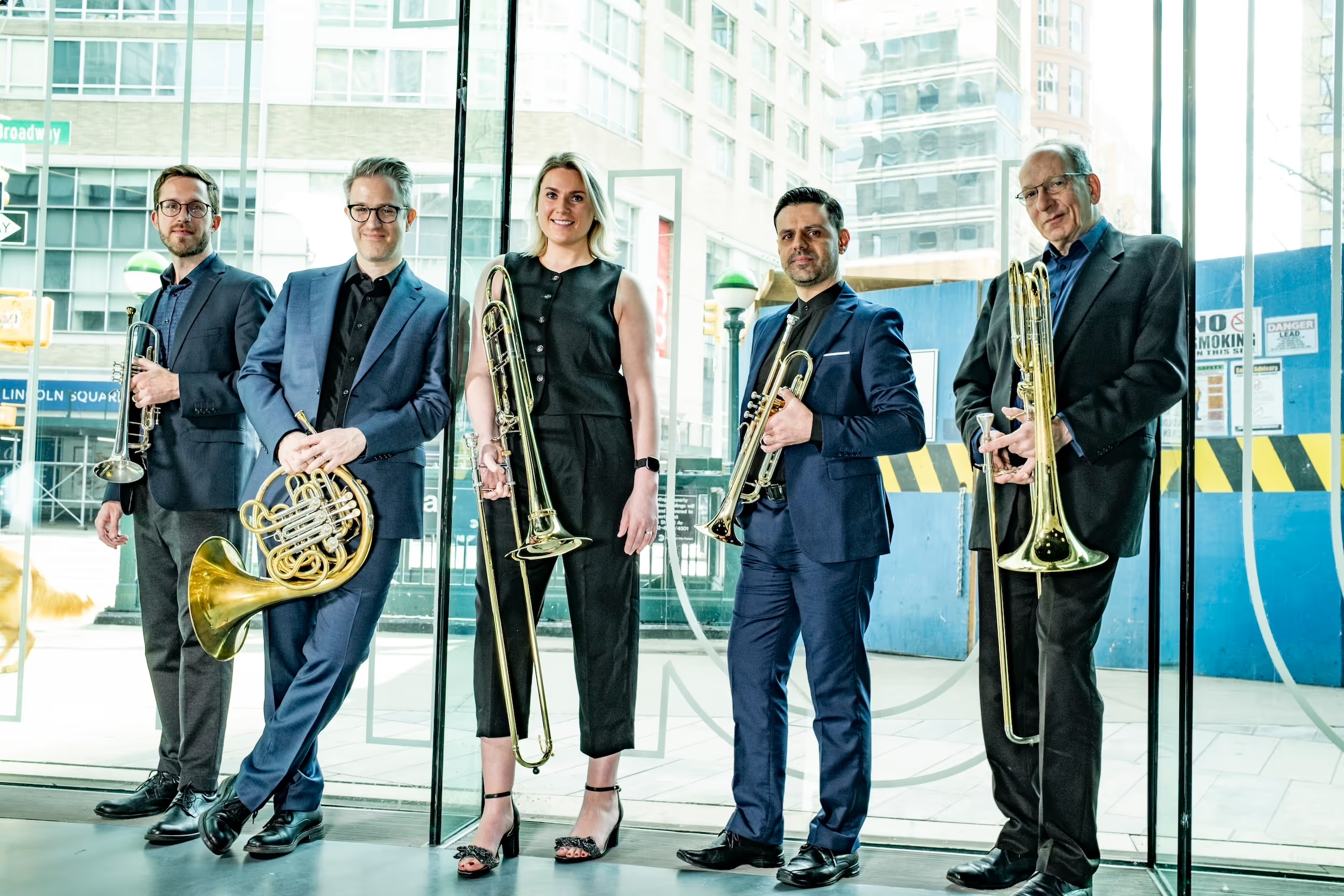
The group — Tiago Linck and Brandon Ridenour (trumpets), Eric Reed (horn), Hillary Simms (trombone), and John D. Rojak (bass trombone) — began the program four centuries back with two pieces by John Dowland, the English lutenist whose songs of melancholy were heard in courts and taverns alike.
Brandon Ridenour prepared editions of Earl of Essex Galliard, a courtly dance from around 1597, and “Can She Excuse My Wrongs?” — the answer to which turned out to be ‘No’. Robert Devereux, the earl who wrote the text, would later be beheaded by Elizabeth I — an irony not lost on Ridenour in his introduction.
Trumpeters Ridenour and Linck carried the top lines with a light touch, clear and unforced with cornetto-like articulation. Eric Reed’s middle voice was a welcome rival to the trumpets. Hillary Simms’s trombone spoke nobly and with agility, and Rojak grounded the ensemble with dark, rounded tone. Finney Chapel supplied resonance without blur, giving the phrases room to bloom while keeping their edges intact.
Anthony Barfield’s Samsāra came next. The title refers to the cycle of birth and rebirth, and the piece unfolds in figures that pass from player to player, accruing energy and then thinning again.
Philip Lasser’s Common Heroes, Uncommon Land intersperses spoken poetry with instrumental movements whose subjects and imagery, like Andrew Wyeth’s paintings, are domestic, direct, and rural.
Lasser writes in a tonal language that values clarity and transparent textures as hymn-like passages alternate with more intricate counterpoint. Reed’s horn energized inner voices, and Linck’s trumpet solos emerged nobly.
After intermission came Jennifer Higdon’s Book of Brass I: Ramp Up (2011), a compact fanfare of stacked rhythmic bursts. The articulation was crisp throughout. Ridenour’s high solo rang out at the close as Simms’ trombone added bite and sass.
Mid-20th-century Brazilian composer Osvaldo Lacerda’s Quinteto Concertante brought a shift in mood and decade. Lacerda drew on folk materials from his country — a point Linck, a fellow Brazilian, noted in his introduction. The rhythms carried an easy lilt, the harmonies open and spacious. The movements — Chóte, Scherzo, Seresta, and Rondo — took their cue from dance forms, each giving a different instrument its turn.
Reed’s horn in the Scherzo was a lyrical pleasure. The trombones were light on their feet, though the Seresta asked Rojak to reveal genuine, if passing, discouragement. In the Rondo, Linck and Ridenour traded phrases with easy grace, the music buoyant and unshowy.
The program closed with David Biedenbender’s Sacred Geometry, a four-movement work inspired by the organic architecture of Antoni Gaudí. The music reflects geometric growth — lines crossing and re-crossing, chords widening, textures accumulating before settling again.
The nautilus, whose logarithmic spiral suggests growth without rupture, serves as a guiding image: each new turn emerges from what preceded it. In the Gaudí movement — described by the composer as a walk through a garden of strange delights — the trumpets, in Harmon mutes, are tuned a quarter step apart, producing a faintly beating shimmer. It was an astounding effect.
In the final movement, ‘Helix,’ lines coil around one another, tracing spiral motion in sound. The climaxes were broad yet controlled, and the closing pages thinned to a luminous quiet. A movement from Reena Esmail’s Khirkiyaan (“Windows”) was the attractive encore.
Throughout the evening the American Brass Quintet sounded entirely at ease. Early music, recent works, large and brief designs were approached with care, beauty of tone, and clarity of purpose. More than sixty years after its founding, the ensemble seems less an advocate for the brass quintet than one of its natural custodians.
Published on ClevelandClassical.com February 25, 2026
Click here for a printable copy of this article
